


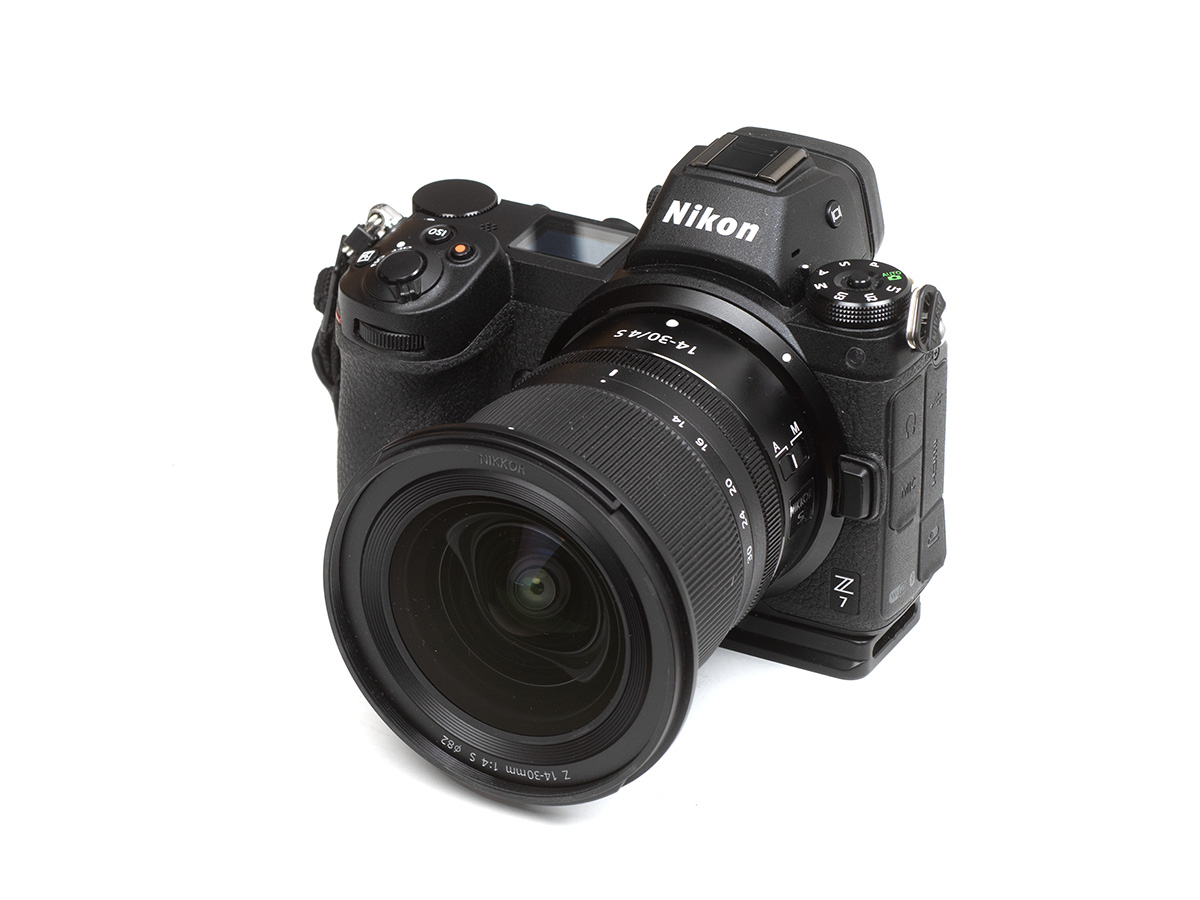
The Nikkor Z 14-30mm f/4 S was released back in 2019 so it’s not exactly a newcomer anymore. At the time, it was certainly a special lens. It offers an extremely wide angle of view – even by today’s standards – and it allows conventional filters to be attached. Many zoom lenses this wide still rely on a bulb-like front element. It’s not a cheap lens at $1100 USD but there aren’t many options around in this segment either.
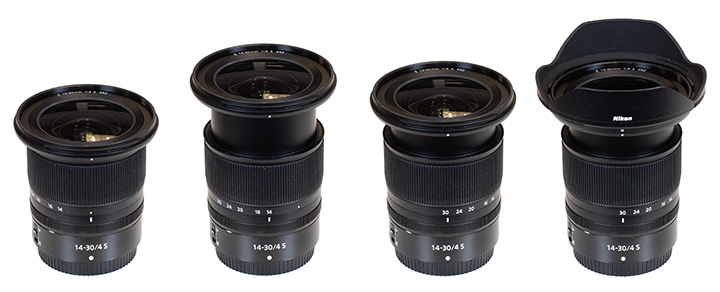
In terms of build quality, it resembles the Z 24-70mm f/4 S. To minimize the size during transport, it uses a retractable design. Thus you have to first turn the zoom ring into its working mode position. This extends the lens quite a bit. The lens is physically longer at its 14mm setting compared to the 30mm (see below). The exterior barrel uses durable polycarbonate plastics based on a metal mount. Nikon omitted a dedicated focus ring for a small, customizable control ring at the rear that defaults to focus control. Other than the compact dimensions, the moderate speed also translates to smaller glass elements and consequently to a low weight of just 485g. Typical for all S-class lenses, Nikon implemented weather sealing at the mount and relevant barrel joints. A petal-shaped lens hood is part of the package.
The Nikkor Z 14-30mm f/4 S uses a STM (stepping motor) for auto-focusing. While this is a dated motor type, the AF is still very snappy and near silent because the focus group is very lightweight to start with. Focus breathing is minimal so Nikon didn’t forget to entertain videographers.
| Specifications | |
|---|---|
| Optical construction | 14 elements in 12 groups (4x ED glass, 4x aspherical) Nano Crystal Coat Fluorine-coated front lens element Floating system for close-focus correction |
| Number of aperture blades | 7 (rounded) |
| min. focus distance | 0.28m (max. magnification: 0.16x) |
| Dimensions | 89 x 85mm |
| Weight | 485g |
| Filter size | 82mm |
| Hood | petal-shaped, bayonet mount, supplied |
| Other features | control ring dust- and drip-resistant |
Distortion
I reckon most of us know the storyline here already – extreme designs tend to result in extreme image distortions and that’s also the case here. RAW images reveal a barrel distortion of 6% (!) at 14mm. This eases soon thereafter before increasing again to pincushion type with a peak of 2.7% at 30mm.
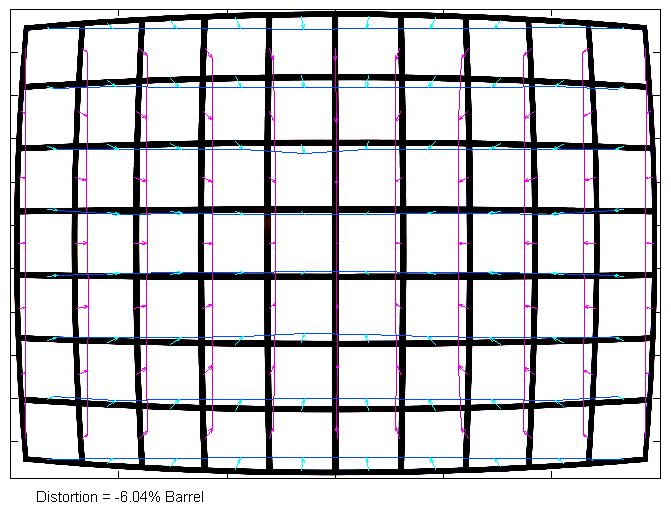
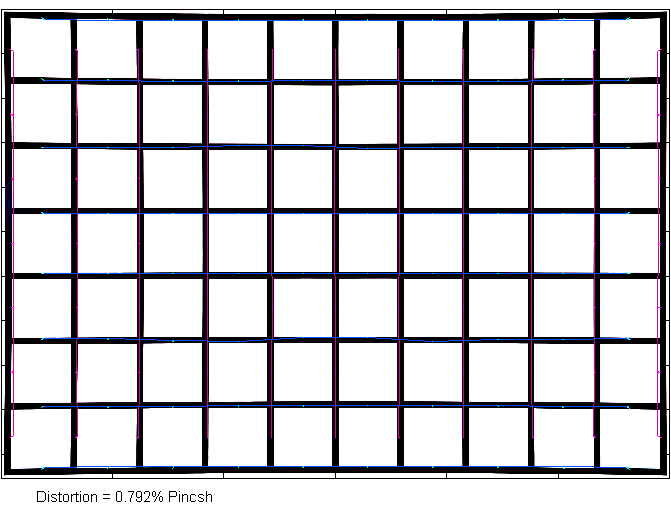
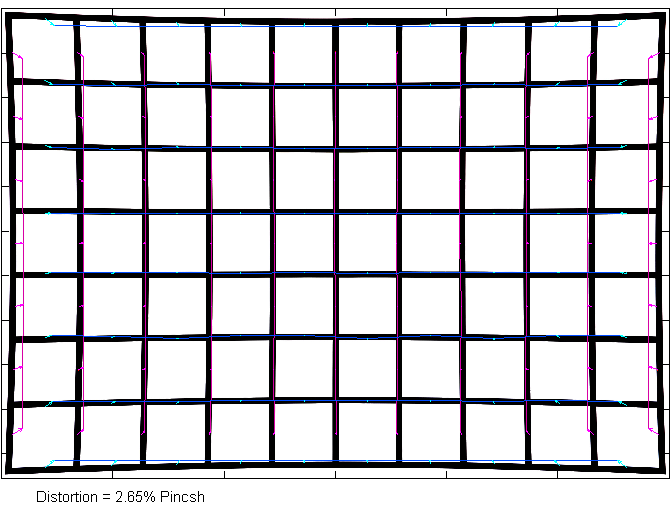
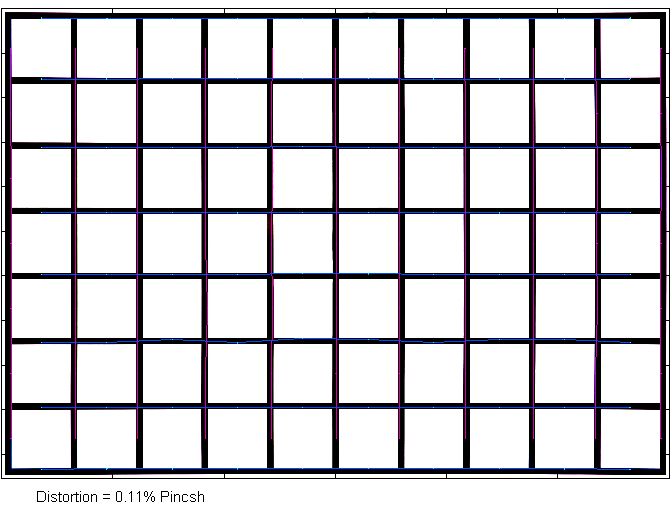
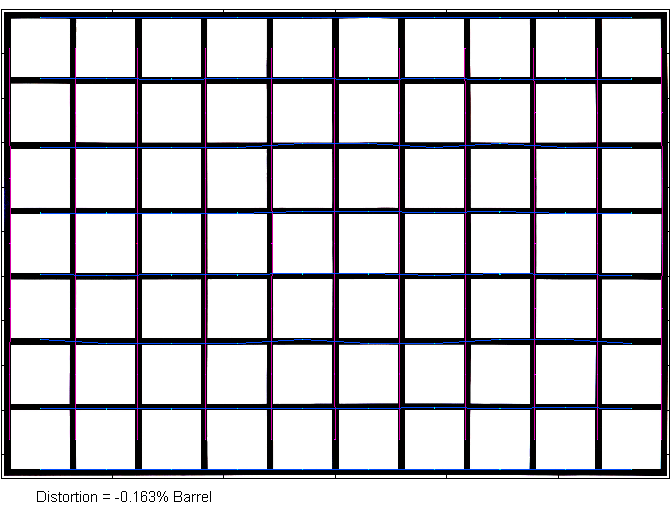
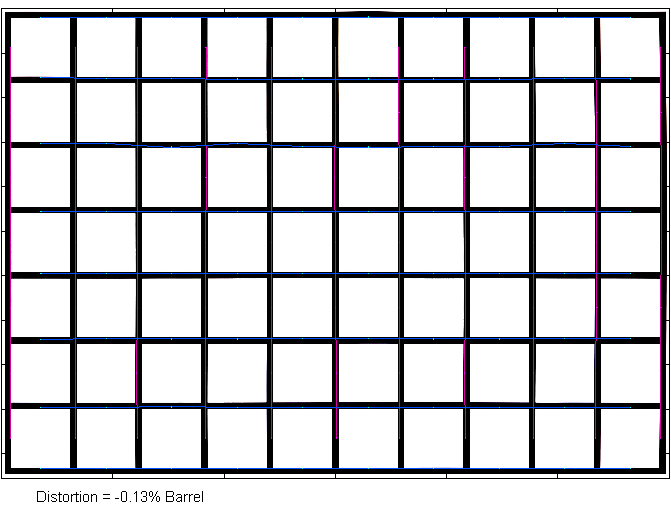
Thus, autocorrection isn’t optional but really required here. However, it does a perfect job as you can see below.
Vignetting
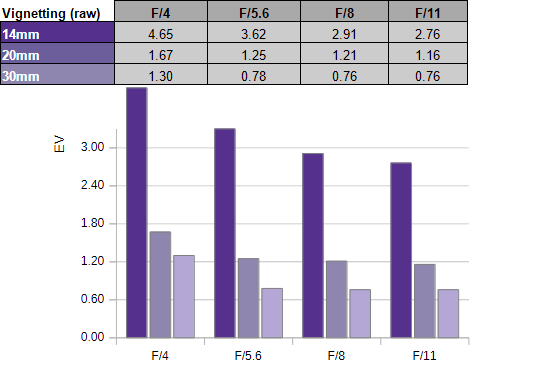
Extreme distortions usually translate to heavy vignetting in RAW images as well – simply because the lens was never intended to be used without digital correction. That’s most obvious at 14mm, of course, with a peak vignetting of more than 4.5 EV (f-stops) at 14mm f/4. The light falloff is still very heavy at f/11. As usual, it’s a lesser issue at longer focal lengths.
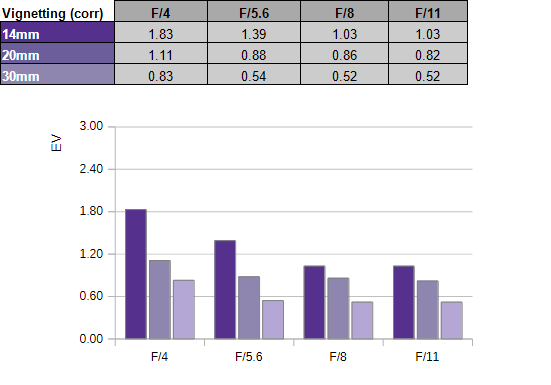
Combined distortion and vignetting compensation reduces the light falloff to just under 2 EV (f-stops) at 14mm f/4. That’s still very visible but the issue is reasonably tamed from f/8. Once again, this eases at longer focal lengths.
Keep in mind that a full correction may not be desirable because vignetting compensation does increase the image noise in the outer image field so it’s reasonable for Nikon not to go to the max here.
MTF (resolution at 45 mp)
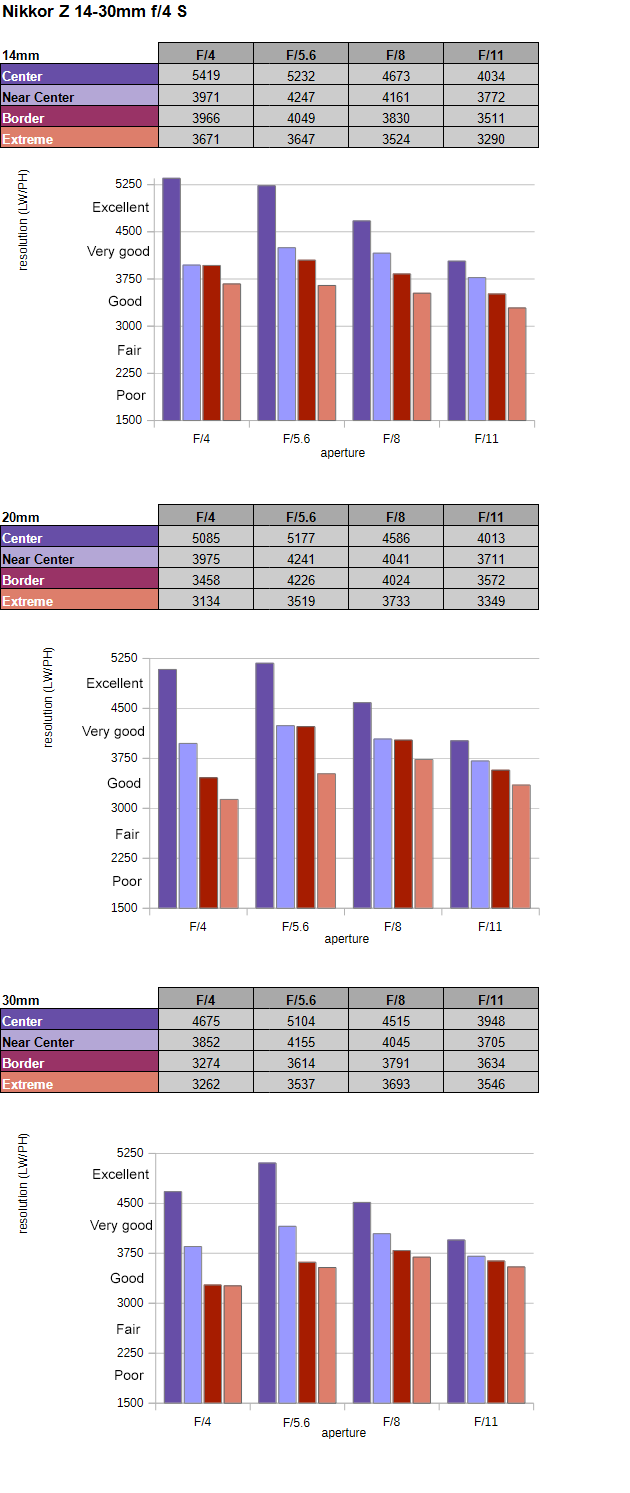
Extreme ultra-wide lenses are never perfect regarding their edge-to-edge sharpness – and that’s also the case here. The center quality is mostly excellent across the zoom range up to f/8. However, there’s a steep drop beyond the dead center. The near-center quality is still very good, though. The Nikkor also manages to keep the borders on a very good level at 14mm. The corners are also fine here. However, and that’s not shown in the chart, there is still a pixel zone at the very edge that is soft (Note: the test software requires a bit of space at the test quadrants so the last pixels aren’t covered). The lens manages to keep this performance throughout the rest of the range with just a slight drop at f/4.
Please note that the MTF results are not directly comparable across the different systems!
Below is a simplified summary of the formal findings. The chart shows line widths per picture height (LW/PH), which can be taken as a measure of sharpness. If you would like to know more about the MTF50 figures, you may check out the corresponding Imatest Explanations.
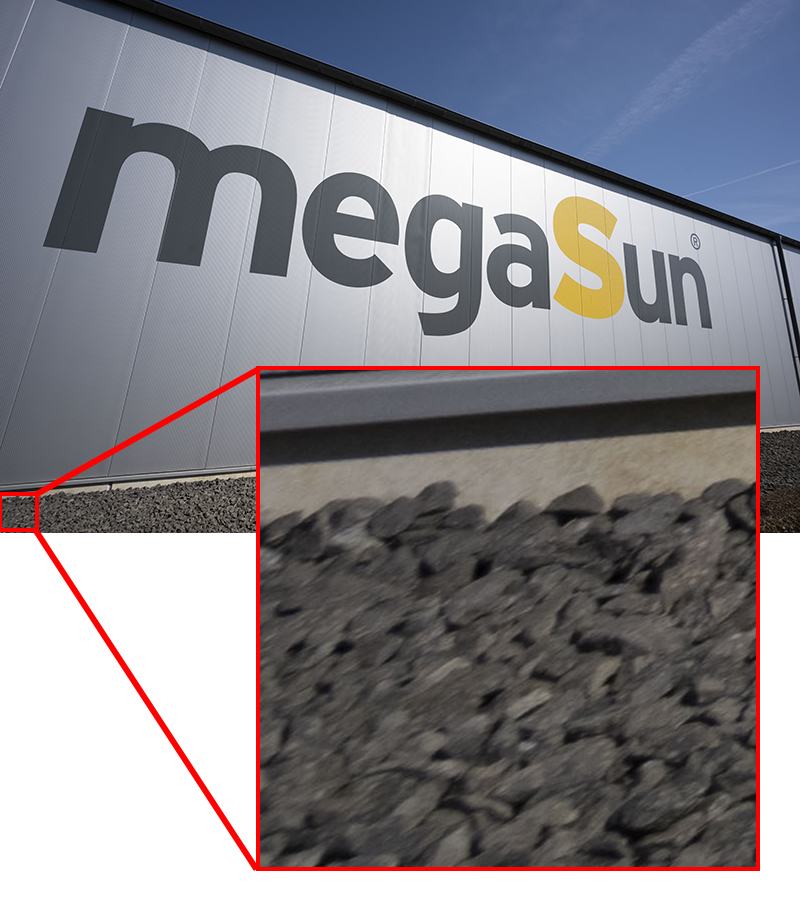
Just to illustrate the point of pain in the corners – below is a 100% crop illustrating it. Yes, it’s far out but if it drives you crazy, it drives you crazy.
Also note that cameras tend to overshoot the focus distance with lenses this wide resulting in blurred foreground. Thus while this lens may provide an immense depth-of-field, focusing on “infinity” is often not a good idea.
Chromatic Aberrations (CAs)
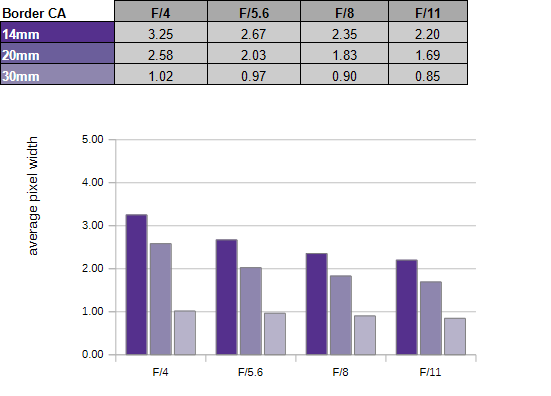
Lateral CAs aren’t a glorious aspect of the Nikkor. That’s most obvious at the wide end where the CAs exceed 3px on average at the borders – with a further deterioration at the edges. It’s not great at 20mm either. The CAs are well corrected at 30mm.
However, keep in mind that lateral CAs are losslessly autocorrected in JPEGs and most RAW converters so it’s not a big deal in real life.
Competition
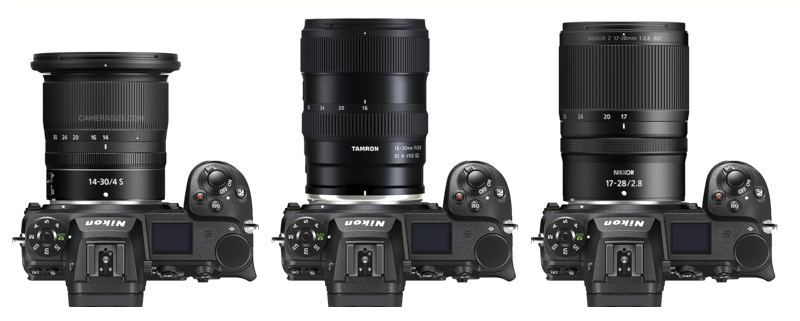
As of the time of this writing, the Nikkor Z 14-30mm f/4 S (to the left below) has two main competitors – the Tamron 16-30mm f/2.8 Di III VXD G2 (center) and the Nikkor Z 17-28mm f/2.8 (to the right). Both are obviously not as wide but both are faster. The Nikkor Z 17-28mm f/2.8 is an older Tamron design relabeled as a Nikkor and not really worth the money. The new Tamron G2 lens, effectively the 2nd generation of the 17-28mm f/2.8, hasn’t been tested locally. The more serious reviews out there suggest that it’s probably in the same performance realm as the Z 14-30mm f/4 S.
Sample Images
Countryside Germany here rather than the usual sights of Australia.


The Nikkor Z 14-30mm f/4 S delivers reasonable quality for a lens this wide but it's also not something to rave about either. It's quite sharp across most of the image frame although some softness creeps in at the very corners. In part that's also because it relies heavily on autocorrection especially at 14mm. The native image distortion, vignetting and CAs are all very high so autocorrection is a must here.
The build quality is generally pretty good. It feels solid thanks to high-quality engineering plastics. The extensive weather sealing is also commendable. A highlight is certainly the compactness and low weight. However, this has been achieved via a retractable zoom design which may not be to everybody's taste.
Overall, it's an okay choice in the Nikon ecosystem - if it has to be a zoom lens. It's more fun on lower-megapixel cameras, though. There are also a couple third-party ultra-wide prime lenses around that are a better option if you can live without the prestige of owning a Nikkor.
The Good
- Extremely wide for a zoom lens
- Lightweight and compact
- Accepts front filters
The Bad
- The extreme corner are soft
- Retractable design
- Relies heavily on autocorrection
-
Optical Quality6
-
Build Quality7
-
Price Performance7