


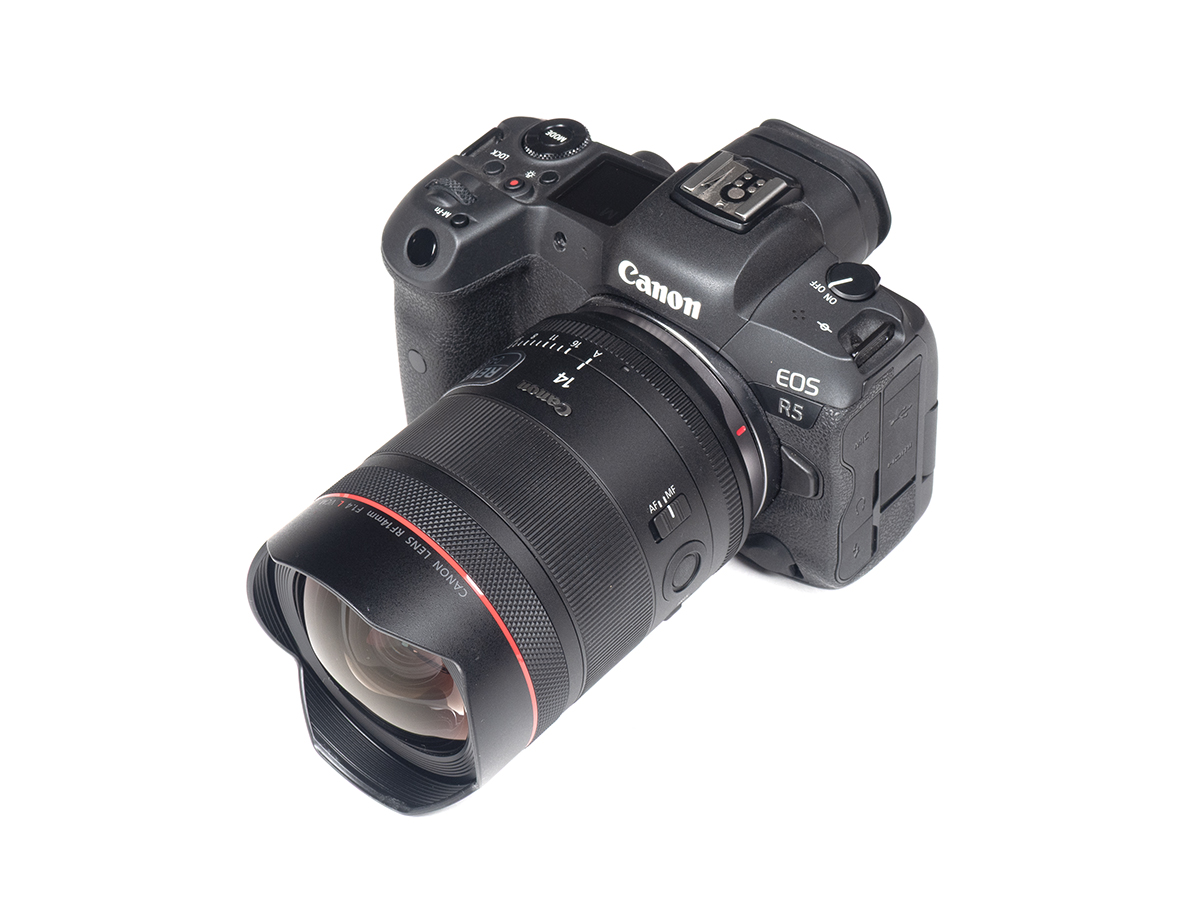
Over the last few years, Canon has created a set of hybrid prime lenses that prioritize video features alongside still photography. These lenses share a nearly identical form factor, minimal focus breathing, a fast f/1.4 max aperture, and they use a magnetic VCM (Voice-Coil-Motor) with Nano USM to drive focus groups independently for autofocus. As of the time of this writing, they range from 14mm to 85mm. In this review, we are discussing the widest and most expensive of these prime lenses — the Canon RF 14mm f/1.4 L VCM. At $2600 USD, this lens is not for the faint-hearted, so let’s see whether it’s worth it.
The lens body is made of high-quality yet lightweight engineering plastics based on a metal mount. Weather sealing has been incorporated, as you can expect from an L-class lens. As usual for most Canon lenses, there’s a configurable control ring at the front with a smoothly turning focus ring behind. The de-clickable aperture ring is located at the back. As you can see in the product image, the 14mm f/1.4 L VCM uses a bulbous front element, so front filters cannot be used here. There is, however, a rear gel filter slot. The small petal-shaped lens hood is built-in.
The high-thrust VCM actuates the heavy focusing lens group, while the Nano USM actuates the lightweight floating lens to deliver extremely fast, reliable, and quiet autofocus. This works perfectly, as you may expect. Manual focusing is done by wire, and it’s very smooth and precise.
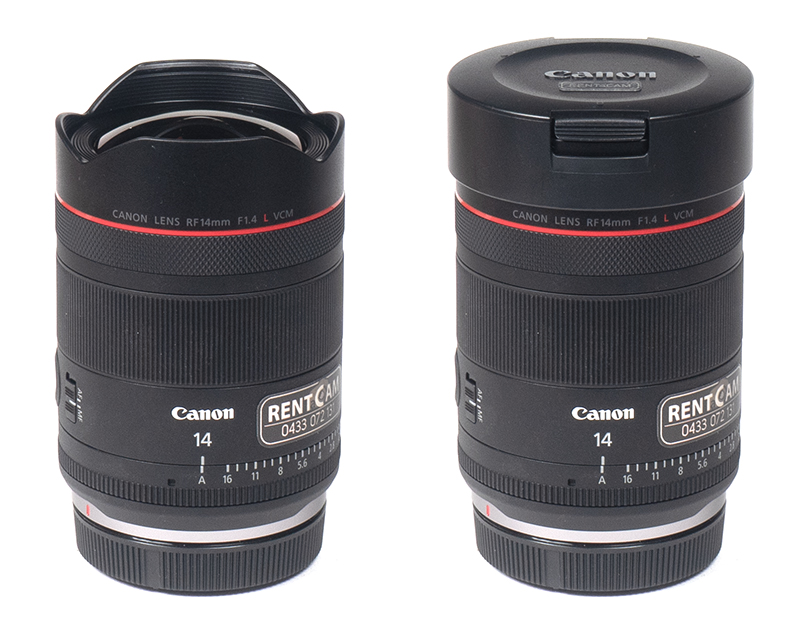
| Specifications | |
|---|---|
| Optical construction | 18 elements in 13 groups (1x fluorite, 1x UD) Floating focusing system Super Spectra, SWC and ASC Coatings Fluorine coating on the front element |
| Number of aperture blades | 11 (rounded) |
| min. focus distance | 0.24m (max magnification 0.11x) |
| Dimensions | φ 76.5 x 112mm |
| Weight | 578g |
| Filter size | – (rear filter support) |
| Hood | petal-shaped, built-in |
| Other features | weather-sealing control ring aperture ring Fn-button |
Distortions
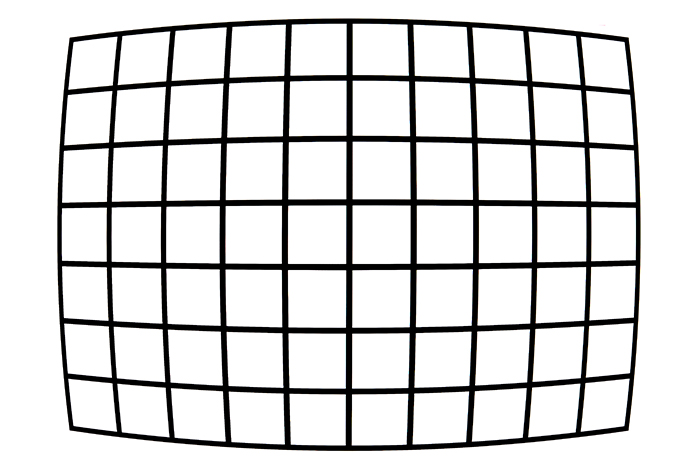
The Canon RF 14mm f/1.4 L VCM is ultra-fast yet comparatively small. At this focal length, something has to give, and that’s image distortion. At almost ~8%, it is nothing short of excessive in RAW files. Auto-correction does handle this nicely, but at a cost, as we’ll see later on.
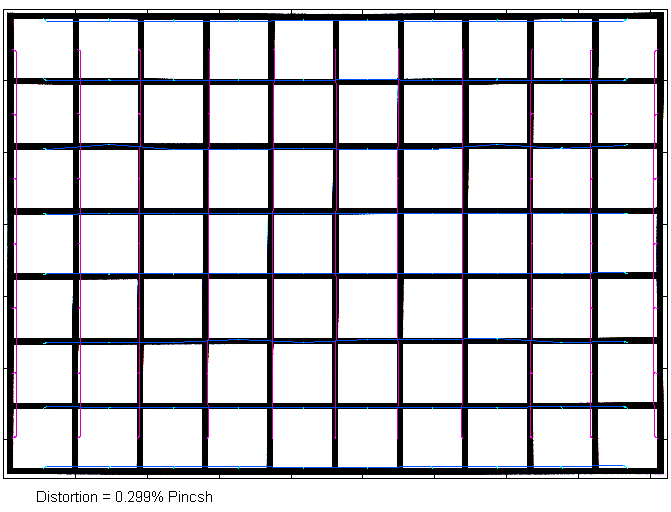
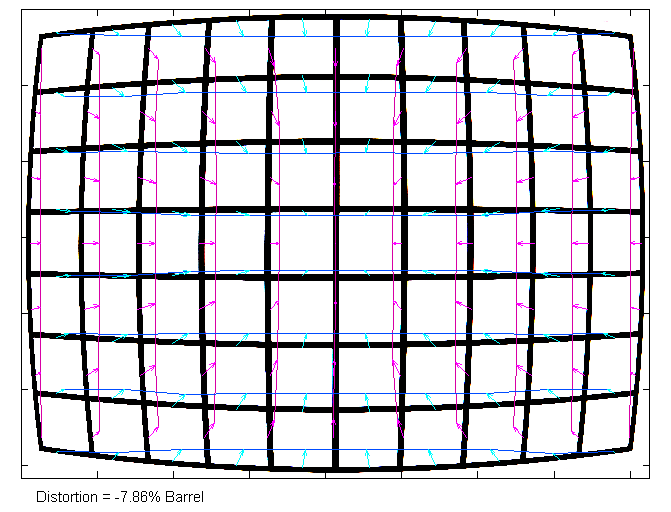
To illustrate the amount of stretching needed – here are the uncropped versions:

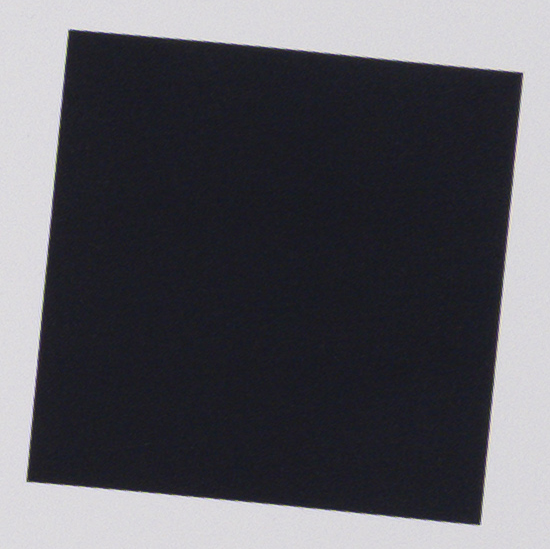
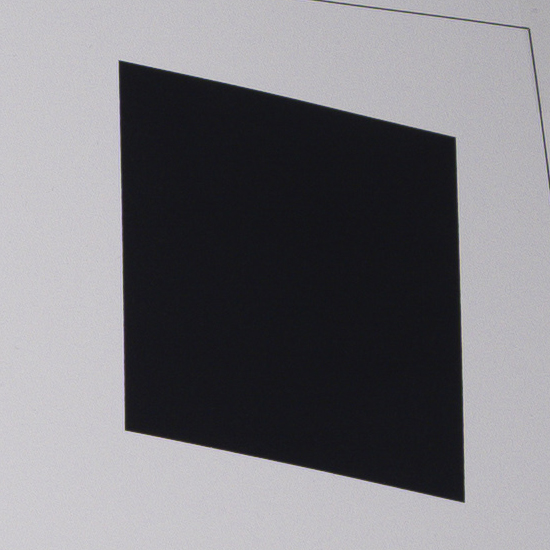
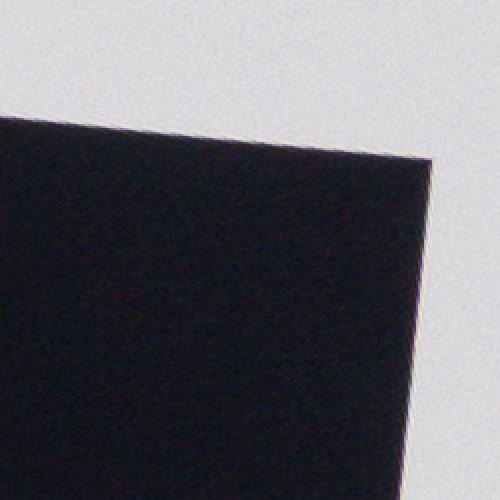
Our resolution analysis is based on quadrants (their edges) located at specific image areas. The 100% crop below shows the “extreme corner” quadrant. We are showing this here in the distortion chapter to illustrate how this quadrant is stretched back into its original shape. Note how the size is changing. You may imagine that this stretching isn’t lossless. But more on this later on.
Vignetting
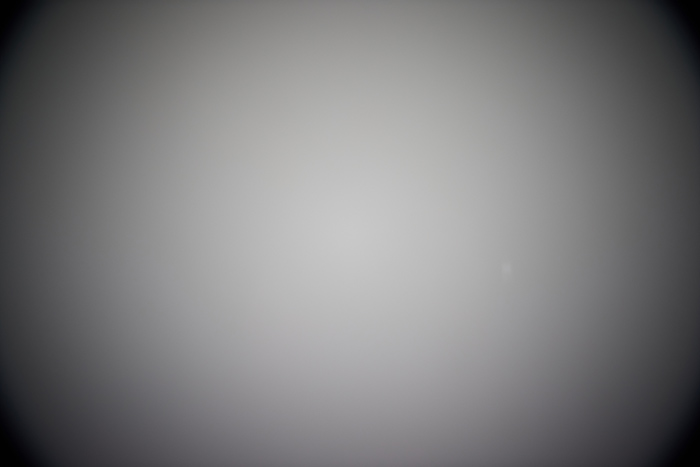
Canon expects users to take advantage of auto-correction here as well. The native image field (without distortion correction) has black corners at all settings. With auto-correction, there’s still a quite heavy amount of vignetting at f/1.4. It’s much reduced at f/2, though, and not really relevant anymore from f/2.8.
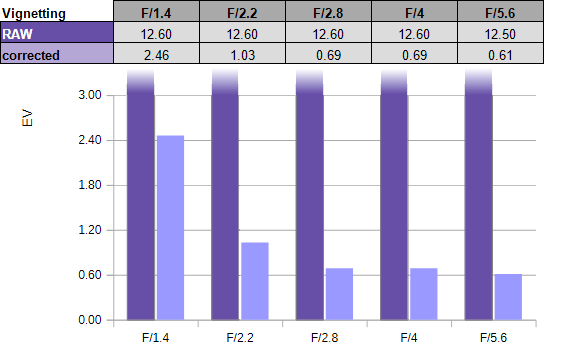
Here’s a visual showing the vignetting at f/1.4 with and without autocorrection:

MTF (resolution) at 45 megapixels (Corrected)
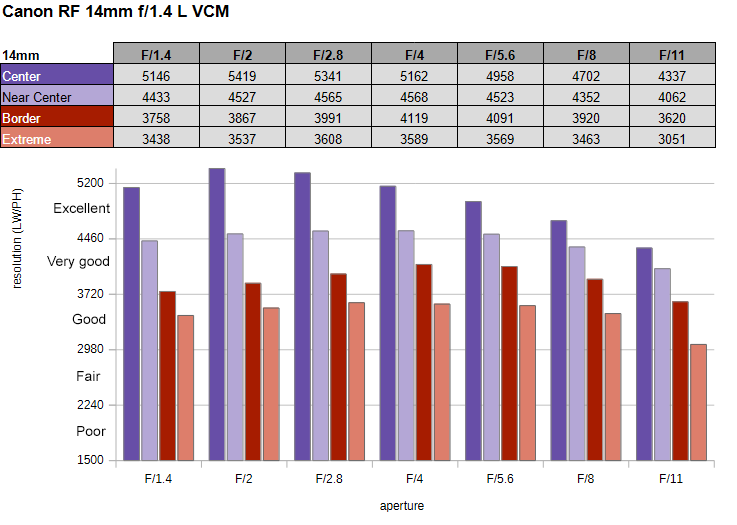
The resolution characteristic of the Canon RF 14mm f/1.4 L VCM is a little unusual – specifically in the corners. The chart shows the results with applied autocorrection – you would rather not use the lens without it, as we’ve seen above.
The dead center quality is outstanding straight from f/1.4. The near-center quality drops from here but stays very good to excellent all the way to f/8. The border quality is still very good at f/1.4 (albeit just) and increases slightly until reaching the peak at f/4. The corner quality is generally good even at f/1.4, which is impressive for such a lens. f/11 sees a more substantial drop in quality due to diffraction, as usual.
The field curvature is low. The centering quality of the tested sample was high.
Please note that the MTF results are not directly comparable across the different systems!
Below is a simplified summary of the formal findings. The chart shows line widths per picture height (LW/PH) which can be taken as a measure of sharpness. If you would like to know more about the MTF50 figures, you may check out the corresponding Imatest Explanations.
Auto-Correction Interpolation
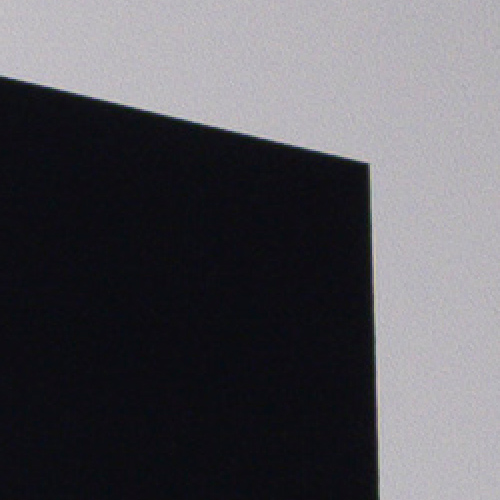
Some readers will probably comment that the following is a little academic, but let’s check what’s happening here. The crops below show a corner spot at f/2.8 at 200% magnification – with and without auto-correction. In comparison, the autocorrected crop shows “pixel-stepping” interpolation artifacts at the edges.
Or, in other words – while the optical design produces a very high corner resolution, the effective resolution is basically “auto-correction-limited”. Which is why the corner resolution is so uniform across the aperture range in the previous chapter. In numbers – the raw corners have a LW/PH of 4500 LW/PH compared to 3600 LW/PH after auto-correction.
Note: This is the result of a Photoshop ACR conversion. It may vary with other RAW converters.
Chromatic Aberrations (CAs)
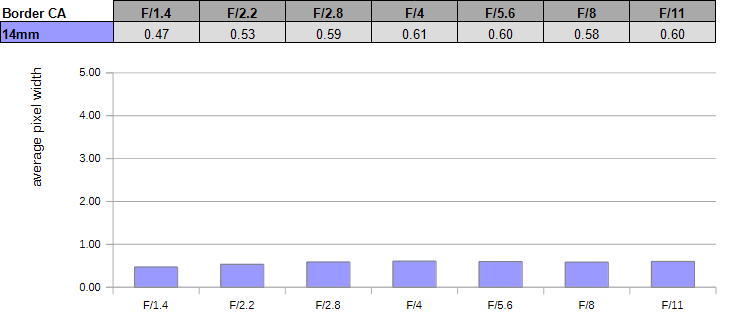
Lateral CAs have an average width of around 0.6px at the image borders. This is mostly negligible, even without autocorrection.
Bokeh
Even at f/1.4, you will have to shoot at fairly close focus distances to achieve a shallow depth-of-field with a 14mm lens, but let’s cover the basics here.
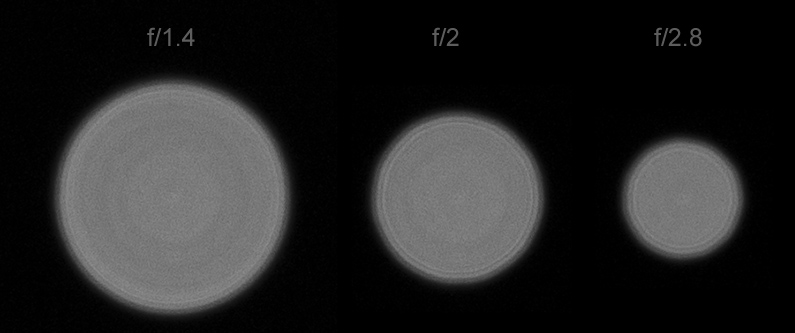
Out-of-focus highlights are relatively clean, with fairly subtle onion rings in the inner zone. The center discs show just a little outlining that increases a bit when stopping down. The center disc shape remains perfectly circular at f/2 and mostly at f/2.8 thanks to the no less than 11 aperture blades.
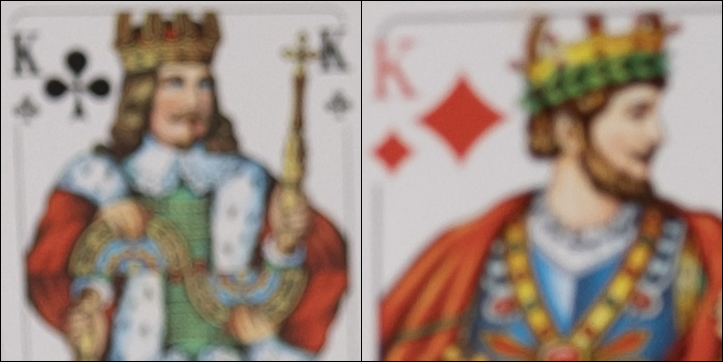
The rendering quality in the focus transition zone is surprisingly smooth both in the background (shown to the left below) as well as the foreground (to the right). This is very rare among ultra-wide lenses.
Sun stars
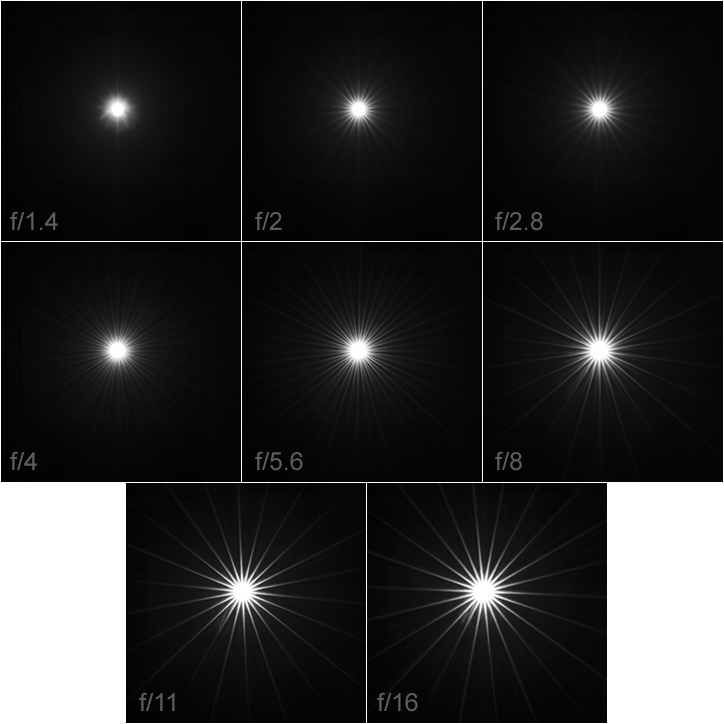
Sun stars are diffraction spikes caused by the non-circular aperture when shooting a pointy light source such as streetlights or the sun. At f/1.4, the aperture is circular, so the result is just a “blob”. The (technically) more edgy aperture produces small hair-like rays from f/2 to f/4. They are getting a bit more pronounced at f/5.6. However, the real action starts at f/8 with “longer” rays. As so often the sun stars are best at f/11 and f/16. While 11 aperture blades (=22 rays) are a bit much in this specific scope, the rays are very pointy, which is what you really want here (in our opinion anyway).
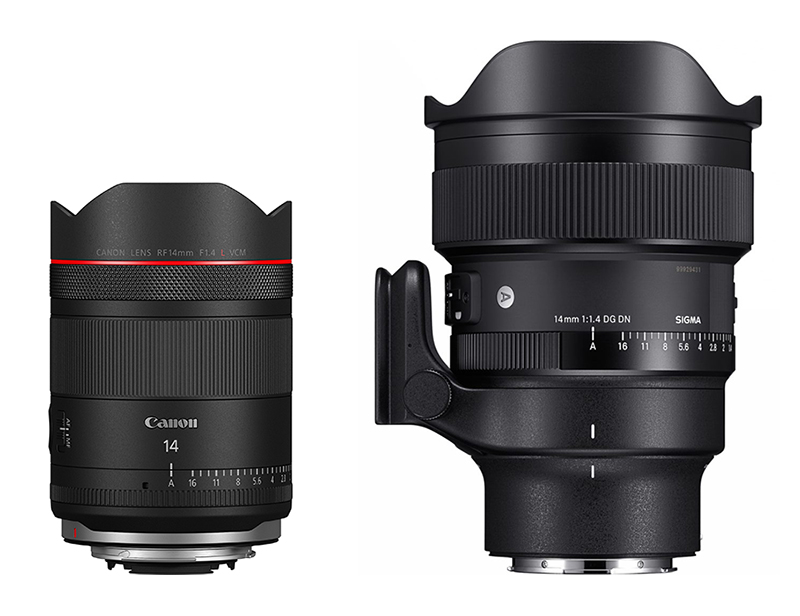
Canon RF 14mm f/1.4 L VCM vs Sigma 14mm f/1.4 DG ART
Canon users don’t really have a choice when it comes to an ultra-fast wide-angle prime lens. However, let’s compare it to the Sigma 14mm f/1.4 DG ART which obviously shares the same focal length and speed.
Just by looking at the product images below, the difference in design philosophy becomes clear. The way we see it, Canon’s goal was to design a comparatively small prime lens to match the other VCM prime lenses in their lineup. Sigma, on the other hand, went all in with no compromises at all. We haven’t tested the Sigma lens, but the colleagues over at Photography Life have determined a barrel distortion of just 2.8% which doesn’t really need a further correction unless you are nitpicky. However, this also means that they ended up with a much bigger lens that is twice as heavy as the Canon. Something has to give – always.
Sample Images


Every now and then, Canon is out to show who's the gorilla in the jungle with some exotic lens designs. They rattled the industry with the RF 10-20mm f/4 L IS, the RF 85mm f/1.2 L DS, or the RF 28-70mm f/2 L. And now they are leaving their mark with the Canon RF 14mm f/1.4 L VCM. It's the widest and fastest ultra-wide prime lens around - and it's bafflingly compact for what it is. Thus, kudos to Canon for making it happen. The compact dimensions resulted in some compromises, which made it necessary to heavily rely on digital autocorrection. Having said this, it's only the end result that counts, and it's mostly impressive for a lens in this class - meaning a 14mm full-frame lens is never going to be completely flawless. The center quality is great, and even the corners manage still good results. Unless you use a high-megapixel camera, astrophotographers should be pretty happy, and you will not see any softness in 8K video. Despite autocorrection, there's still some vignetting at f/1.4 but it's mostly fine from f/2 in this respect. The bokeh is surprisingly smooth for a lens in this class, and sun-star lovers should also be pleased. In terms of build quality, the RF 14mm f/1.4 L VCM stays in line with its cousins. It uses Canon's L-class flavor of tough engineering plastic with extensive weather sealing. Some may not like the bulb-like front element, though, and if you want to use filters, you have to use the rather cumbersome rear gel filter slot. Videographers surely appreciate the fact that the 14mm f/1.4 is about as compact as the other Canon VCM lenses, so the balance on your rig barely changes. If you require such a fast lens or have a priority on video productions, the RF 14mm f/1.4 L VCM is an attractive option. Otherwise, Canon L-class zoom lenses are about as good at this focal length. If you'd like to support our work, please consider shopping for this or other lenses via one of the following partners: * B&H (US) * Adorama (US)
The Good
- As fast as it gets in this class
- Superb center, maintains good corner quality even at f/1.4
- Nice bokeh
- Pleasing sun stars
- Compact and lightweight for such a lens
The Bad
- Not exactly affordable
- Relies heavily on autocorrection
- Bulbous front element thus no front filters
-
Optical Quality7.5
-
Build Quality8.5
-
Price Performance7