


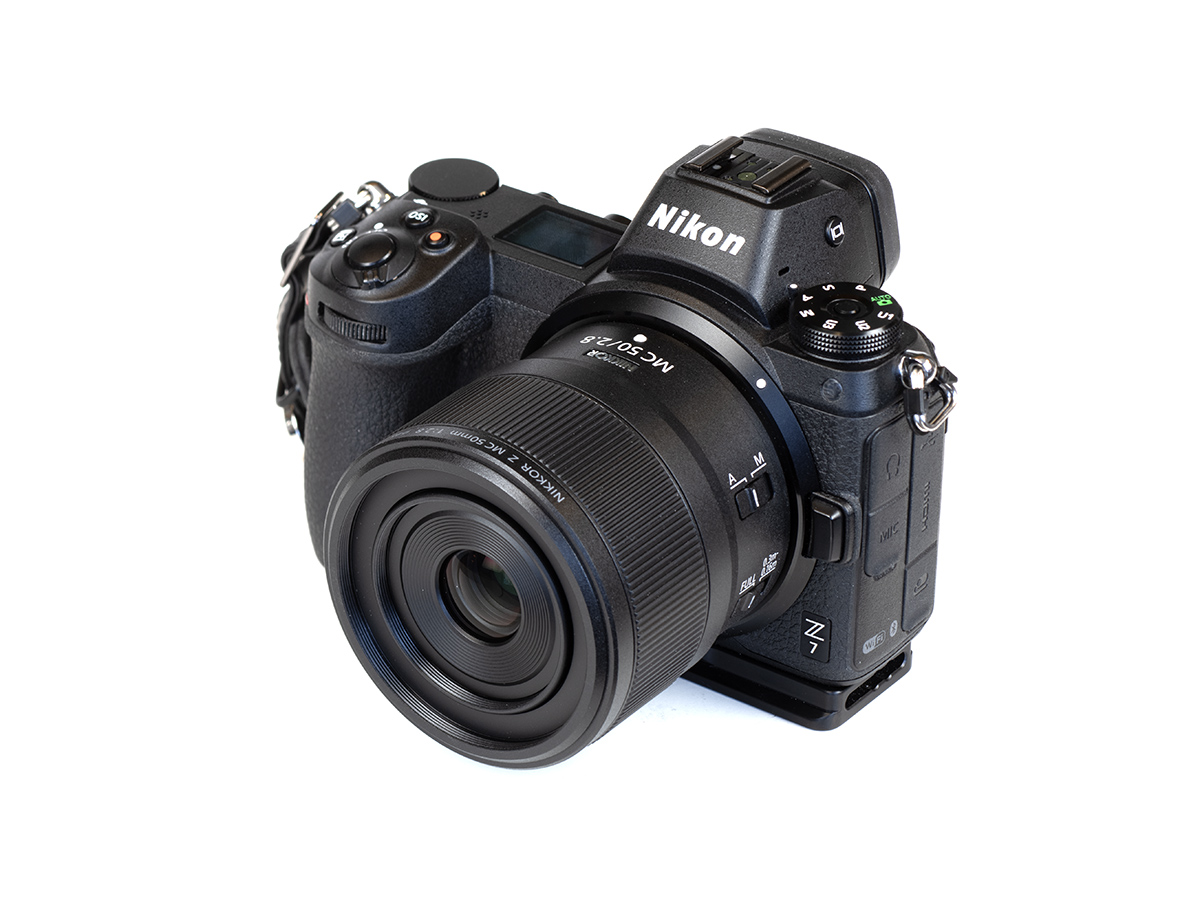
The Nikkor Z MC 50mm f/2.8 is the more affordable of the two “Micro” lenses in the Nikon lineup. It can serve you both as a (slow-speed) “nifty-fifty” as well as a dedicated macro lens. Unlike the Z MC 105mm f/2.8 VR S it is not a member of the more premium “S-class” and it shows in a couple of aspects.
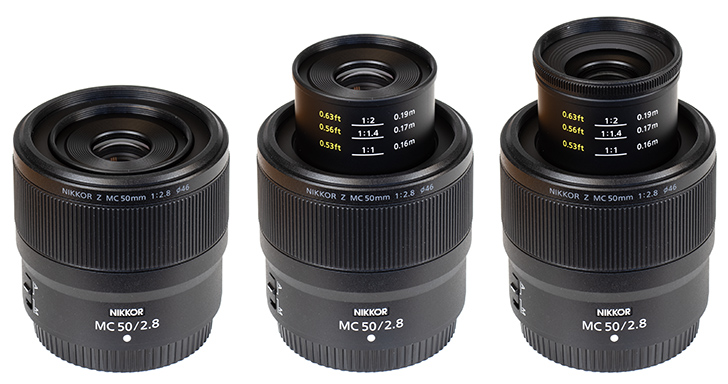
The construction can be described as somewhat archaic. Modern macro lenses use an internal focusing mechanism. Instead the Z MC 50mm f/2.8 uses an extending focusing system. So the inner lens tube extends towards closer focus distances. That’s basically similar to using an extension tube on a conventional 50mm lens. The build quality is “okay” with Nikon’s engineering plastics based on a metal mount. The focus ring is also made of plastic rather than being rubberized. It is very lightweight at just 260g but it doesn’t feel “dense”. Nikon implemented some weather-sealing. However, the extending inner tube doesn’t really inspire confidence in this respect. Nikon also includes a tiny barrel-shaped “lens hood”. It can probably be described as “best effort” here because the working distance (object to front-element) at 1:1 magnification is merely 5cm. There is simply not more space but this makes it also fairly useless to begin with. Technically, you can use the secondary 62mm filter thread to screw in a deeper lens hood (for standard use).
The Z MC 50m f/2.8 uses a single STM motor for autofocusing. It’s fast enough at standard focus distances but sluggish when hunting through the focus range. Fortunately, Nikon implemented a focus limiter (0.3-0.16m) for macro work. Manual focusing doesn’t feel overly precise. There is no dedicated control ring. Instead the focus ring can be reprogrammed to other functions in your camera.
| Specifications | |
|---|---|
| Optical construction | 10 elements in 7 groups (1x ED, 1x aspherical) fluorine-coated front lens element |
| Number of aperture blades | 9 (rounded) |
| min. focus distance | 0.16m (max. magnification: 1x) |
| Dimensions | 74.5 x 66mm |
| Weight | 260g |
| Filter size | 46mm (62mm) |
| Hood | (tiny) barrel-shaped, screw-in, supplied |
| Other features | control ring (defaults to focus ring) focus limiter dust- and drip-resistant |
Distortion
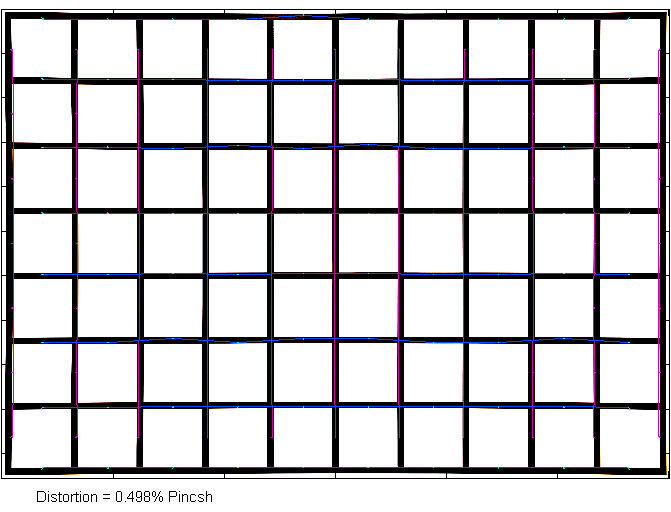
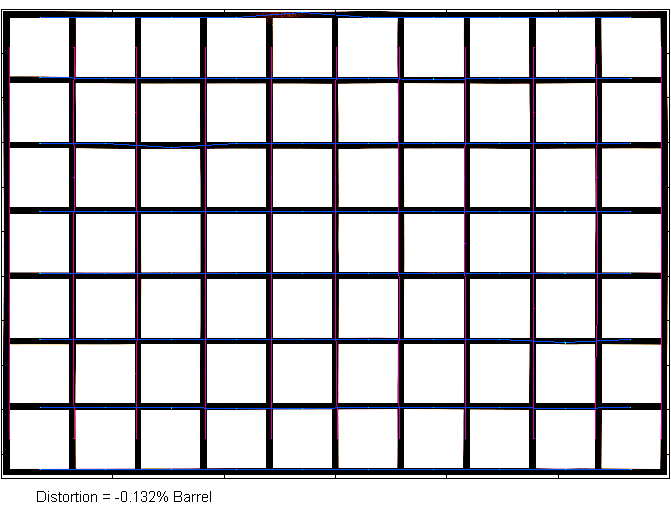
The Nikkor Z MC 50mm f/2.8 produces a slight pincushion distortion in RAW images. Auto-correction handles this nicely if needed.
Vignetting
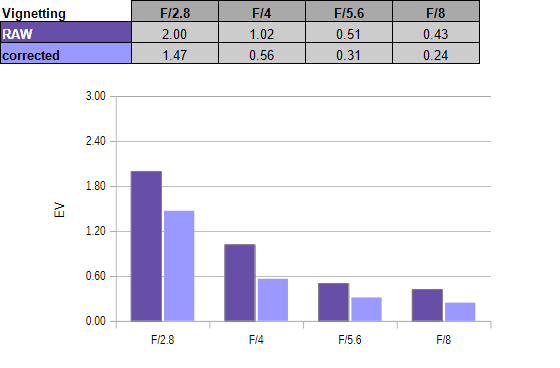
The RAW vignetting reaches ~2 EV (f-stops) at f/2.8 which is rather disappointing for such a slow-speed 50mm lens. It is acceptable at f/4 and negligible from f/5.6 onward. Auto-correction reduces the light falloff only mildly at f/2.8, but the issue is mostly gone from f/4 in this case.
MTF (resolution at 45 mp)
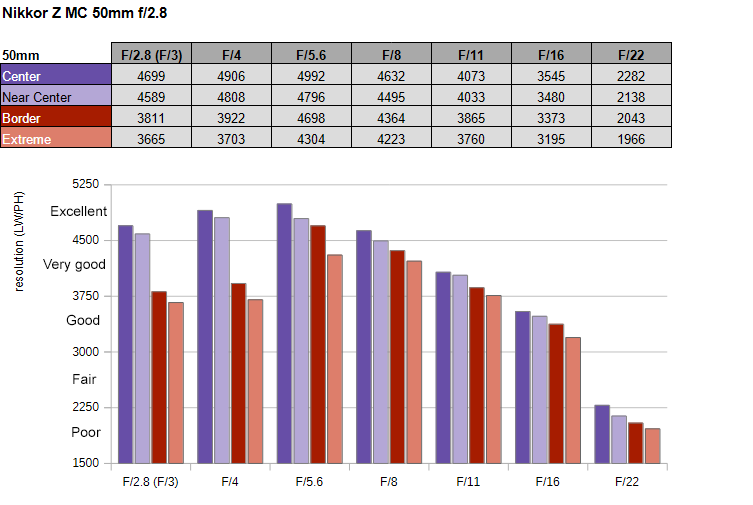
The Nikkor produced high resolution figures in the lab. The broader center is excellent at f/2.8. The outer image field is “only” good to very good due to some astigmatism. The latter is still a fairly dominant factor at f/4. There is a substantial jump in the overall quality at f/5.6, though. The border resolution is boosted quite a bit and the corners are easily on a very good level. As usual diffraction is the limiting factor from f/8. f/11 is still very usable. Softness creeps in at f/16, and do yourself a favor and avoid f/22.
Please note that the resolution figures were obtained at “normal” focus distances. We can’t realistically perform MTF checks at 1:1 object magnification. However, the Nikkor does have a floating focusing system so it should be able to maintain the quality at macro distances.
Please note that the MTF results are not directly comparable across the different systems!
Below is a simplified summary of the formal findings. The chart shows line widths per picture height (LW/PH), which can be taken as a measure of sharpness. If you would like to know more about the MTF50 figures, you may check out the corresponding Imatest Explanations.
Chromatic Aberrations (CAs)
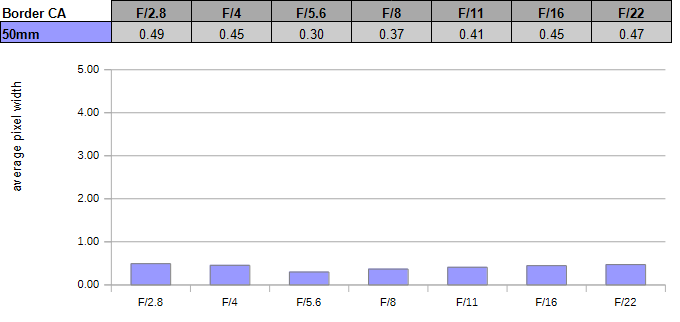
Lateral CAs are low with an average pixel width of around 0.4px at the borders. This is negligible already but auto-correction can fix the rest without any loss in image quality.
Bokeh
A 50mm f/2.8 isn’t ideal for achieving a shallow depth-of-field at standard focus distances but that’s, of course, different with closeups, so let’s check the bokeh.
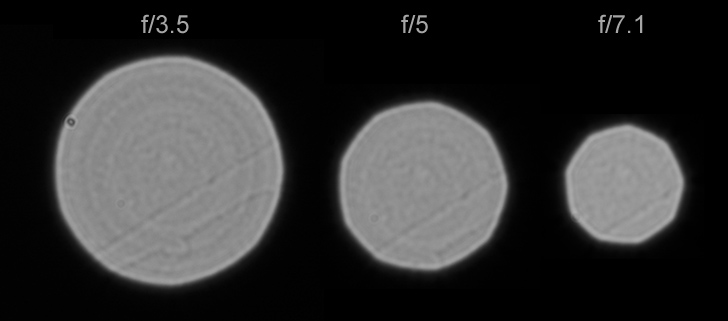
Note: You may wonder why the shown aperture starts at f/3.5 (followed by f/5 and f/7.1). The camera/lens is adjusting the values to the EFFECTIVE aperture at the selected focus distance. This is typical for macro lenses.
The out-of-focus highlights exhibit some weirdness at least in our test sample. You may spot a stripe in the sample crop below. Our best guess is a polishing defect on a glass element (?). Other than this, we can observe an onion-like substructure in the inner disc zone and a bit of outlining (and yes, there’s a dust spot). The more edgy aperture shape creeps in at f/5 and it’s quite obvious from f/7.1.
When looking at the whole image, the circular highlight shape is maintained from the center to the mid field which is quite good. The corner highlights are more ellipsoid than cat eyes so that’s good. The border discs are restored to their circular shape at f/5 and the corner discs follow at f/7.1.
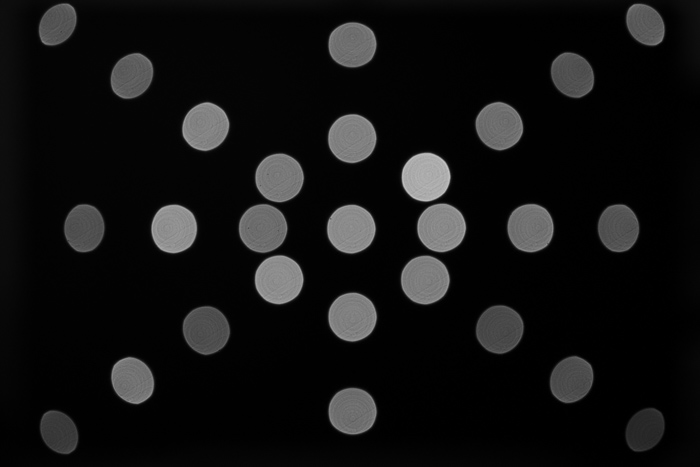
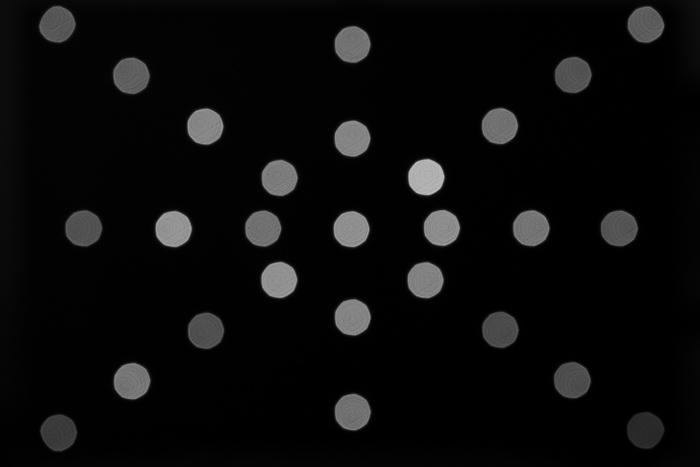
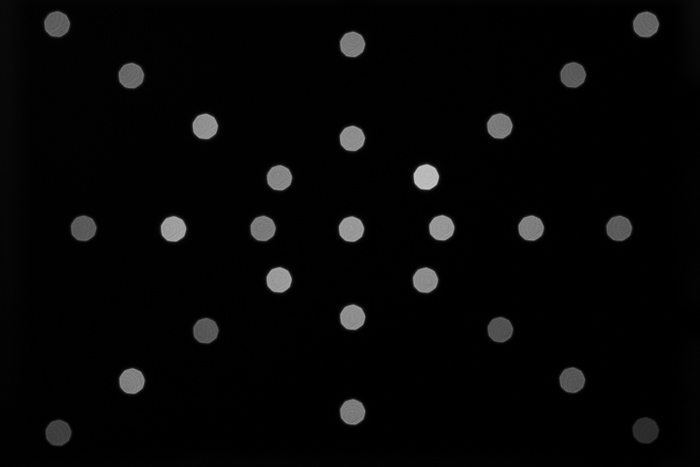
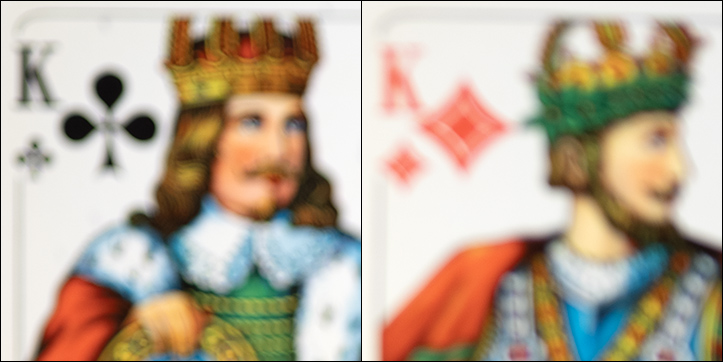
The general blur in the focus transition zone is very smooth in the image background (shown to the left below). The foreground blur (to the right) is somewhat “smeary” in comparison.
Bokeh Fringing (LoCA)
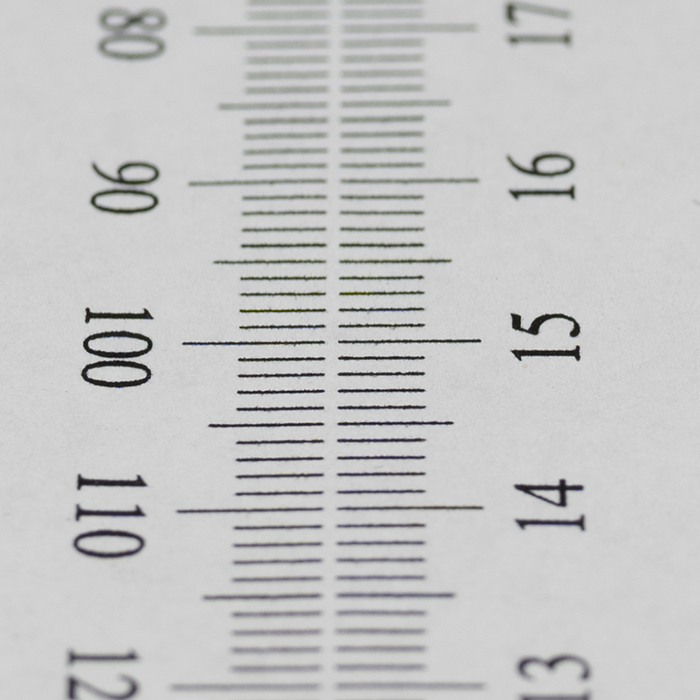
LoCAs (axial CAs) are a color-fringing effect on the Z-axis. They show up as purplish/yellowish halos in front of the in-focus zone and greenish/bluish beyond. The Nikkor Z MC 50mm f/2.8 is not overly fast. There’s still some color fringing going on at f/3.5 and traces remain at f/5. The fringing is gone at f/7.1.
Also note that there’s no focus shift when stopping down which is important for a macro lens.
Competition
50mm macro lenses aren’t overly popular due to their very short working distance so other manufacturers didn’t really bother to release competitors with AF in this segment. If you insist on macro lens here you still have manual focusing options. There’s the brilliant Voigtlander APO-Lanthar 65mm f/2 Aspherical for the same money. While it is a manual focus lens, it does transmit EXIF data to the camera so IBIS can be used here. The slightly longer focal length and the extra stop in speed make it also more versatile. On the downside, it only focuses down to a max object magnification of 1:2 and it also has an extending focusing system. Another manual focus option could be the Laowa 58mm f/2.8 Ultra-Macro APO which provides a magnification of up to 2:1. And there are really cheap macro lenses such as the TTArtisan 40mm f/2.8 Macro or the 7Artisans 60mm f/2.8 Macro 2x.
The cheapest – but not the worst option – would be to use a forementioned extension tube on a standard 50mm lens if you have one already. These can be had for as little as $50 USD or so.
Sample Images
Countryside Germany here rather than the usual sights of Australia.


The Nikkor Z MC 50mm f/2.8 is capable of delivering very good image quality. Images are sharp at f/2.8 and exceedingly so at f/5.6. Lateral CAs are negligible. However, axial CAs can be visible at large aperture settings. There is some vignetting and a tiny bit of image distortion but autocorrection handles most of this. The quality of the bokeh isn't perfect but pretty good in real life (unless your sample has an issue like ours).
While the lens is optically fine, there are question marks about the build quality, though. Yes, it's not an S-class lens but there's a lot of plastic here, and the extending focusing system is a bit ... meh. Also keep in mind that a working distance of just 5cm at 1:1 has compromises in terms of lighting and shooting live critters if that's your thing.
The Nikkor Z MC 50mm f/2.8 does the job but overall we'd rather suggest the Z MC 105mm f/2.8 VR S instead really.
Please consider to support us by shopping at:
* Amazon US
* Amazon Europe
* B&H
* Adorama
* KEH (used gear)
The Good
- Lightweight and Compact
- Sharp
The Bad
- Extending focusing mechanism
- Feels a bit cheap
- Weird lens hood
-
Optical Quality8
-
Build Quality6
-
Price / Performance5