


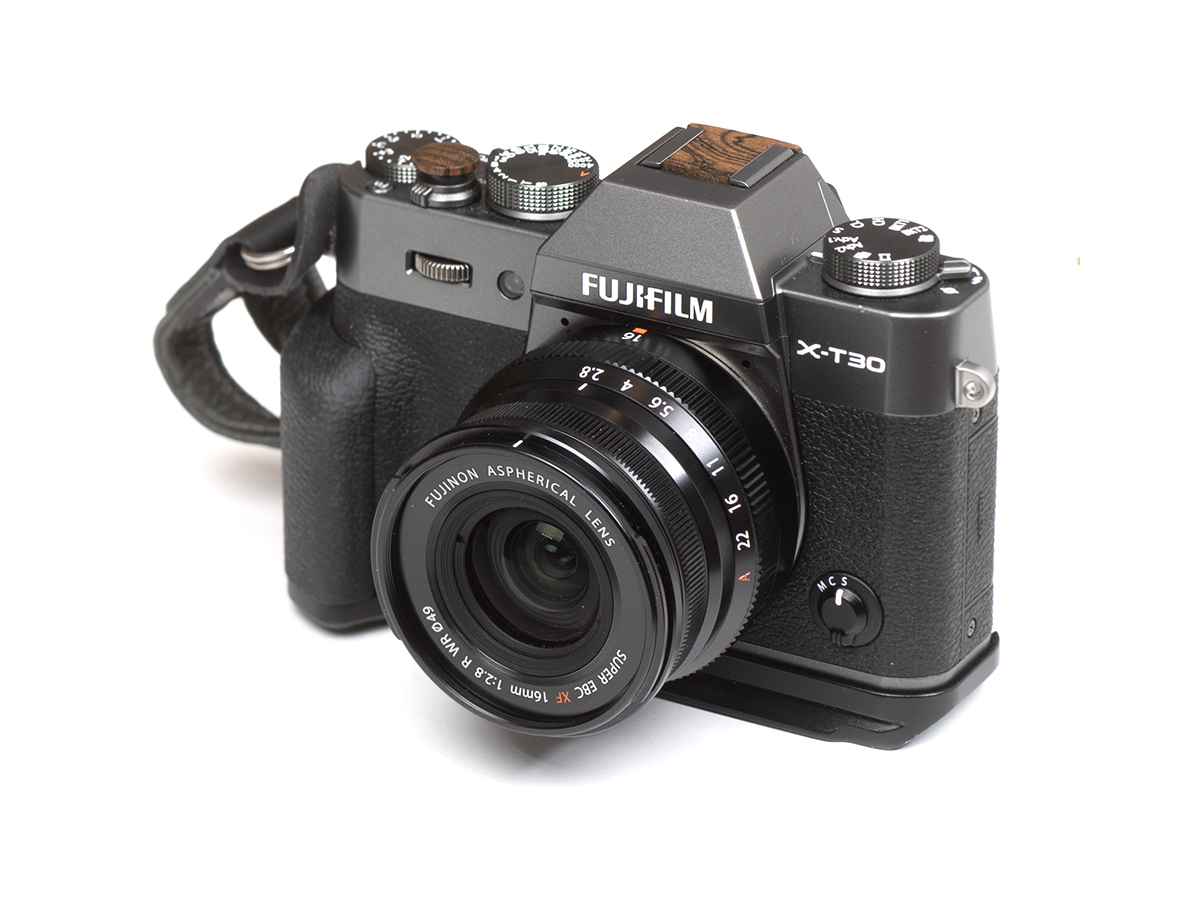
We don’t know who first came up with the nickname “Fujicron”, but it’s certainly a fitting name for Fujifilm’s medium-speed prime lenses consisting of the XF 16mm f/2.8, 23mm f/2, 35mm f/2, and 50mm f/2. For those not familiar with the term, it relates to Leica’s “Summicron” prime lenses, which stand out not in terms of speed but compact size and low weight. This review focuses on the widest of these Fujicrons – the Fujinon XF 16mm f/2.8 R WR. Unlike the Summicrons, the lens is very affordable at just $450 USD. Released in 2019, it’s not a new lens anymore, but it slipped our attention, so it’s about time to cover it here.
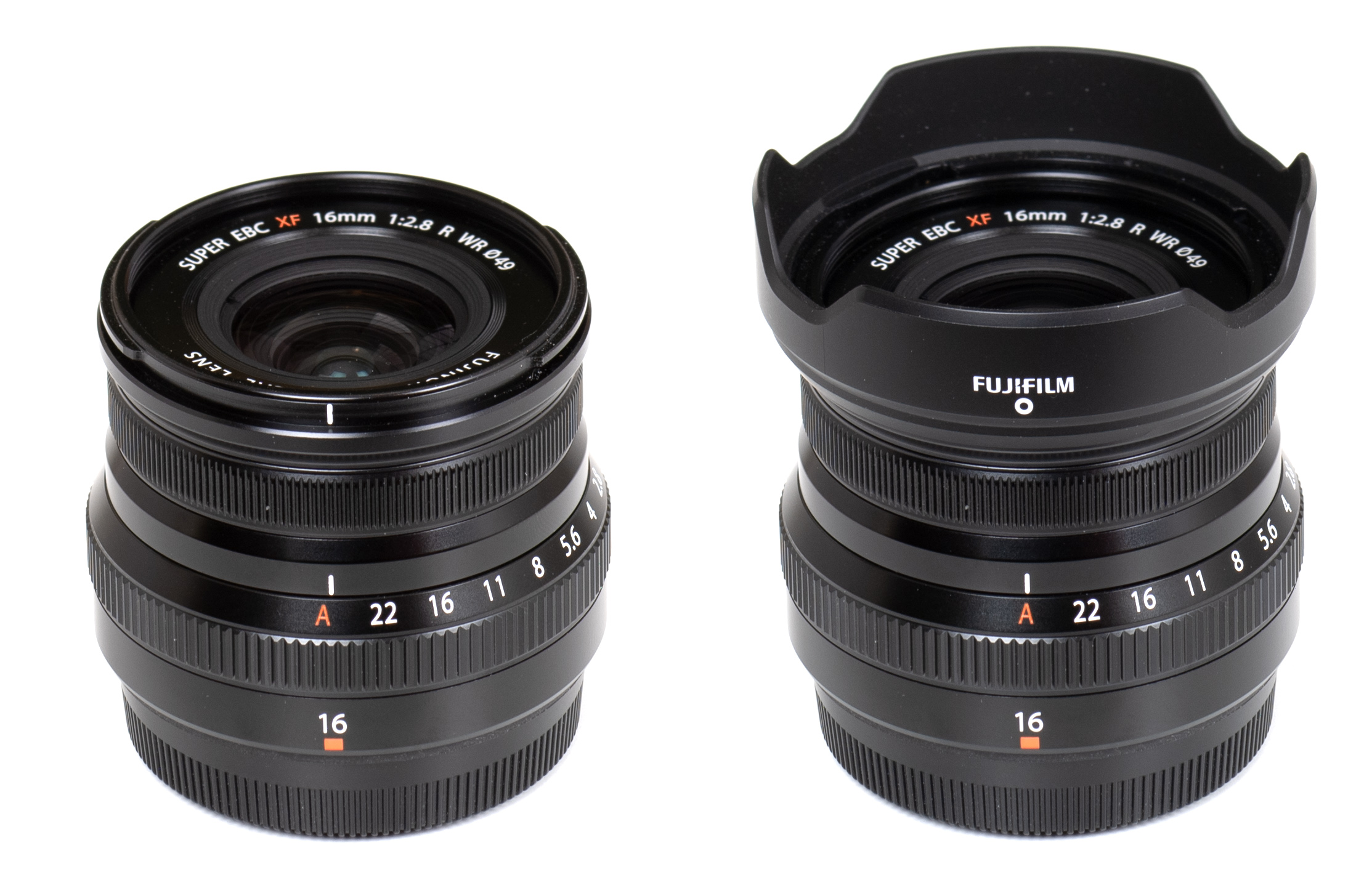
Despite the surprisingly low price tag, the build quality is exceptionally high based on a tightly assembled metal body with a focus and an aperture ring. It feels substantial yet weighs a mere 155g. Typical for most contemporary Fujifilm lenses, it is sealed against moisture and dust, and it’s freeze-proof down to -10°C. A petal-shaped lens hood is part of the package.
The Fujinon XF 16mm f/2.8 R WR uses an older style stepping motor for autofocusing. However, it only needs to shift a tiny lens group, making it extremely fast. It’s also virtually silent.
| Specifications | |
|---|---|
| Optical construction | 10 elements in 8 groups (2x aspherical) Super EBC Coating |
| Number of aperture blades | 9 (rounded) |
| min. focus distance | 0.17m (max magnification: 0.13x) |
| Dimensions | ø 60 x 45.4mm |
| Weight | 155g |
| Filter size | ø 49mm |
| Hood | petal-shaped, bayonet mount, included |
| Other features | aperture-ring weather- and dust-resistant Freeze-proof down to -10°C |
Distortions
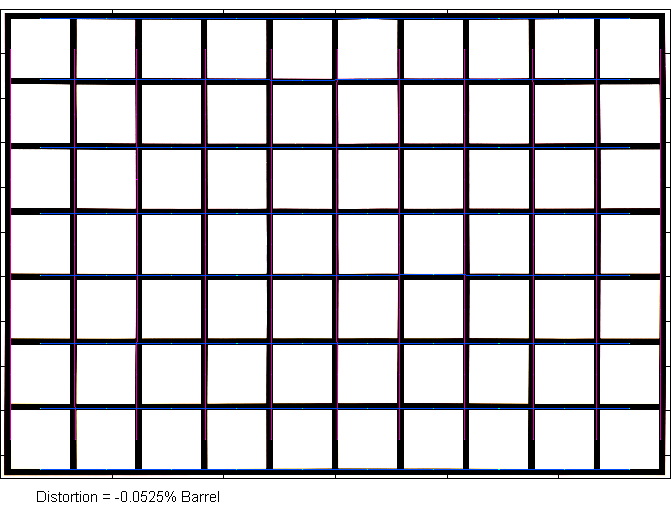
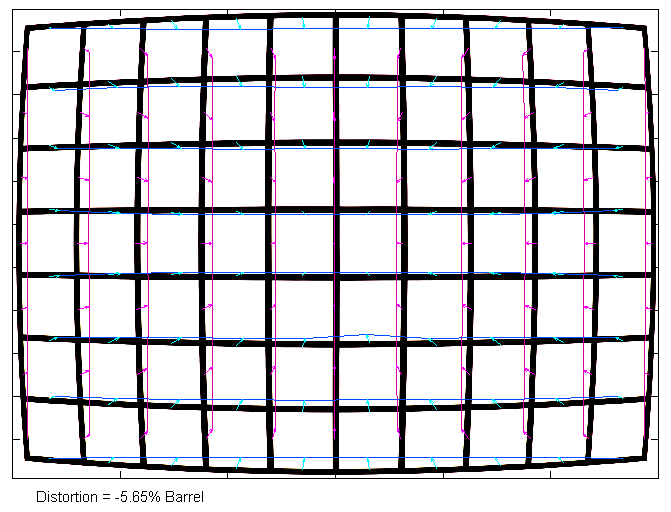
Minimizing lens size usually results in compromises, and one of them is image distortions. The XF 16mm f/2.8 R WR produces a very high barrel distortion of more than 5.5% in RAW files. Auto-correction is required, but it does the job perfectly here.
Vignetting
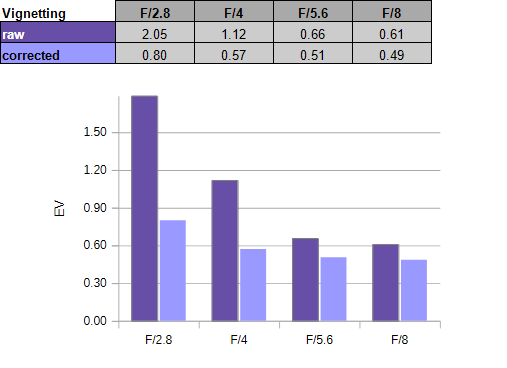
It’s probably also not overly surprising that vignetting is also on the high side. At f/2.8, the light falloff reaches more than 2 EV (f-stops) in RAW files – this is even a bit beyond our usual scale for APS-C format lenses. Stopping down to f/4 reduces this by roughly 1 EV (f-stop) and the issue is mostly resolved from f/5.6.
Auto-correction shaves off about 1.2 EV at f/2.8. This is still visible in critical scenes, but it’s usually acceptable already. Stopping down to f/4 reduces this a bit further before settling around 0.5 EV from f/5.6.
MTF (resolution) at 26 megapixels
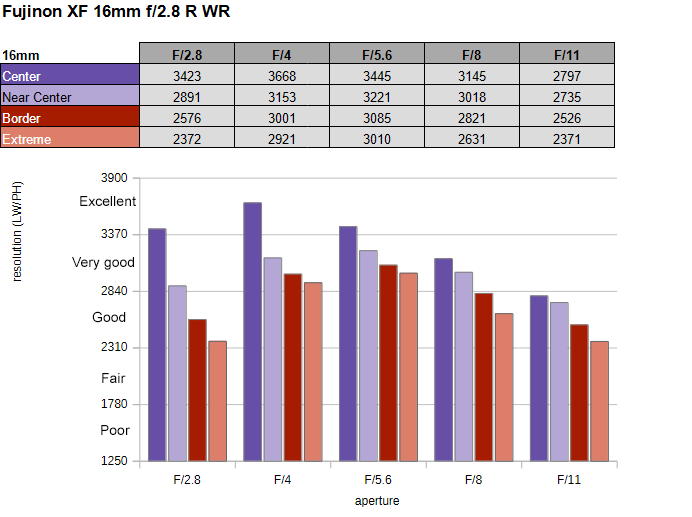
The resolution characteristic of the Fujinon XF 16mm f/2.8 R WR is generally high, although not without caveats. The center quality is very sharp straight from f/2.8. There is a steady drop in resolution towards the image corners, though. The near-center quality is still very good (just), followed by good borders but slightly soft corners. The latter is worsened by field curvature (the chart shows the quality on the focus field, so this isn’t obvious here). Stopping down to f/4 boosts the overall quality quite a bit, and for best results you should choose f/5.6 to compensate for the field curvature. f/8 sees a downturn due to diffraction, and f/11 should be generally avoided.
The centering quality of the tested sample was Okay.
Please note that the MTF results are not directly comparable across the different systems!
Below is a simplified summary of the formal findings. The chart shows line widths per picture height (LW/PH) which can be taken as a measure of sharpness. If you would like to know more about the MTF50 figures, you may check out the corresponding Imatest Explanations.
Chromatic Aberrations (CAs)
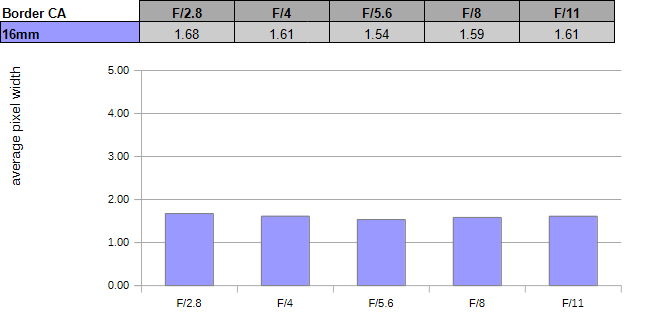
Lateral CAs are slightly higher than usual, with an average pixel width of around 1.6px at the image borders. It’s still not dramatically high, though. Auto-correction should be able to handle this without a loss in image quality.
Bokeh
A 16mm f/2.8 APS-C lens is hardly ideal for creating a shallow depth-of-field, but let’s still take a look at the basics.
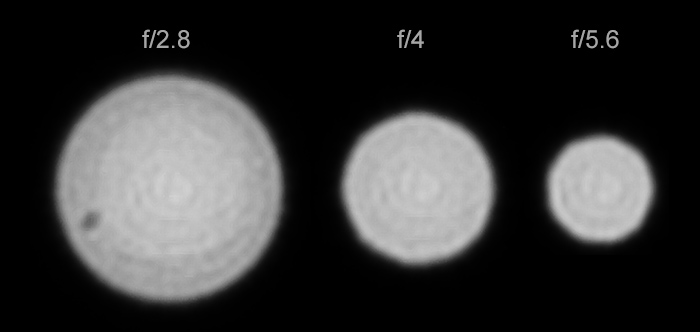
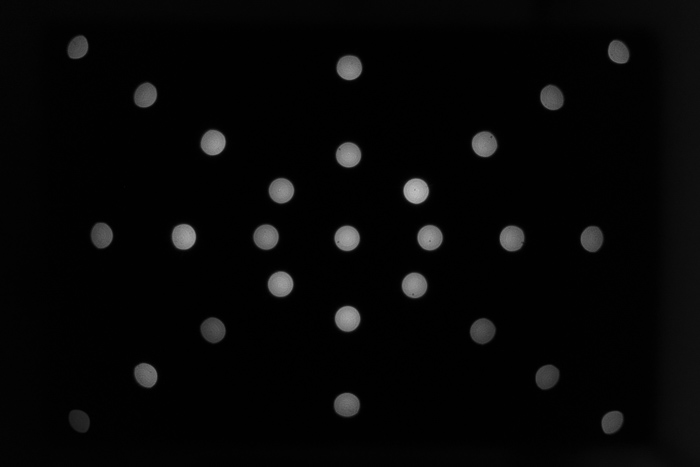
Out-of-focus highlights show a grainy inner substructure (and a dust spot), probably thanks to the two aspherical elements. The center discs are circular at wide-open aperture and at f/4 (mostly). The more edgy aperture shape creeps in at f/5.6.
The XF 16mm f/2.8 R WR doesn’t focus close enough for our complete test scene, so below is just the f/2.8 snapshot with smaller than usual highlight discs. Their circular shape is maintained up to the midfield. From there, they deteriorate to “cat eyes” in the image corners. Stopping down restores the corner discs as usual (not shown).
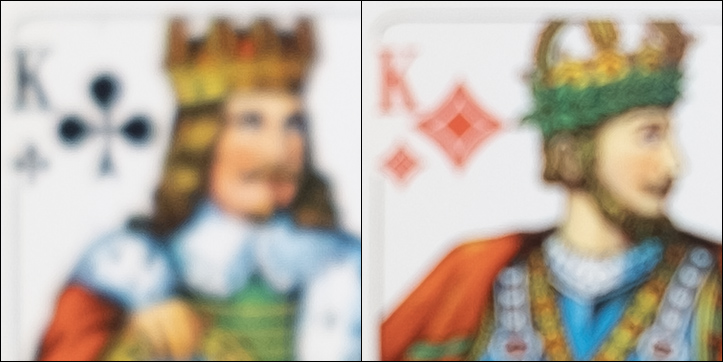
The out-of-focus rendering in the focus transition zone is decent for such a lens. The background blur (shown to the left below, a bit too defocused to be honest) is smooth. The less critical foreground blur (to the right) is rather busy (double-edged).
Competition
Fujinon lenses are no longer the only option for Fujifilm camera users. The stiffest competitor is probably the Viltrox AF 15mm f/1.8 Air XF. At comparable aperture settings, it is actually sharper, and it merely costs half as much as the XF 16mm f/2.8 R WR. However, its build quality isn’t quite as enjoyable. A yet-to-be-tested alternative is the new Sigma 15mm f/1.4 DC Contemporary. Traditionally, Sigma’s Contemporary primes were quite impressive – also from a price/performance standpoint. The older Sigma 16mm f/1.4 DC Contemporary was no slouch either at comparable aperture settings, and it’s still available for about the same price as the Fujinon despite being 2 stops faster. But it’s also much bigger.
Sample Images
Some pictures from rural Germany taken some years ago.


The Fujinon XF 16mm f/2.8 R WR is almost a bit of an oldie by now, but it has aged fairly well. Optically, it may not be the cutting edge, but it's pretty sharp if you stop down to f/4. At f/2.8, there is some corner softness, also due to field curvature. It also relies heavily on autocorrection, but it works pretty well.
The aspect where the lens truly shines is its build quality. Despite its small size and low weight, it feels very solid, and the weather-resistant (WR) design is reassuring. The AF is pretty snappy, too.
Overall, it may no longer be the obvious choice in this class, but it's still an attractive "Fujicron".
If you'd like to support our work, please consider shopping for this or other lenses via one of the following partners:
* Amazon (US)
* Amazon (Europe)
* B&H (US)
* Adorama (US)
* KEH (US, used gear)
The Good
- Pretty sharp when stopped down
- Great build quality
- Tiny
The Bad
- Soft corners at f/2.8 also due to field curvature
- Relies heavily on auto-correction
-
Optical Quality
-
Build Quality
-
Price / Performance