


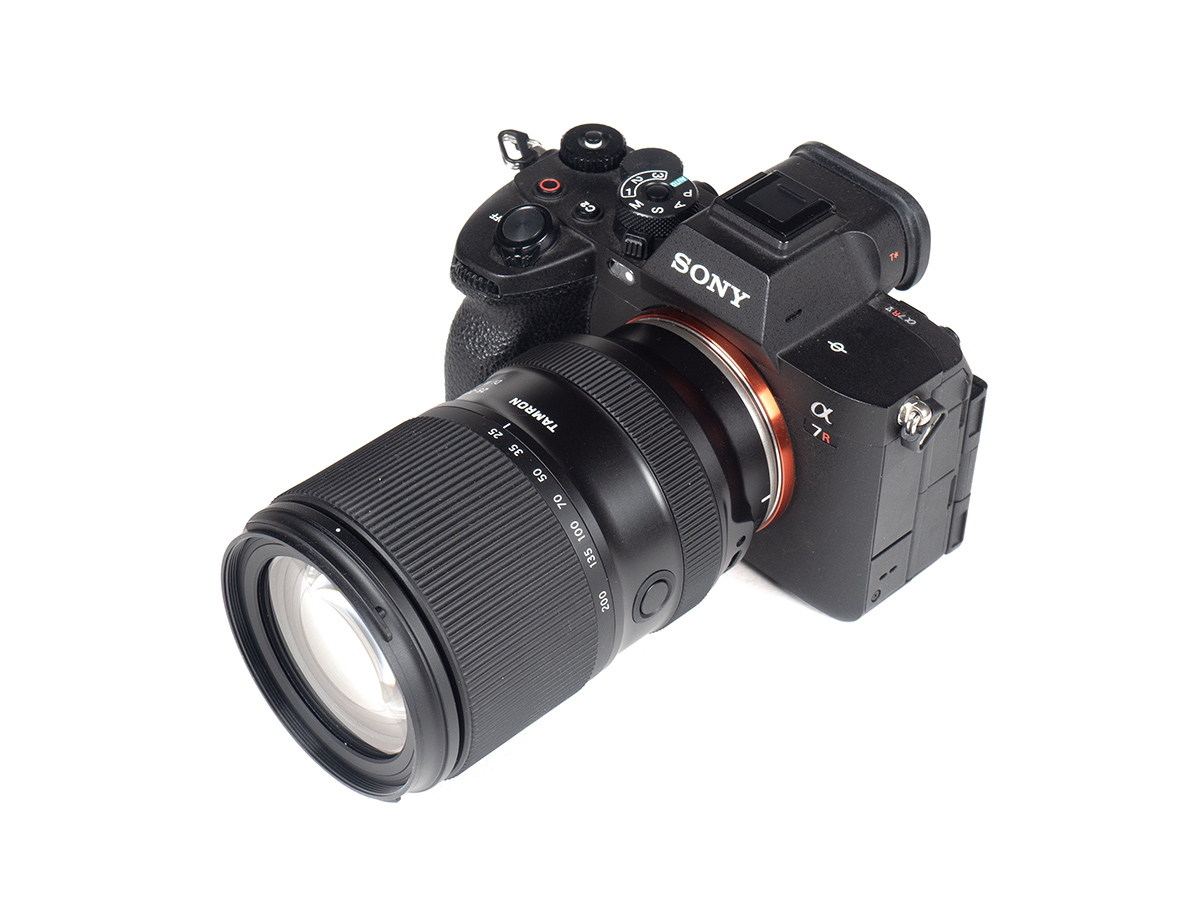
Tamron has a long tradition of making “super-zoom” lenses. They released the first of such lenses back in 1994 – the 28-200mm f/3.8-5.6 Aspherical. I can count at least 21 (!) of such lenses in total, but I reckon I didn’t catch them all. Their latest interpretation of the topic is the Tamron 25-200mm f/2.8-5.6 Di III VXD G2, a successor of the popular 28-200mm f/2.8-5.6 Di III RXD. Tamron obviously felt that it was time to push things a little with a little extra range at the wide end as well as improvements in build quality and AF speed. The Tamron lens is currently available in Sony E-mount and retails around $900 USD or 850 EUR.
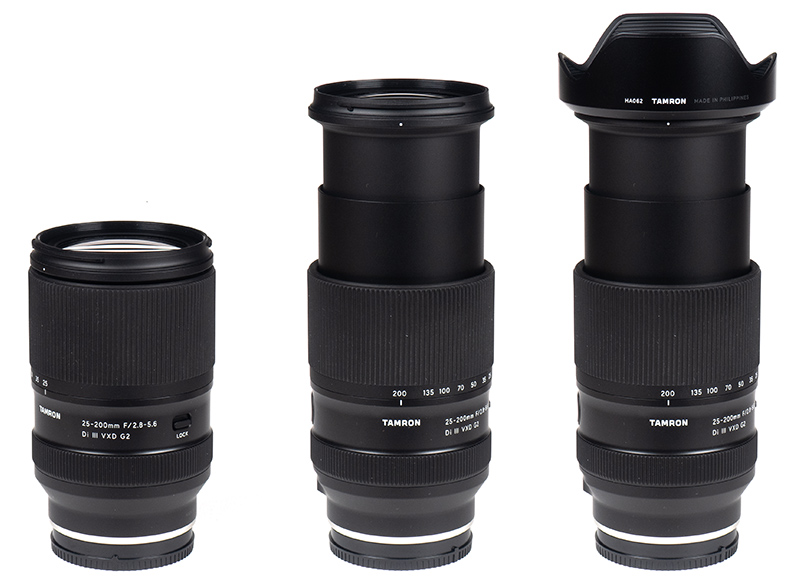
The 25-200mm f/2.8-5.6 Di III inherits the body design of Tamron’s G2 lineup. Most of the first generation Di III lenses had a rather mediocre(-feeling) build quality, and it’s apparent that Tamron has put some effort into fixing this (and there’s another body redesign coming with the 12-20mm f/2.8). The engineering plastics used for the lens body are finally of good quality. The very broad rubberized zoom ring turns smoothly despite the immense zoom ratio and two inner lens tubes. The focus ring at the rear is silky smooth as well. This lens is primarily targeting travel photography so it’s sensible that Tamron implemented weather-sealing. This is also a good idea because such extending zoom lenses tend to suck in air and as such dust. To prevent zoom creeping, there’s also a zoom lock switch although this only engages at 25mm, unfortunately. A small petal-shaped lens hood is provided.
Tamron is using its VXD (“Voice-coil eXtreme-torque Drive”) for autofocusing. It is blazing fast and silent. Tamron is quite proud of the close focus capabilities of the 25-200mm f/2.8-5.6. However, the impressive maximum 1:1.9 object magnification is only possible at 25mm, where it’s not that useful. At 200mm, this drops to a more conventional 1:3.9. An image stabilizer is not provided. Given that most contemporary mirrorless cameras provide IBIS, this is a reasonable compromise – such super-zoom lenses are already complex enough as is. Customizations and firmware updates are possible via a USB-C port at the rear using Tamron’s Lens Utility app for iOS/Android.
| Specifications | |
|---|---|
| Optical construction | 18 elements in 14 groups (1x XLD, 3x LD, 2x aspherical, 2x hybrid) BBAR G2 Coating Fluorine Coating |
| Number of aperture blades | 9 (rounded) |
| min. focus distance | 0.16m (W) – 0.8m (T) max. magnification: 1:1.9 (W) – 1:3.9 (T) |
| Dimensions | φ 76.2 × 121.5mm |
| Weight | 575g |
| Filter size | φ 67mm |
| Hood | petal-shaped, bayonet mount, supplied |
| Other features | dust- and drip-resistance Compatible with TAMRON Lens Utility Software (iOS/Android) Moisture-Resistant Construction Zoom Lock switch Fn-Button |
| Mounts | Sony E |
Distortion
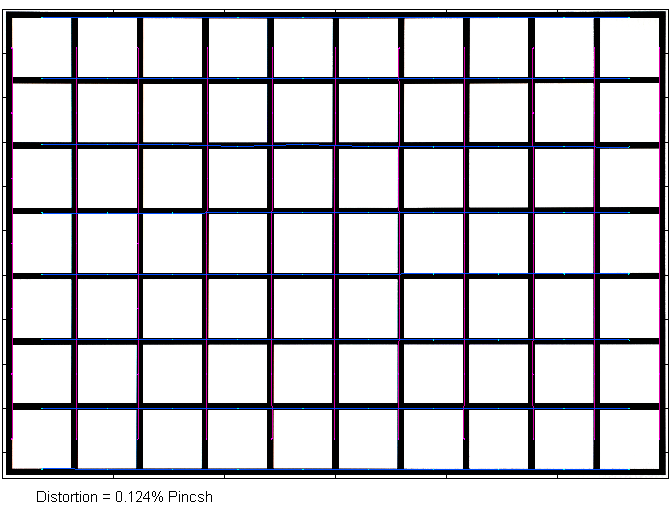
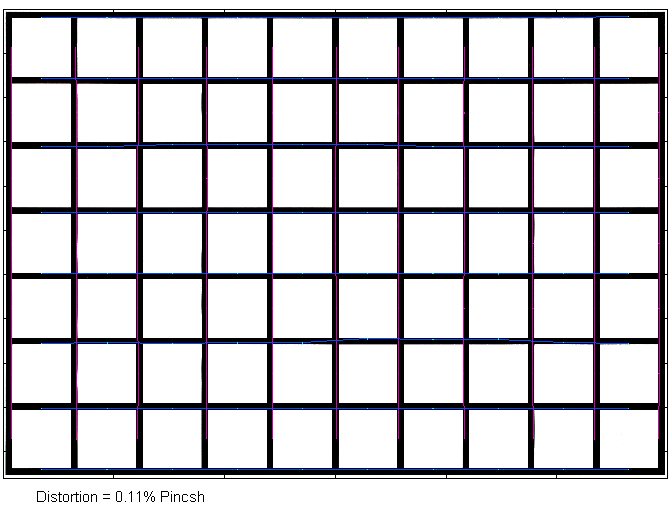
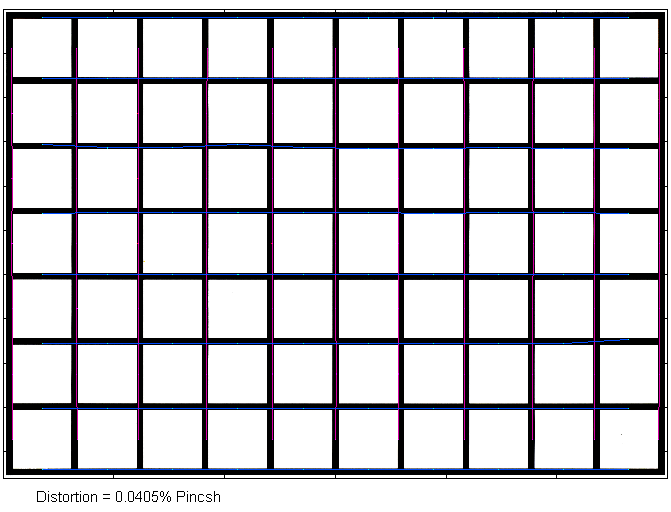
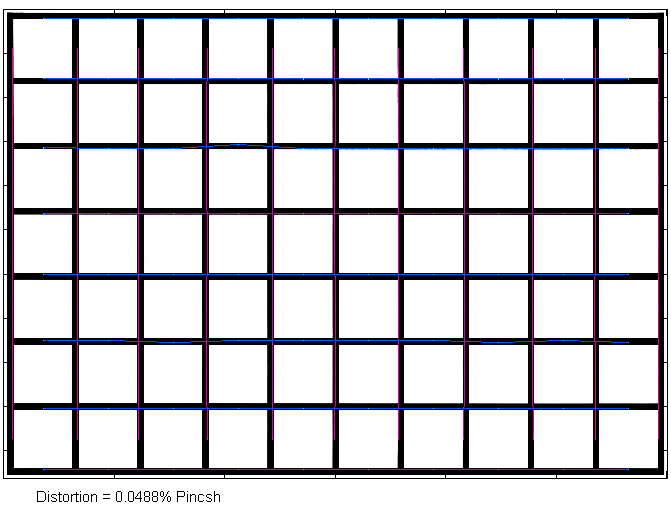
Keen readers may expect some crazy image distortions in RAW files. However, surprise, surprise, this isn’t really the case here. At 25mm, the barrel distortion stays well below 4%. This is still clearly visible in many scenes but it’s not excessive either – by today’s standards anyway. This eases soon thereafter and we can spot a mild pincushion distortion at 40mm. They increase significantly to almost 3% at 75mm before easing again to medium pincushion distortion at 200mm.
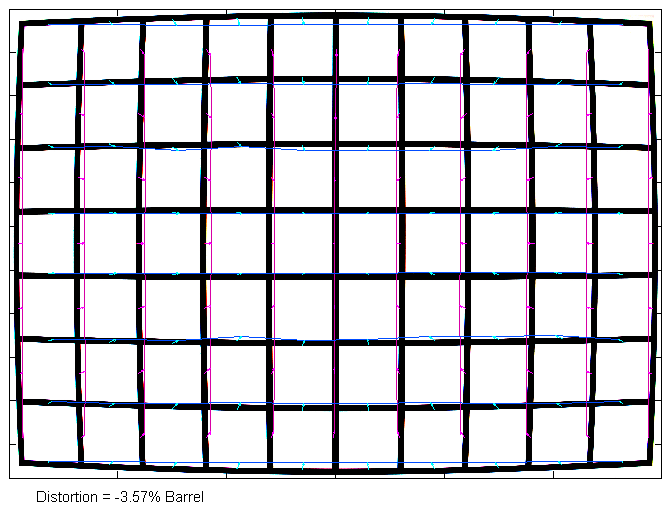
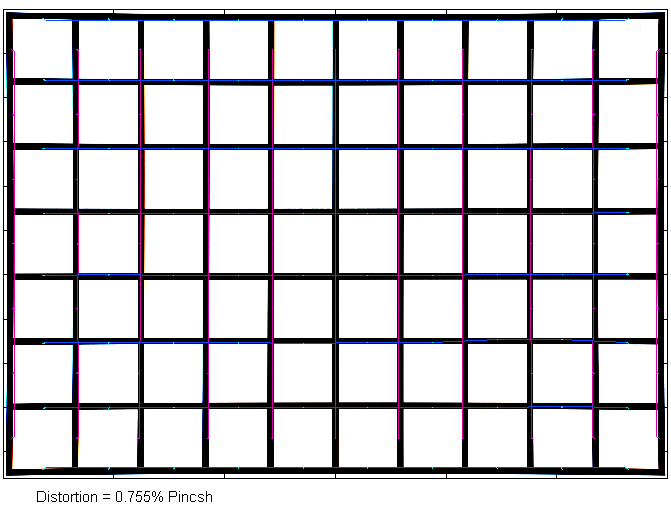
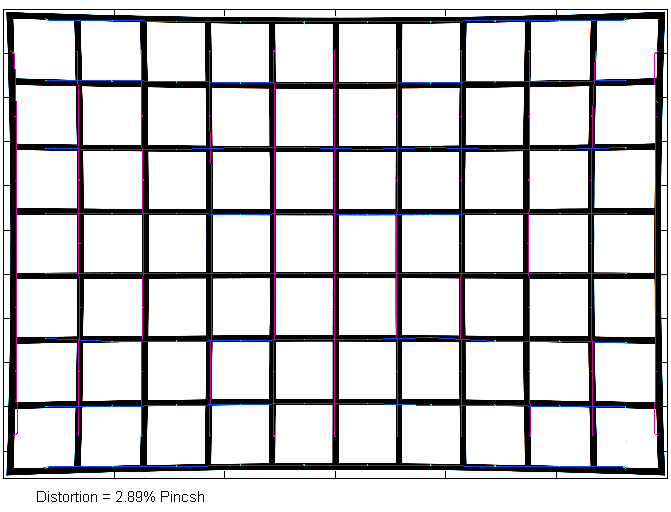
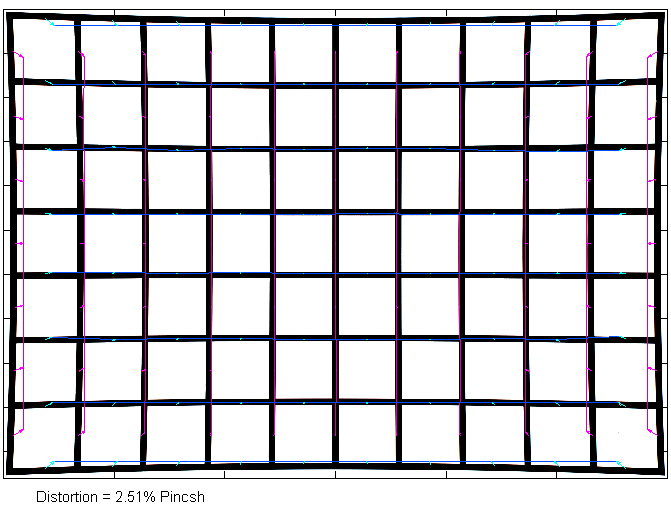
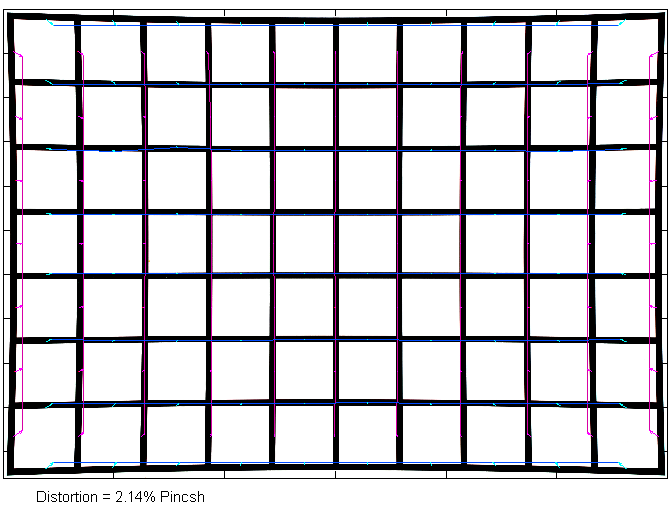
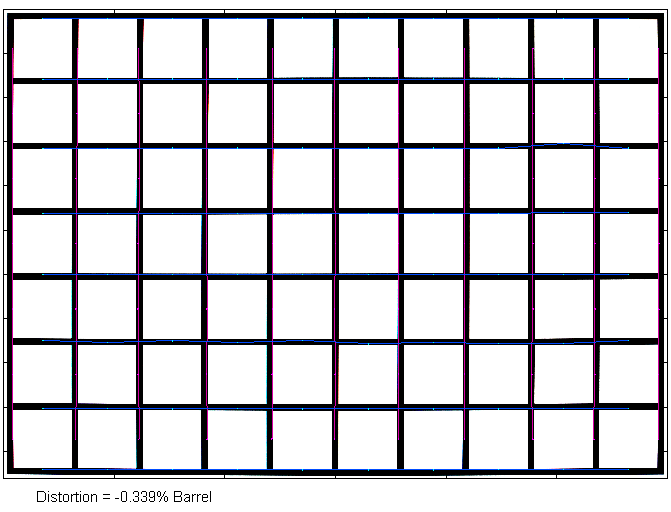
Auto-correction reduces this to a mostly negligible degree, as you can see below.
Vignetting
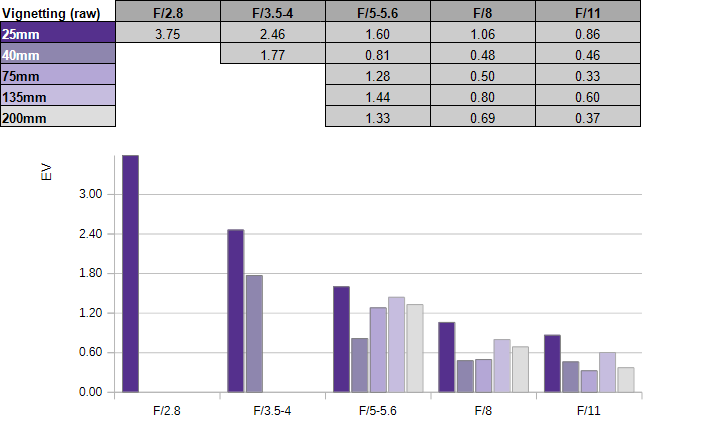
While the comparatively moderate RAW distortions surprised us, the RAW vignetting is more in line with what we expected here. At 25mm f/2.8, the light falloff is very heavy at almost 4 EV (f-stops). Stopped down to f/4, it’s a more bearable 2.5 EV and the vignetting is acceptable from f/8 here. At longer focal lengths, the vignetting remains high at max aperture, but it’s reasonalby reduced one stop down.
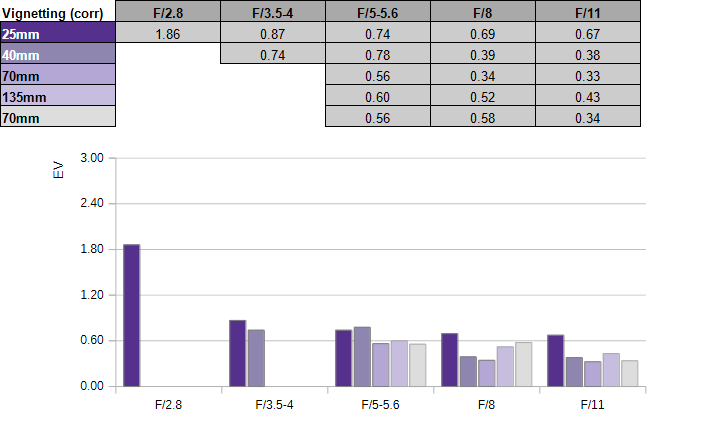
The combined distortion and vignetting correction reduce this drastically, although some light falloff is still present at 25mm f/2.8. It’s not much of an issue at other settings.
MTF (resolution at 42 mp)
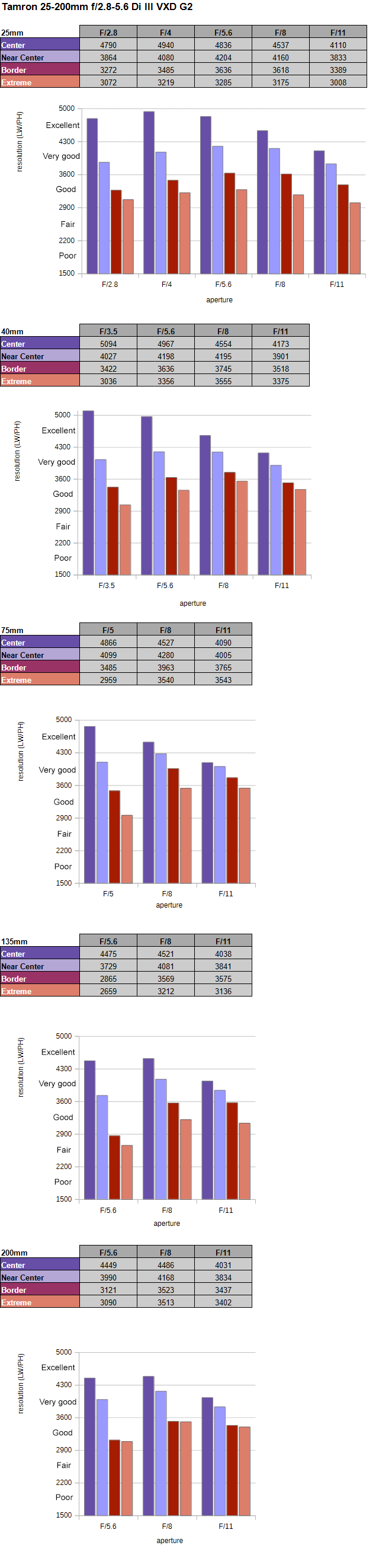
The resolution characteristic varies wildly across the zoom range. At 25mm, the Tamron lens is extremely sharp in the dead center. This drops to a very good level near the center and the outer image field is still good at f/2.8 Stopping down lifts the quality of the borders/corners slightly towards medium aperture settings, but they are never great. The overall quality improves a bit at 40mm. At 75mm the center quality remains impressive. However, the corners take a hit at f/5, but they have recovered nicely at f/8. The weakest spot is actually not at 200mm but around the 135mm mark. The center quality remains high but the outer image quality is a rather soft at f/5.6. But once again, stopping down to f/8 boosts the borders/corners back to good results. At 200mm, the border/corner quality improves very slightly.
The centering quality of the tested sample was okay. It’s more variable at the long end which is typical for such lenses. The field curvature varies across the zoom range. It’s low at the wide end but increases from there. It’s also a bit “wavy”.
Please note that the MTF results are not directly comparable across the different systems!
Below is a simplified summary of the formal findings. The chart shows line widths per picture height (LW/PH), which can be taken as a measure of sharpness. If you would like to know more about the MTF50 figures, you may check out the corresponding Imatest Explanations.
Chromatic Aberrations (CAs)
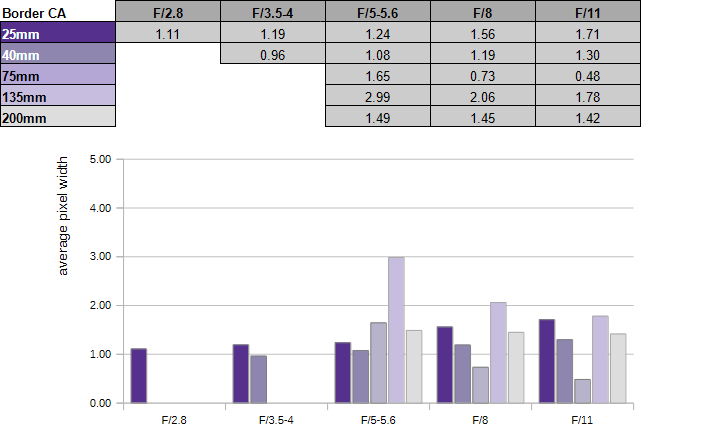
Lateral CAs are a mixed bag. They are reasonably well controlled from 25-75mm and 200mm. However, the border CAs increase massively at 135mm f/5.6 (in line with the drop in sharpness), peaking at a whopping 3px here. Stopping down to f/8 or f/11 reduces this quite a bit, though.
However, keep in mind that lateral CAs are losslessly autocorrected in JPEGs and most RAW converters so it’s not a big deal in real life.
Bokeh
The Tamron 25-200mm f/2.8-5.6 Di III VXD G2 isn’t a bokeh monster but you can create some decently shallow depth-of-field at longer focal lengths and/or your subject is close by. So let’s check the technical qualities here.
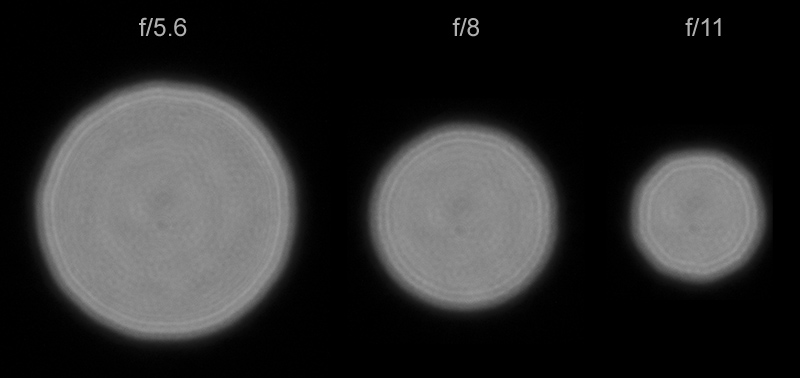
Out-of-focus highlights have a moderately clean inner sub-structure – even some of the best lenses produce a bit of “grain” here. There is, however, some outlining that doesn’t disappear when stopping down. The center discs are nicely circular at f/5.6 and f/8 (shown at 100mm below). The more edgy aperture shape is more obvious from f/11.
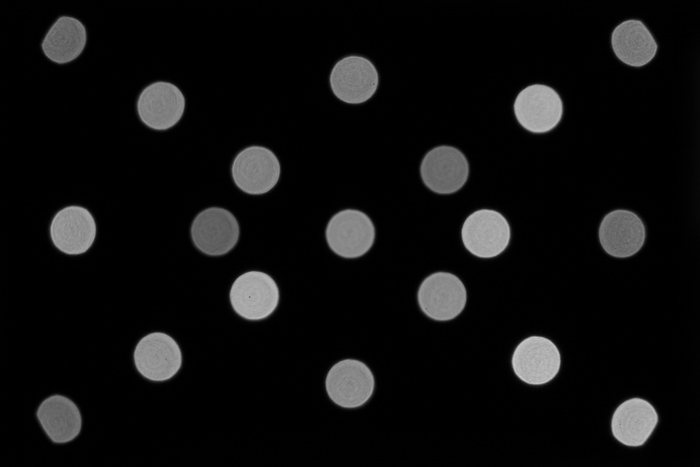
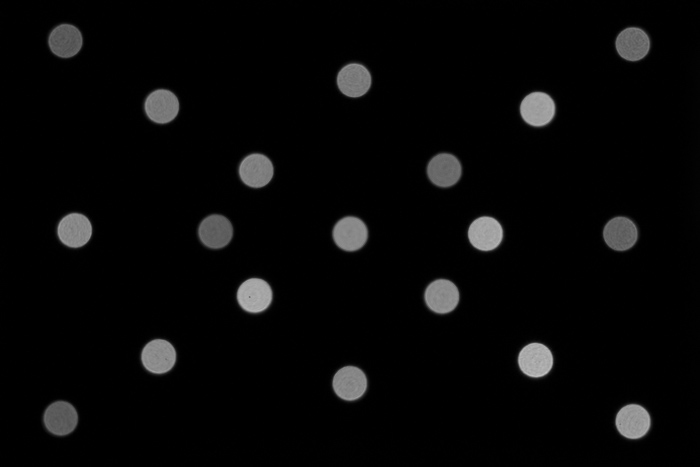
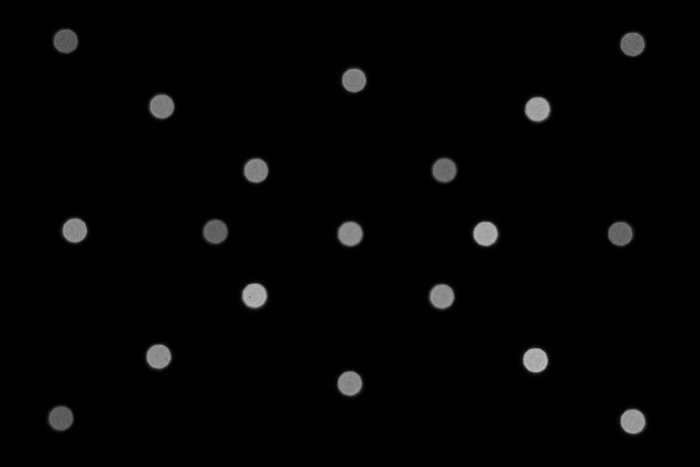
The disc shape is mostly maintained across most of the image frame at maximum aperture already. Only the border discs show a “cut off” due to mechanical vignetting. The corner discs are fully restored at f/8.
The out-of-focus rendering in the focus transition zone is actually pretty good for such a lens. The foreground blur (shown to the right below) is silky smooth. The background blur (to the left) is more nervous with harsher contrast egdes.

Sun Stars
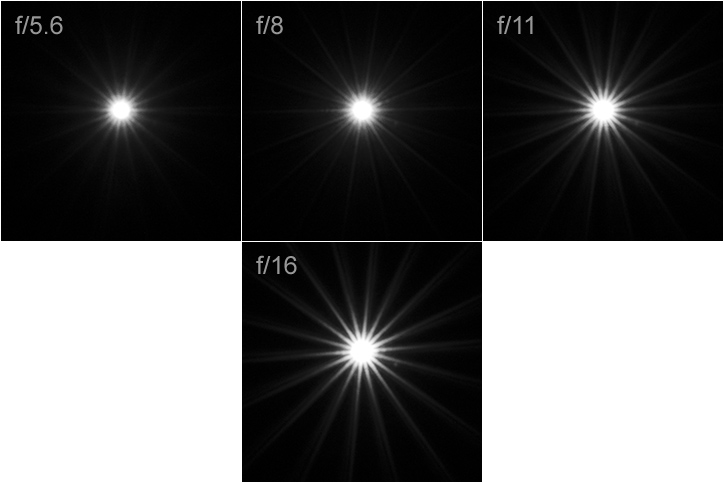
Below is a sequence of cropped images from f/5.6 all the way up to f/16 (at 25mm) – illustrating the sun star behavior. Sun stars are diffraction spikes from the aperture that show up if a bright light source is part of the scene (usually in night shots or if the sun is part of your scene).
There isn’t much going on at f/5.6 and f/8 due to the circular aperture shape. This changes at f/11, where the rays are getting more distinctive. As so often, the best sun stars are rendered at f/16. The rays are also nicely pointy rather than the less desirable “fan-like” style.
Competition / Alternatives
The Tamron 25-200mm f/2.8-5.6 Di III VXD G2 doesn’t exist in isolation. There are two obvious alternatives: the Sigma 20-200mm f/3.5-6.3 DG Contemporary and the Sony FE 24-240mm f/3.5-6.3 OSS. In terms of zoom range these are even more ambitious than the Tamron. We haven’t tested these lenses yet, but if we can believe other reviews on the web their performance is slightly inferior.
Sample Images


Super-zoom lenses are a compromise - more so than conventional zoom lenses, obviously. So the question is whether Tamron went too far with the 8x zoom ratio of the Tamron 25-200mm f/2.8-5.6 Di III VXD G2? Within its scope, the performance is mostly fine. The broader center quality is surprisingly sharp even by high standards, and the borders/corners are mostly decent at f/8. There is some softness in the outer image field at longer focal lengths at f/5.6, though. The RAW vignetting and CAs are high at some settings, though, so autocorrection has to come to the rescue here. The bokeh quality is better than expected. Tamron gave the lens the "G2" treatment for an improved build quality. The quality of the engineering plastics feels pretty good now. The lens uses an extending zoom design with two inner tubes. Many moving parts are usually not a good idea, but there's no wobbling whatsoever. Incorporating some weather-sealing is also commendable. A surprise is the blazingly fast AF that can easily compete with the best Sony lenses. Overall, it's a decent travel zoom lens. However, the natural home of the Tamron 25-200mm f/2.8-5.6 Di III VXD G2 is more on ~30 megapixel cameras rather than 60+. If you'd like to support our work, please consider shopping for this or other lenses via one of the following partners: * Amazon US * Amazon Europe * B&H * Adorama
The Good
- Much improved build quality
- Great zoom range
- Extremely fast AF
The Bad
- Somewhat inconsistent optical qualities
-
Optical Quality5.5
-
Build Quality7
-
Price / Performance7