


Introduction
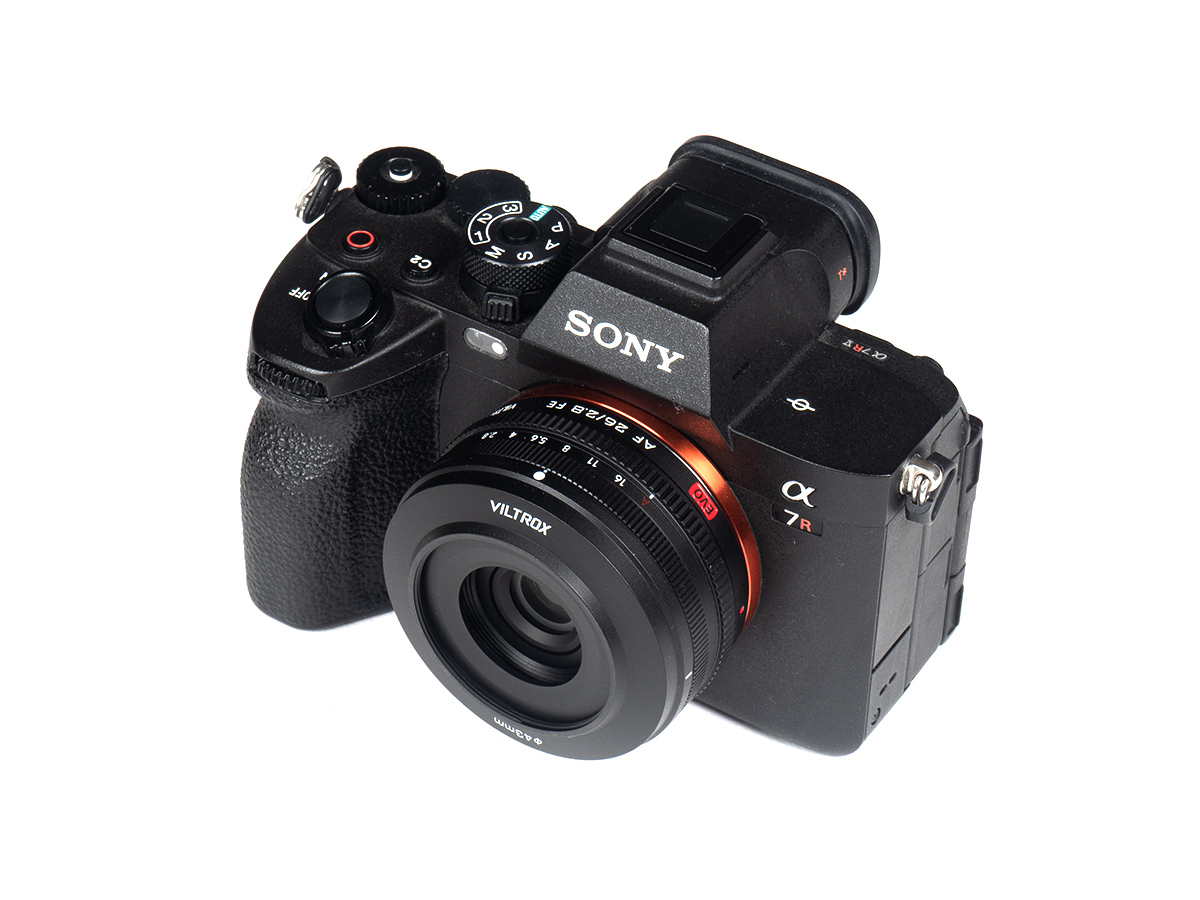
I suppose that the readers of this article will fall into two categories – one group will be bored because it’s only about a moderately fast wide-angle prime lens, and the other group is excited because it’s a member of the rare species of pancake lenses. And yours truly is in the latter group. So let’s meet the Viltrox AF 26mm f/2.8 EVO FE. The lens is available in Sony E- and Nikon Z-mount for 299USD (319EUR, 279GBP, 420CAD, 52800JPY). This is actually Viltrox’s 2nd pancake lens. The other one is the Viltrox AF 28mm f/4.5 VCM. However, the AF 26mm f/2.8 EVO is much more advanced. Namely, it is not limited by a fixed aperture.
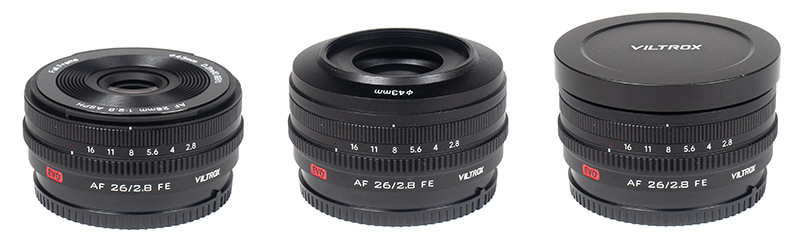
As “pancake lens” implies the Viltrox AF 26mm f/2.8 FE is as flat as they come at merely 23.8mm in height. It’s an all-metal construction. Viltrox still managed to implement not only a tiny focus ring but also a dedicated aperture ring. A small dome-shaped hood is part of the package. It has another party trick up its sleeve – it uses a magnetic snap-on front cap, and quite a strong one at that. It’s probably best to leave it on not just because it’s so tiny anyway but also because it shields the inner lens tube that can extend by about half a centimeter during focusing. In terms of weather-sealing there’s only a mount gasket – which is in line with Viltrox’s other EVO lenses.
The AF uses a conventional STM (stepping motor). It’s not the fastest around but it does the job. It’s interesting to note that the simpler AF 28mm f/4.5 VCM uses a more advanced AF motor (Voice-coil).
| Specifications | |
|---|---|
| Optical construction | 8 elements in 6 groups, incl. 1x HR, 2x aspherical HD Nano multilayer coating with water-resistant and antifouling coating |
| Number of aperture blades | 7 |
| min. focus distance | 0.2m (max. magnification 0.2x) |
| Dimensions | φ 66 × 23.8mm |
| Weight | 130g |
| Filter size | φ 43mm |
| Hood | Dome-style, screw-in, supplied |
| Other features | Aperture ring Mount gasket Magnetic front cap |
| Available mounts | Sony E, Nikon Z |
Distortions
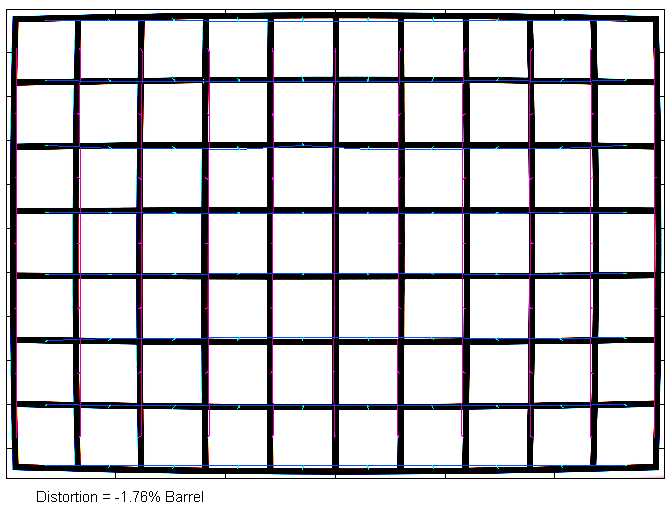
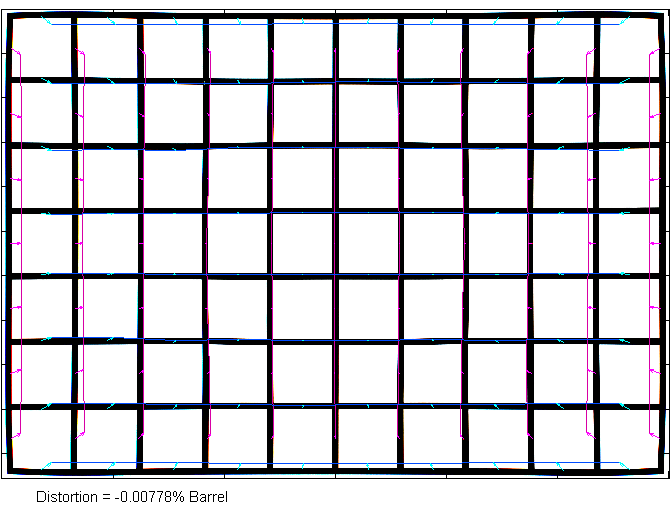
The Viltrox AF 26mm f/2.8 EVO produces a medium barrel distortion in RAW images. The lens has a correction profile which reduces the distortion in terms of the numerical result. However, it results in a wavy distortion, which isn’t necessarily better.
Vignetting
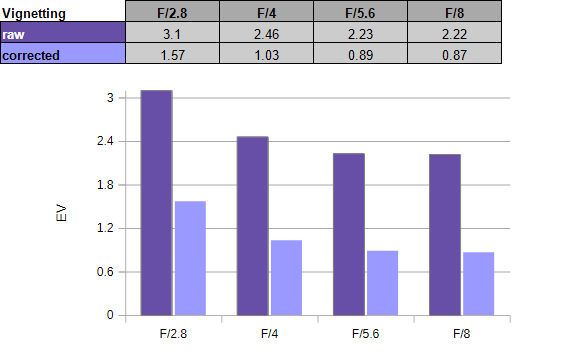
Pancake lenses are often prone to heavy vignetting – and the Viltrox lens is no different here. At f/2.8, the vignetting exceeds 3 EV (f-stops) in RAW files. Stopping down reduces this a bit, but the light falloff doesn’t drop below 2.2 EV.
Autocorrection works much better here. At maximum aperture the vignetting is reduced by 1.5 EV (f-stops) and it’s acceptable from f/4 in this case. It’s never fully gone, though.
MTF (resolution) at 42 megapixels
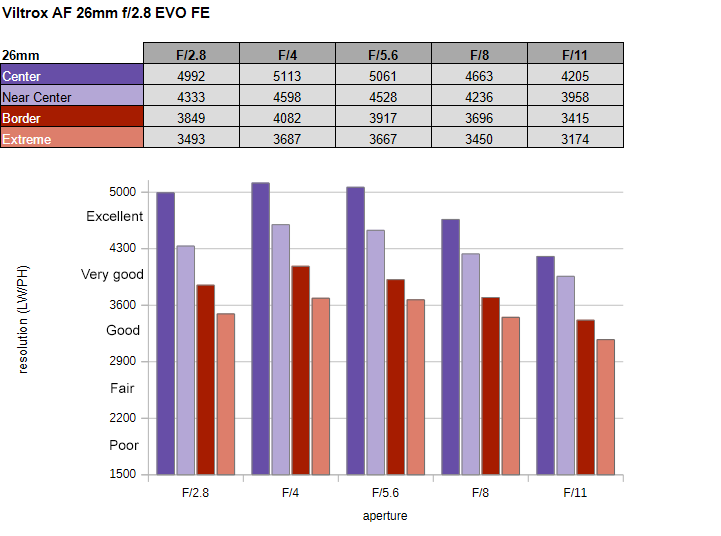
The Viltrox AF 26mm f/2.8 EVO produced decent resolution figures in the lab. This is especially true in the dead center, which is tack sharp straight from f/2.8. The near-center quality is still impressively high. The quality drops a little further at the borders and corners but the quality remains very good and good respectively. The technical peak quality is reached at f/4 which yields slightly higher results across the image field. Diffraction sets in beyond. This doesn’t really have a visible effect at f/5.6. It’s getting more relevant at f/11 and f/16 should be avoided unless really needed.
The centering of the tested sample was good. The field curvature is minor.
Please note that the MTF results are not directly comparable across the different systems!
Below is a simplified summary of the formal findings. The chart shows line widths per picture height (LW/PH) which can be taken as a measure of sharpness. If you would like to know more about the MTF50 figures, you may check out the corresponding Imatest Explanations.
Chromatic Aberrations (CAs)
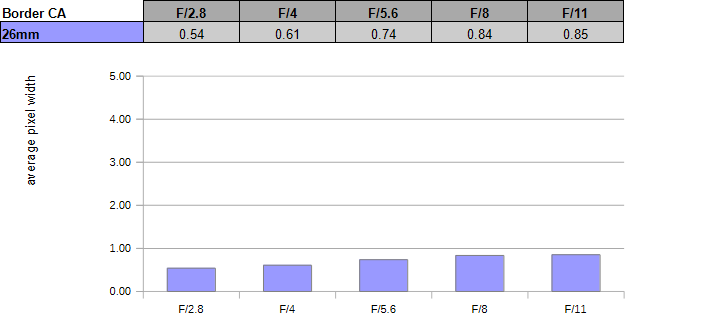
Lateral CAs are fairly low, with a peak CA pixel width between ~0.5px and ~0.8px at the image borders. They still increase somewhat in the corners, as usual.
Bokeh
A 26mm f/2.8 lens isn’t really aligned to shallow depth-of-field photography, but let’s take a brief look.
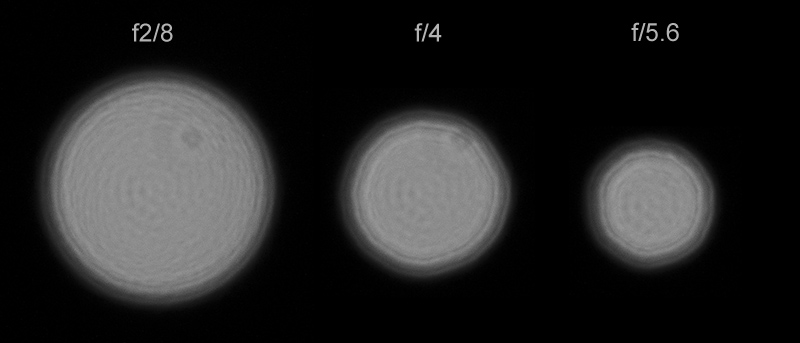
Out-of-focus highlights show an onion-like substructure (and a dust spot) and a bit of outlining at the edges. At f/2.8, the discs are circular in the image center. They are getting more edgy from f/4 already.
The background rendering is surprisingly smooth in the focus transition zone (shown to the left below). The less important foreground blur (to the right) is quite busy in comparison.

Sun Stars
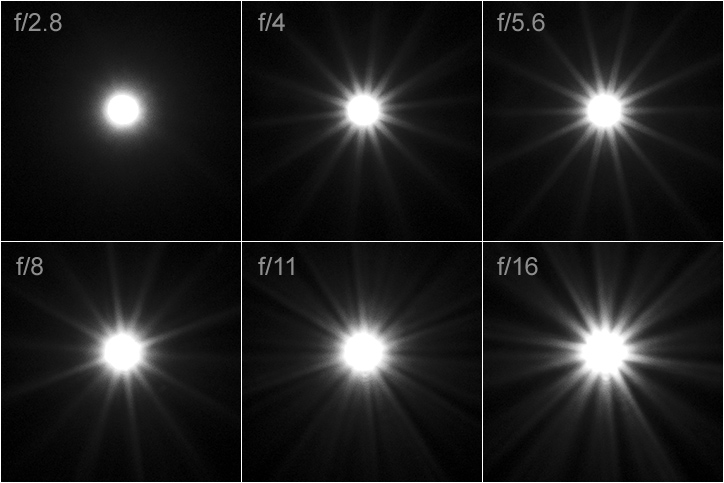
Below is a sequence of 100% cropped images from f/4 all the way up to f/16 – illustrating the sun star behavior. Sun stars are diffraction spikes from the aperture that show up if a bright light source is part of the scene (usually in night shots or if the sun is part of your scene).
The effect is underdeveloped here. As usual, there’s just a blob from the circular aperture at f/2.8. Some rays appear at f/4 already and they are more emphasized at f/5.6. Strangely, the sunstars are reduced at f/8 and f/11 – which is something that we haven’t seen before. They “come back” at f/16 although very blurry rather than pointy.
Competition
The Viltrox AF 26mm f/2.8 EVO has a couple of competitors. There’s Viltrox’s own AF 28mm f/4.5 VCM. This is smaller still, but it’s really more like a better lens cap instead of a fully capable lens. Performance-wise, it’s substantially worse. A more serious option is the Sony FE 24mm f/2.8 G. It isn’t quite as small but still pretty compact. It’s probably a tiny bit better (we haven’t tested it yet), but also 2.5x pricier. Then there is or to be precise was the Samyang AF 24mm f/2.8 FE. It has been discontinued but you may still find it here and there. It’s fairly comparable to the Viltrox lens, although the build quality is inferior.
Sample Images


There are only a couple affordable yet still cool lenses out there, and the Viltrox AF 26mm f/2.8 EVO FE is among them. The focal length may be a bit unconventional but this is surely not a showstopper if you are after a wide-angle prime lens. Optically, it performs quite well. It is extremely sharp in the image center. There's a drop in quality towards the corners but they remain good to very good at the relevant settings. The vignetting is a bit on the high side, but auto-correction reduces this to acceptable levels. Image distortions are best left untouched but they are rather moderate anyway. Lateral CAs are quite low.
The build quality is surprisingly high. It has has a metal body including the metal dome-shaped hood and the magnetic lens cap. It even has metal aperture and focus rings. The STM (stepping motor) works fine but don't expect lightspeed. There is an inner lens tube that is moving when focusing so better leave the tiny dome-shaped hood in place.
There may be slightly better wide-angle lenses out there, but none are as small and lightweight as the Viltrox AF 26mm f/2.8 EVO FE. It's ideal for street photography or if you have to pack light. Besides being a decent performer, it can also serve as a backup lens that won't take much extra space in your bag. And it doesn't cost an arm and a leg - thus it receives our "value recommendation" here.
If you are interested in this lens and like to support us, please consider purchasing it via:
* Viltrox Store (w/ a 5% discount for a short while)
* Amazon Store US
* Amazon Europe
* B&H US
The Good
- It's a pancake lens!
- Quite sharp
- Nice build quality
- Affordable
- Magnetic front cap
The Bad
- Prone to flare
- High vignetting
- Sunstars are underdeveloped
-
Optical Quality7
-
Build Quality8
-
Price Performance10