


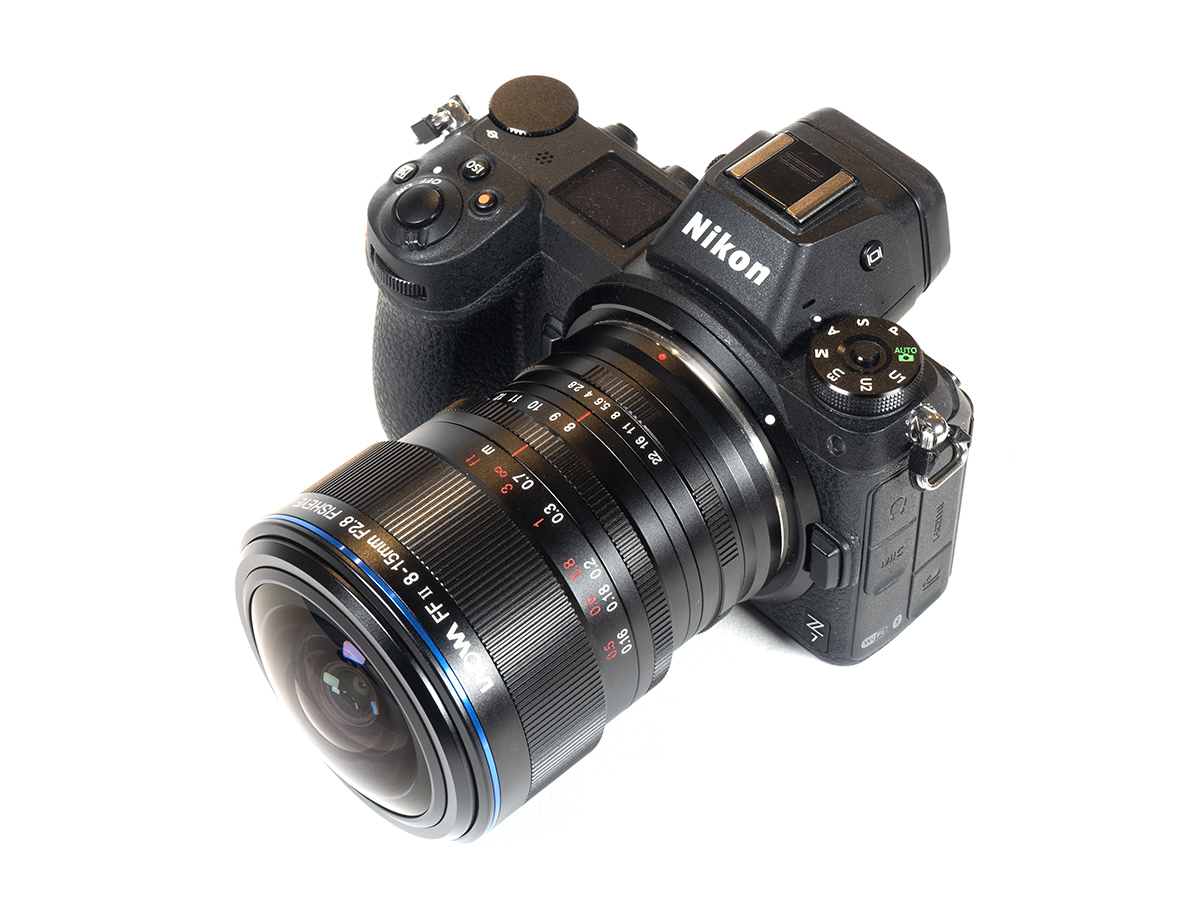
I’d like to start this review with a caveat – it is almost crazy trying to test a fisheye lens in a formal way. The image distortions are all over the place, and making readings for a software analysis is a gamble. However, every once in a while we should challenge ourselves with an impossible task, shouldn’t we? 🙂
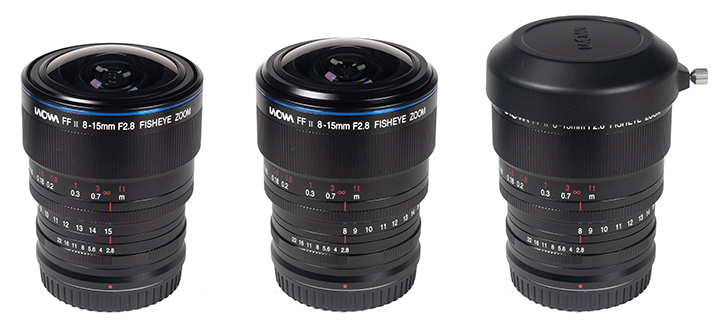
Anyway, so here’s our attempt to review the Laowa 8-15mm f/2.8 Zoom Fisheye lens. For starters, it’s not really a zoom lens in a conventional way. It’s a circular fisheye lens at 8mm and a full-frame fisheye lens at 15mm. You can tweak this by 1-2mm on either end, but the range between is really the odd zone where the image zone is cut off with some degree of black sides/corners. This “duo focal length” is typical for this kind of zoom lens, of course. The tested sample is the fully manual version without electronic coupling. It feels very sturdy due to an all-metal construction. Due to all the metal and the big glass elements, it’s not lightweight at 650g. The focus and zoom rings are very smooth. However, the zoom ring is fairly small, and you sometimes turn the (clicked) aperture ring unintentionally instead. As you can see below, the front element is protruding a little, and there’s no lens hood. The simple reason is that a lens hood would show up in your images due to the immense field of view (175°-180°). The latter is always a challenge because if you aren’t careful, your feet tend to be part of your scene as well. If you look hard, you may also notice that there’s an inner lens tube that extends a tiny bit (mostly) at the wide end of the zoom range.
It is available in all popular mounts. We’ve tested the Nikon Z version here.
| Specifications | |
|---|---|
| Optical construction | 13 elements in 9 groups (4x ED, 1x HR) |
| Number of aperture blades | 9 |
| min. focus distance | 0.16m (max magnification: ?) |
| Dimensions | φ 76.4 × 96.36mm |
| Weight | 650g |
| Filter size | – |
| Hood | – |
| Other features | Aperture ring |
| Available mounts | Sony E, Nikon Z, Canon RF, L-mount, Fujifilm GFX, Hasselblad XCD |
Distortions
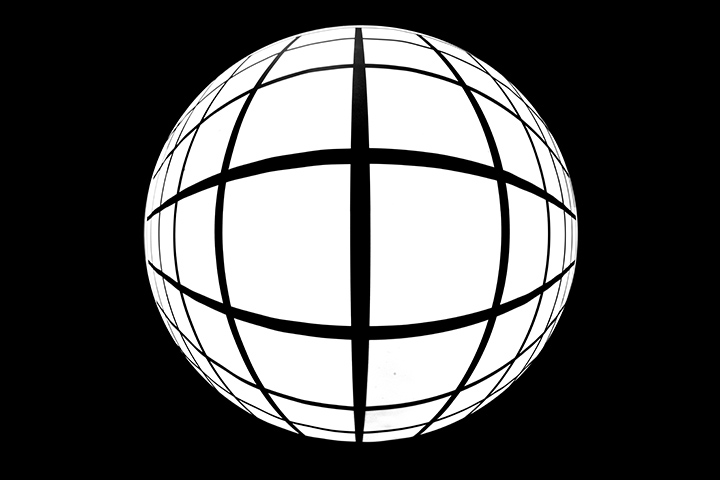
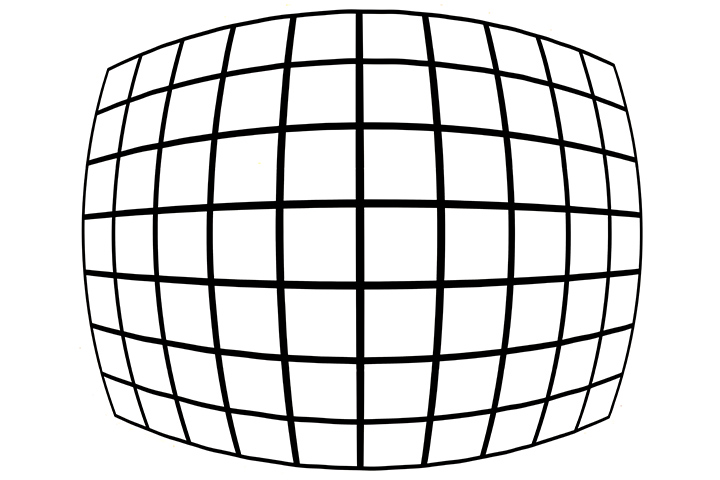
Surprise, surprise – the image distortions are insane – and beyond what the test software can put into numbers. The images below should give you an idea, though.
Note: At 15mm, I avoided vertical clipping of the grid – all the white space to the left and right is still part of the image.
MTF (resolution) at 45 megapixels
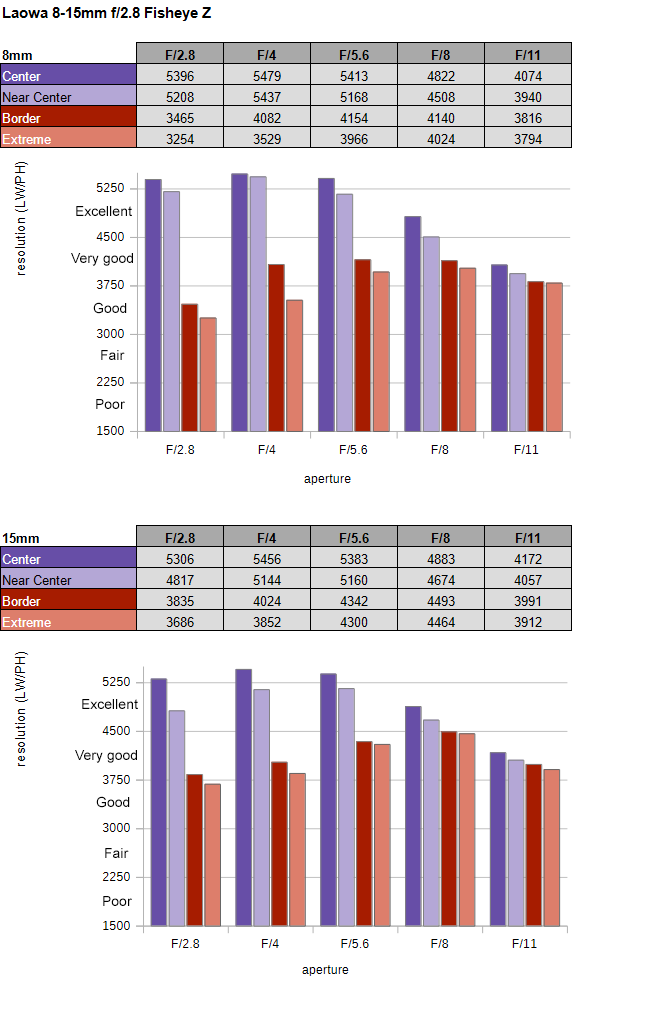
As mentioned in the introduction, you should treat the findings in this chapter as “experimental”. Taking correct readings at the borders and corners is barely possible due to the distortions and much reduced size of the test targets.
Having said this, the broader center quality is excessively sharp both at 8mm and 15mm. The border/corner quality is decent at f/2.8 and improves to a very good level at medium aperture settings. At 15mm, there appears to be a drop somewhere midfield that doesn’t show up in the charts below, though.
Field curvature and centering quality have to remain undetermined here.
Please note that the MTF results are not directly comparable across the different systems!
Below is a simplified summary of the formal findings. The chart shows line widths per picture height (LW/PH), which can be taken as a measure of sharpness. If you are keen to know more about the MTF50 figures, you may check out the corresponding Imatest Explanations.
Lateral CAs
No formal readings here this time. However, the CAs are generally very low – estimated around 0.5px at the borders. At 8mm, you can spot some color fringing effects at the edges of the image field – this is normal for circular fisheye lenses, and we’d recommend cropping the edge zone a bit during post-processing.
Sample Images


Fisheye lenses aren't everybody's darlings, but every once in a while they can be useful, and it's certainly just fun to play around with them. If you are a fan and own a full-frame fisheye lens, you may sometimes wish for a circular fisheye lens - and vice versa. And that's the value proposition of the Laowa 8-15mm f/2.8 FF Zoom Fisheye, which offers the best of both fisheye worlds here. It's pretty good optically. Images are mostly sharp across the image field. Lateral CAs are well controlled. Image distortions are extreme, but that's simply what fisheye lenses do. You can push the lens into producing flare effects, but it's no worse than with other ultra-wide lenses.
Regarding build quality, it's a tightly assembled metal tank. There's no electronic coupling, so you have to focus and set the aperture on the lens. This shouldn't be an obstacle due to the immense depth of field. Remember to turn off your camera's IBIS because an 8-15mm fisheye lens is different from a conventional ultra-wide-angle lens. Also double-check the exposure results at 8mm because much of the image is simply pitch black, which can fool your camera's metering system.
At $699, the Laowa 8-15mm f/2.8 FF Zoom Fisheye is not a cheap lens in absolute terms, but it is still reasonably priced because you are getting the two fisheye types combined in a single lens. And just for comparison - the Canon RF 7-14mm f/2.8-3.5 L Fisheye STM costs almost three times as much.
The Good
- Combines circular and full-frame fisheye effects
- Good optical quality
- Nice build quality
The Bad
- No electronic coupling
- It's a bit heavy for a lens that you may only use occasionally
-
Optical Quality7
-
Build Quality8
-
Price / Performance8