


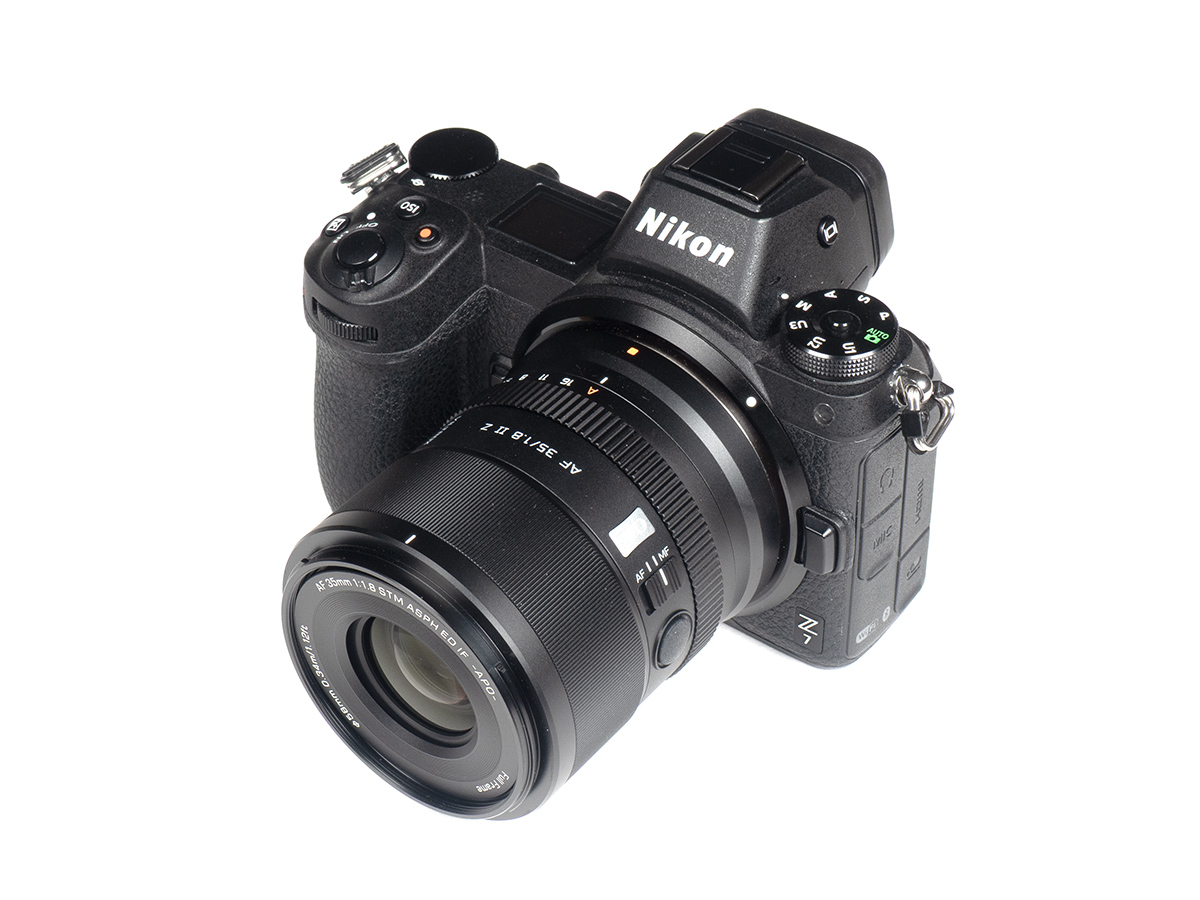
The Viltrox AF 35mm f/1.8 EVO is the 3rd EVO lens by Viltrox. And given that the 85mm f/2 EVO and 55mm f/1.8 EVO performed nicely, this raises some expectations. As usual, the 35mm f/1.8, available in both Nikon Z and Sony E-mount, is competitively priced at 395 USD / 459 EUR / 385 GBP/ 579 CAD /73,100 JPY, although this does represent a price hike of ~100 USD over the 85mm f/2 EOV. Technically, this is a second-generation lens, which is also printed as such on the lens. The mark I has a very different optical design, and it wasn’t a designated “EVO” lens either. Viltrox claims that this new lens uses an APO (“Apochromatic”) design, which is also printed on the front ring (“AF 35mm f/1.8 STM ASPH ED IF -APO-“).
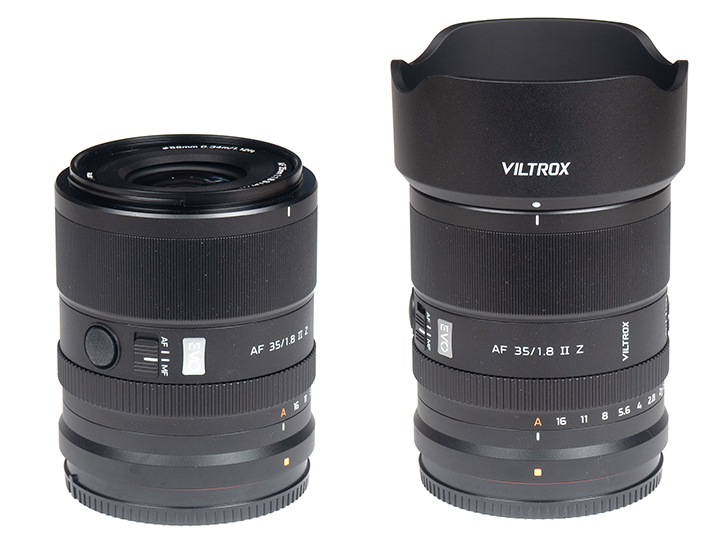
The build quality is in line with what we’ve seen with the other EVO lenses. The lens body is made of metal, including the very smooth focus ring and the de-clickable aperture ring. It also features a very clicky customizable Fn-button. In terms of weather-sealing, there’s just a mount gasket. A petal-shaped lens hood is part of the package.
The 35mm f/1.8 uses an STM motor for internal focusing—thus the lens does not extend during focus operations. While this isn’t the latest and greatest motor type, it works fine regarding both speed and quietness.
| Specifications | |
|---|---|
| Optical construction | 13 elements in 10 groups (1x aspherical, 2x ED, 3x HR) |
| Number of aperture blades | 9 |
| min. focus distance | 0.34m (max magnification: 0.1x) |
| Dimensions | φ69 × 78mm |
| Weight | 350g |
| Filter size | φ58mm |
| Hood | barrel-shaped (bayonet mount, supplied) |
| Other features | Aperture ring (de-clickable) Fn custom button Firmware updates via USB-C/Bluetooth Mount gasket |
Distortions
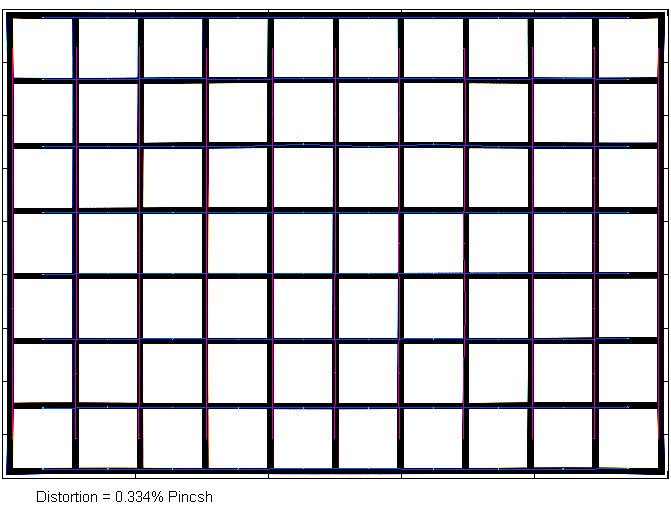
The lens produces a native image distortion of ~0.3% pincushion-style. This is very low and can be ignored. Auto-correction didn’t make a difference, nor is it necessary in this case.
Vignetting
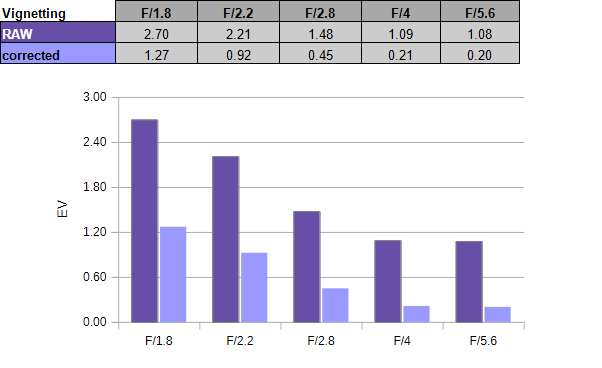
The vignetting characteristic is quite typical for a lens in this class. At f/1.8, there’s a very noticeable light falloff of 2.7 EV (f-stops). This has eased substantially at f/2.8. However, it never really disappears, with vignetting of just over 1 EV thereafter.
Auto-correction does make a substantial difference here with a reduction of 1.5 EV (f-stops) at f/1.8. In practical terms, the vignetting is mostly gone from about f/2.8.
MTF (resolution) at 45 megapixels
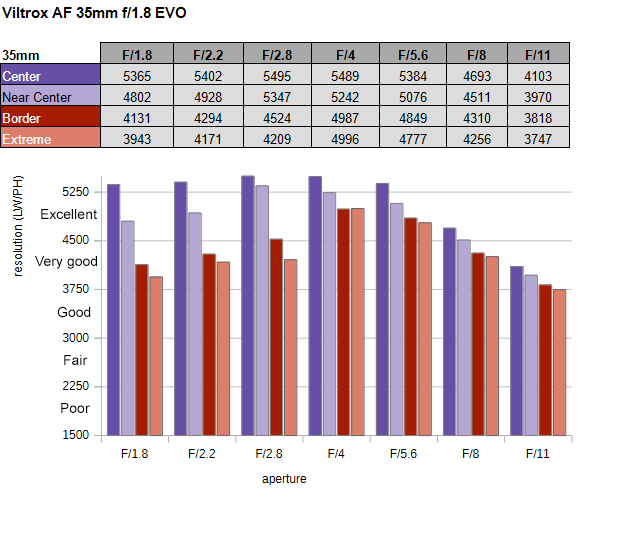
The Viltrox AF 35mm f/1.8 EVO produced very impressive resolution figures in the lab – something to get used to with Viltrox lenses, it seems. The dead center quality is nothing short of outstanding straight at f/1.8. There is a drop in quality the more you look towards the edges, but even the extreme corners maintain very good results. Stopping down to f/2.2 doesn’t change much. At f/2.8, the broader center goes stratospheric, and there’s a slight improvement in the outer image field. The quality is best at f/4, with superb quality across the image field. As is so often the case, diffraction is a limiting factor beyond f/5.6, with a higher impact from f/11.
The centering quality of the tested sample was good. The field curvature is quite flat.
Please note that the MTF results are not directly comparable across the different systems!
Below is a simplified summary of the formal findings. The chart shows line widths per picture height (LW/PH) which can be taken as a measure of sharpness. If you are keen to know more about the MTF50 figures, you may check out the corresponding Imatest Explanations.
Chromatic Aberrations (CAs)
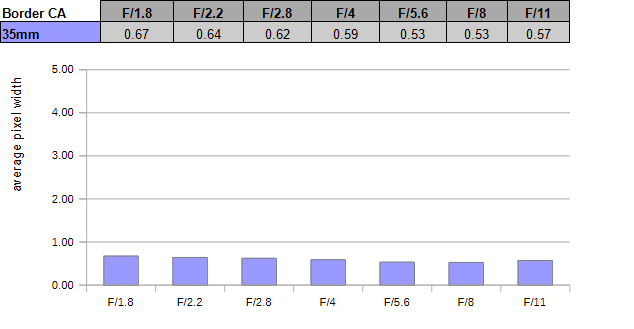
Lateral CAs are low, with an average pixel width around the 0.6px mark at the image borders. That’s usually nothing to worry about, and a good RAW converter should be able to handle this with ease.
Bokeh
The AF 35mm f/1.8 is a moderate wide-angle lens, so the bokeh is often not very pronounced unless you shoot at fairly close distances. Regardless, let’s take a look.
Out-of-focus highlights are nicely rendered near the image center with virtually no outlining and an almost clean inner zone of the discs. The circular shape is maintained up to f/2.8. There’s just a hint of edginess from the aperture shape creeping in at f/4.
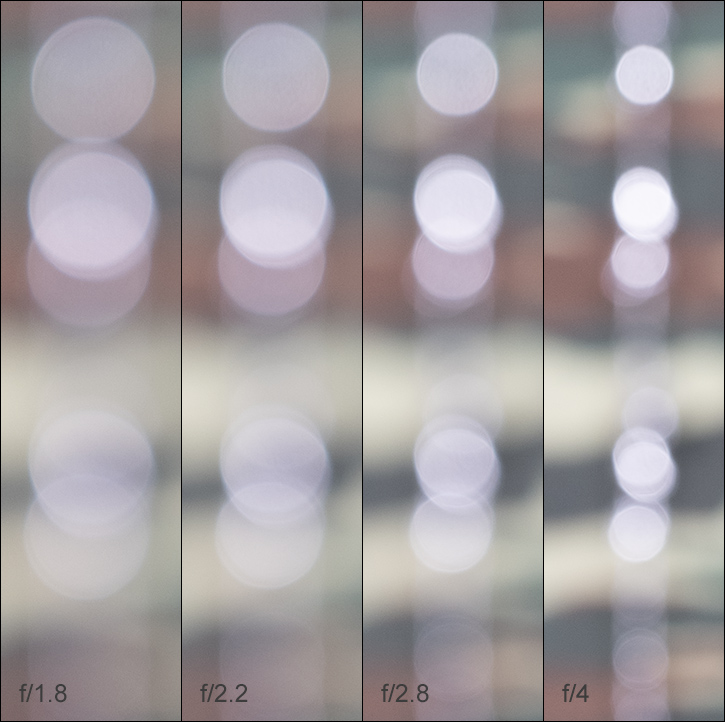
As so often, the highlights deteriorate to “cat eyes” the more they are positioned towards the borders/corners – this is a mechanical effect related to the size of the front opening of a lens. This is most obvious at maximum aperture. Stopping down to f/2.8 restores the circular shape across the image field.




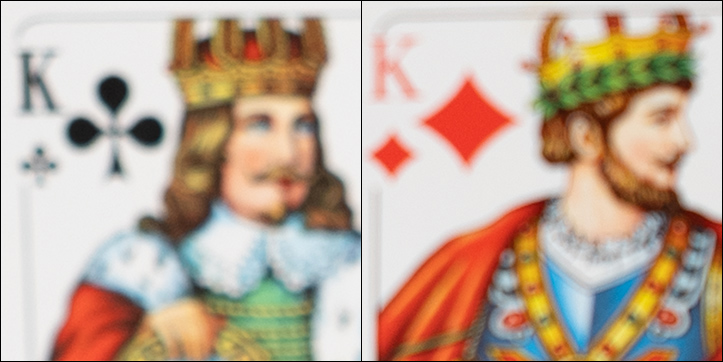
The blur in the focus transition zone is quite smooth in the image background (shown to the left below) and slightly “shadowy” in the less important foreground (to the right). The blur is quite contrasty again. We’ve seen this in our review of the 55mm f/1.8 EVO already.
Bokeh Fringing / LoCA
LoCAs, or bokeh fringing, is a color fringing effect on the Z-axis. It shows up with a purplish tint in front of the focus point and a greenish tint behind – and it’s nearly impossible to fully correct in post.
As hinted above, Viltrox claims an apochromatic correction of all color fringing. We wouldn’t go so far as confirming it this time (unlike on the 55mm f/1.8 EVO). At f/1.8, you can spot some color fringing in the transition zones. It’s not overly pronounced though – and far less than on the Nikkor Z 35mm f/1.8 S (…). The fringing is mostly gone from f/2.8 already.




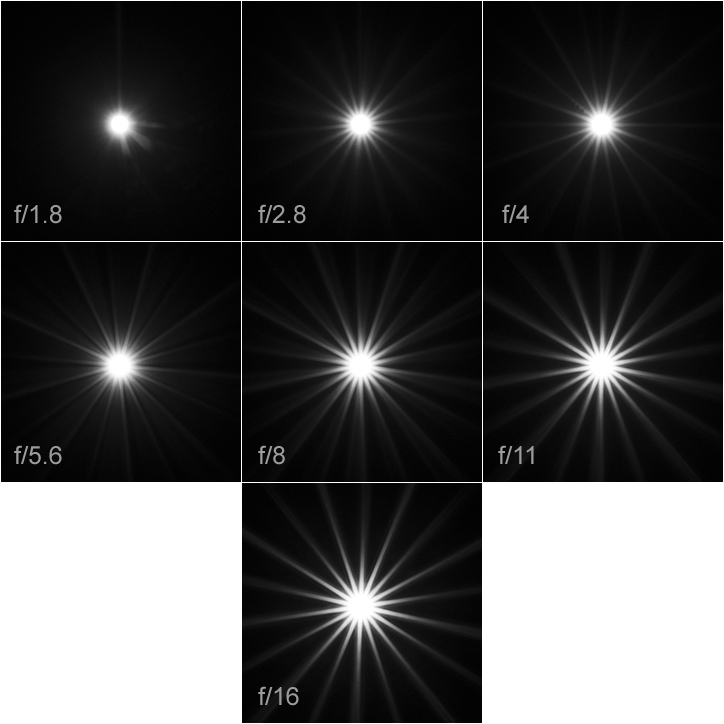
Sun Stars
Sunstars are caused by diffraction spikes at the edge where two aperture blades meet. They occur at spotlights such as streetlights or, in our test cases, using a bright LED.
The aperture is fully circular at f/1.8, so a pointy light source is just a “blob” here. However, rays appear already at f/2.8, but they are only really pronounced from f/8 onward, with the best results at f/11 and f/16. The rays are nicely “pointy” (rather than fan-like) – although there are many of them (18) due to the 9 aperture blades.
Competition
There are several 35mm lenses available in Nikon Z-mount, with some affordable options. The direct competitor is certainly the Nikkor Z 35mm f/1.8 S. Despite the “S” designation, we’d rate this as inferior to the Viltrox AF 35mm f/1.8 EVO. It’s not quite as sharp at large apertures, and axial CAs are quite heavy – and that’s at more than twice the price tag. Nikon also offers two variants of the 40mm f/2. They are more compact, which has its own appeal, of course. But they aren’t any better, either.
If you aren’t into clinical performance, there’s the Nikkor Z 35mm f/1.4, which follows a more vintage-style design philosophy. It won’t be quite as sharp, but the bokeh may have some more “character” (dreamy) to it.
And then, there’s the usual bunch from Meike, Yongnuo, TTArtisan, 7Artisans, or Brightin Star. Given the performance of the Viltrox lens, it seems unlikely to find a better option here.
Sample Images


It's almost getting boring - another Viltrox lens, another excellent performer. The Viltrox AF 35mm f/1.8 EVO produces great center quality straight from f/1.8, and the borders/corners aren't a slouch, either. At medium aperture settings, it even reaches greatness. Image distortions are very low, and vignetting is nicely auto-corrected. Lateral as well as axial CAs are low, although we wouldn't sign off on the APO claim yet here. The quality of the bokeh is pretty good for a moderately wide-angle lens.
In terms of build quality, the 35mm f/1.8 EVO stays true to what we've seen from other EVO lenses. The tightly assembled metal body feels very sturdy, and there's at least a mount gasket to help against the elements. The AF works just fine and silently.
Overall, another easy value recommendation.
The Viltrox AF 35mm f/1.8 EVO can be purchased via
* Viltrox Store (First release 5% off)
* Adorama
* Amazon
* B&H
The Good
- Very sharp
- Great build quality
- Excellent value
The Bad
- Max magnification of 0.1x isn't overly impressive
-
Optical Quality8.5
-
Build Quality8
-
Price / Performance10