


Introduction
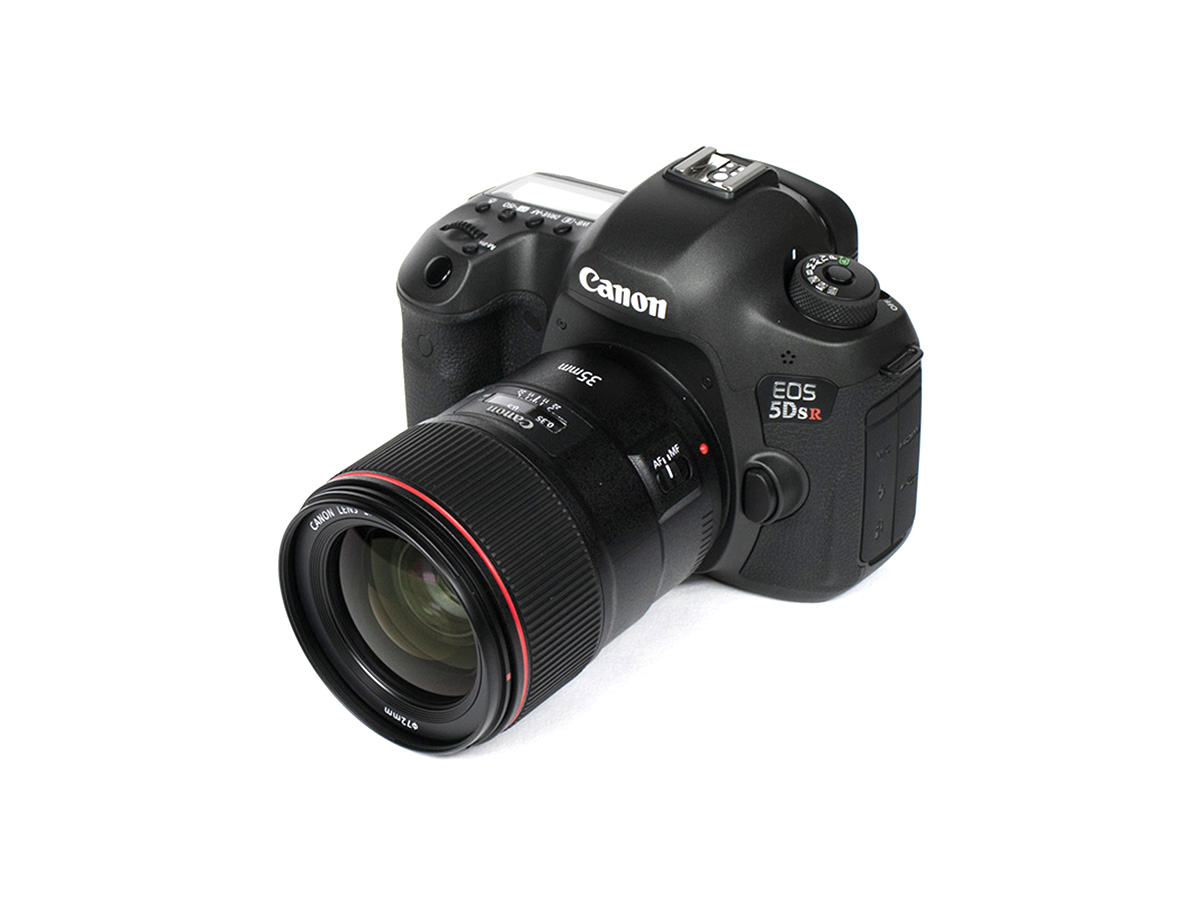
Eventually all good things must go and this time it has hit the Canon EF 35mm f/1.4 USM L. Released back in late 1998, it has been along for the ride for quite some time. However, lately Canon was starting the feel the heat namely from the Sigma 35mm f/1.4 DG HSM Art and the Tamron 35mm f/1.8 Di VC so here we go again with a refreshed version … let’s welcome the new Canon EF 35mm f/1.4 USM L II. Obviously a member of the “Luxury” (L) league, it is primarily targeting professionals. Canon seems to think that money is no issue in this case because the pricing has been lifted to new heights as well. At 1800US$/2000EUR, it is probably beyond a price point where the fun ends for most mortals nowadays.
The most significant new feature in this lens is Canon’s new BR or “Blue Spectrum Refractive” element. To cite Canon: “The optical element offers characteristics that significantly refract blue light to achieve what the developer is calling “impressive levels of (axial) chromatic aberration correction”. Canon also applied its new fluorine coating to repel dust and smearing on the front and rear elements. The new SWC (sub-wavelength coating) on the rear surfaces of the first two highly curved elements is meant to reduce flare. We’ll see whether all this can make a difference… and justify the price tag.
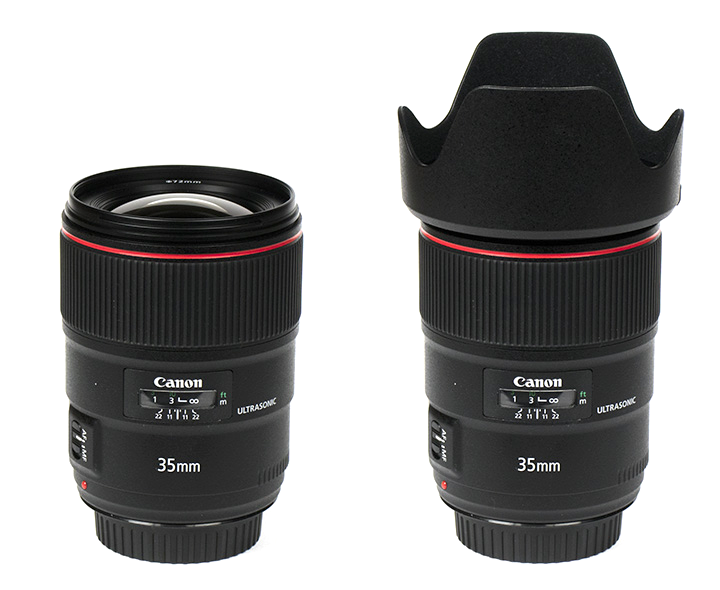
If you know the old lens, you will notice that the mk II is quite a bit longer (2cm) and also heavier (180g). This is promising to some degree – bigger tends to be better after all. Whether you appreciate this in your lens bag may be a different story though. Typical for such professional grade lenses it is beautifully crafted based on a metal body and high quality plastics. Canon also claims to have improved the weather sealing compared to the mk I version. The very broad, rubberized focus ring has a smooth action. The size of the lens remains constant regardless of the focus setting. A deep petal-shaped hood is included.
As usual Canon used its Ring-type USM AF in this lens. While it is certainly near-silent, we think that the AF speed is slightly reduced albeit still fast. Full-time manual (FTM) focusing is, of course, always possible in One-Shot AF mode.
| Specifications | |
|---|---|
| Optical construction | 14 elements in 11 groups (1xBR, 2x aspherical, 1xED) SWC coating fluorine coating |
| Number of aperture blades | 9 (rounded) |
| min. focus distance | 0.28m (max. magnification ratio 1:4.75) |
| Dimensions | 80 x 106mm |
| Weight | 760g |
| Filter size | 72mm |
| Hood | petal-shaped (bayonet mount, supplied) |
| Other features | weather sealing |
| Mounts | Canon EF |
Distortion
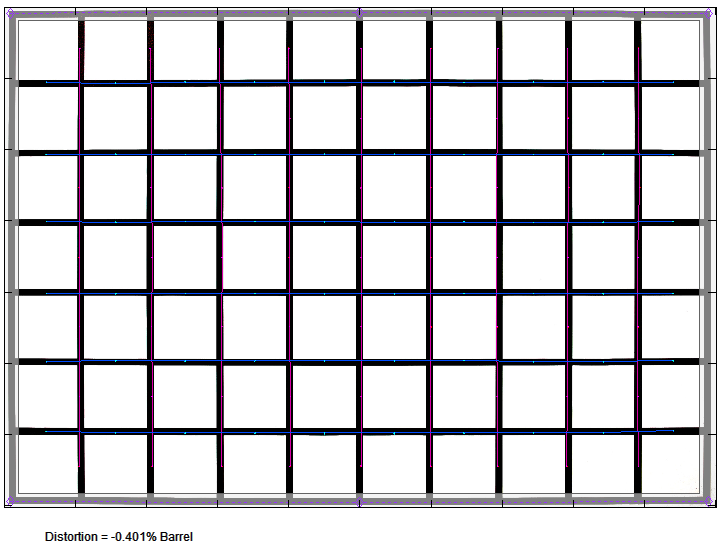
Let’s start with the simple things – distortions. No issues here really. A barrel distortion of just 0.4% is pretty much irrelevant in most situations.
Vignetting
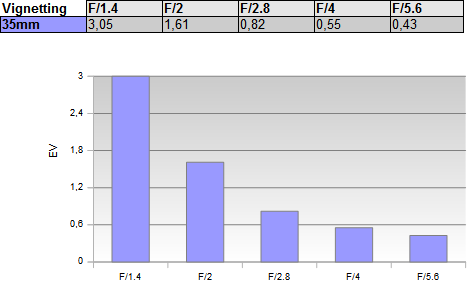
Very fast lenses usually suffer from pronounced vignetting at large apertures, and the new Canon lens is no exception to this rule here. Wide open, there is a hefty amount of light fall-off (3EV) towards the corners. As usual, stopping down reduces the amount of vignetting considerably. At f/2.8, vignetting is down to moderate levels and from f/4 onward it should no longer be an issue for most subjects. Still the lens isn’t that special here.
MTF (resolution at 50 megapixels)
The lens delivered somewhat mixed results in the lab. In the image center, the quality is nothing short of breathtaking even at f/1.4. At f/2-f/2.8, it may even be able to outperform the 50mp monster sensor used in the EOS 5Ds R (used for testing). The lens can’t combat the laws of diffraction which are getting more pronounced from f/8 onward. The outer image region is a different story though. At f/1.4 and f/2 they are somewhat soft although you should keep in mind again that this is at 50mp. The resolution reaches good levels at f/2.8 and it’s scratching at the very good mark at f/8. The level of contrast is very high from f/1.4 to f/11.
The field curvature is very low so the slight softness isn’t emphasized any further at large apertures.
Please note that the MTF results are not directly comparable across the different systems! Below is a simplified summary of the formal findings. The chart shows line widths per picture height (LW/PH) which can be taken as a measure of sharpness. If you would like to know more about the MTF50 figures, you may check out the corresponding Imatest Explanations.

Chromatic Aberrations (CAs)
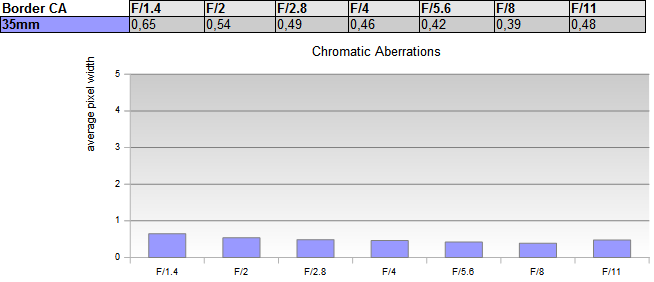
Chromatic aberrations (color shadows at harsh contrast transitions) are very well controlled showing readings below an average pixel width of 0.5px at the image borders.
Bokeh
One of the primary usage scenarios for a large aperture lens is to separate the main subject from the background. In such an image the quality of the bokeh (out-of-focus blur) is of major significance. The Canon lens delivers a quite smooth bokeh for a wide-angle prime but like most wide-angle lenses it is not perfect here.
Out-of-focus highlights are nicely rendered in the center zone. They show a slight outlining effect at f/1.4 but this effect is gone when stopping down to f/2 already. The inner zone of the highlight disc is smooth with only marginal traces of sub-structures.
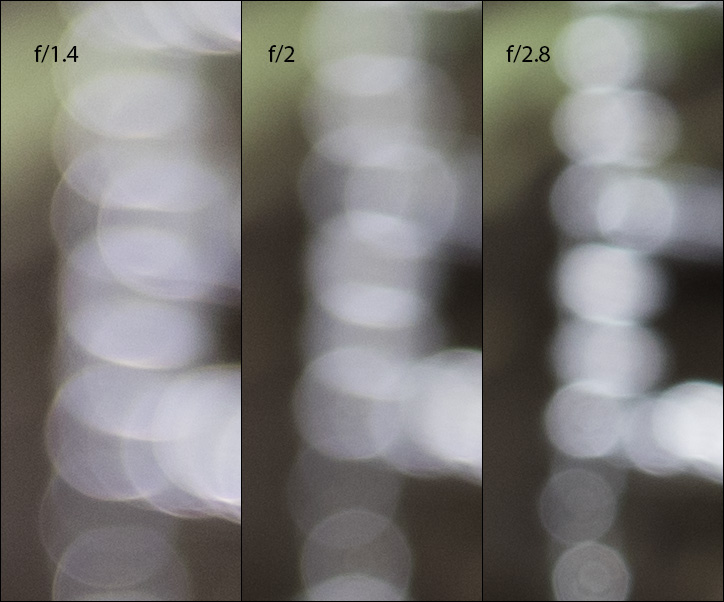
However, even this mighty Canon lens isn’t capable of delivering circular highlight discs at the image borders. Below is an example of “cat’s eyes” taken at the bottom of the image (middle section). This is a vignetting effect that dissolves the more you stop down.

The foreground is quite buttery whereas the more critical image background is somewhat more harsh when it comes to contrast transitions.

Bokeh Fringing / LoCA
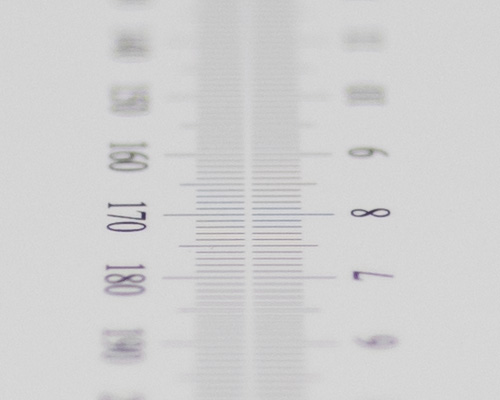
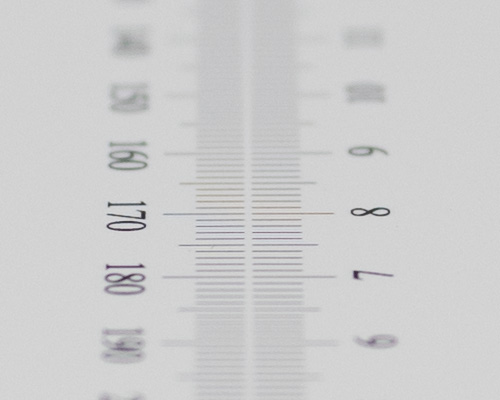
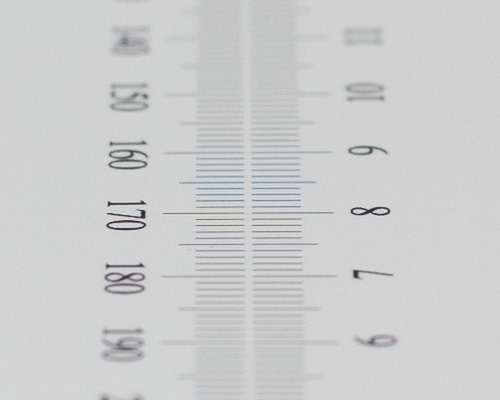
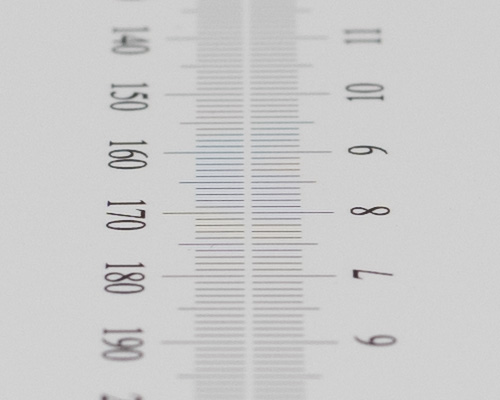
As mentioned in the introduction, Canon uses a “BR” element to reduce axial chromatic aberrations in the EF 35mm f/1.4 USM L II. Bokeh fringing effects are normally a largely unresolved issue – also because they are very difficult to remove during post processing. The good news is that this BR element does make a difference here. You can still spot some purple halos in the front of the focus point and green ones beyond but they are certainly reduced significantly.
In addition, these shots illustrate a focus shift towards the rear the more you stop down. Since the focus point doesn’t really lose its focus, it’s not really significant enough to show up in most images though.
Sample Shots


The Canon EF 35mm f/1.4 USM L II is certainly an improvement over its predecessor but it's not a new world wonder either. Resolution-wise it is tack sharp in the image center. At f/2-f/2.8 it is pushing the 50mp sensor of the Canon EOS 5Ds R to its limits. However, the borders aren't quite so hot especially at large apertures. To be fair though - at large apertures you don't tend to require sharp corners anyway and unless you super-size your posters, it's not that significant. Most users are also using full format cameras with a much lesser resolution. Still, we are seeing the limits of what's possible today. Lateral as well as axial CAs are very low and this certainly helps to push the subjective quality perception. Image distortions are pretty much absent. While it is typical in this lens class, we have to mention that there's some heavy vignetting at f/1.4. The quality of the bokeh is quite good. The image background could be a bit smoother. Out-of-focus highlights are generally nicely rendered except in the outer image regions. A real differentiator is the reduced amount of bokeh fringing which is pretty much better than anything in this class in this respect.
The build quality of the Canon EF 35mm f/1.4 USM L II is pretty much perfect. Top-notch materials, weather sealing, smooth control rings - it doesn't really get any better than this. The USM AF is silent and fast but the competition is pretty much on the same level nowadays. Speaking of the competition we are primarily talking about the Sigma 35mm f/1.4 DG HSM Art. Now we haven't tested this lens on the EOS 5Ds R yet but at least in terms of resolution we are having some strong doubts that it is inferior to this new Canon lens. The Canon is somewhat better in terms of bokeh though. Whether the latter is really worth the double price tag... well, for some it surely is.
-
Optical Quality
-
Build Quality
-
Price / Performance