


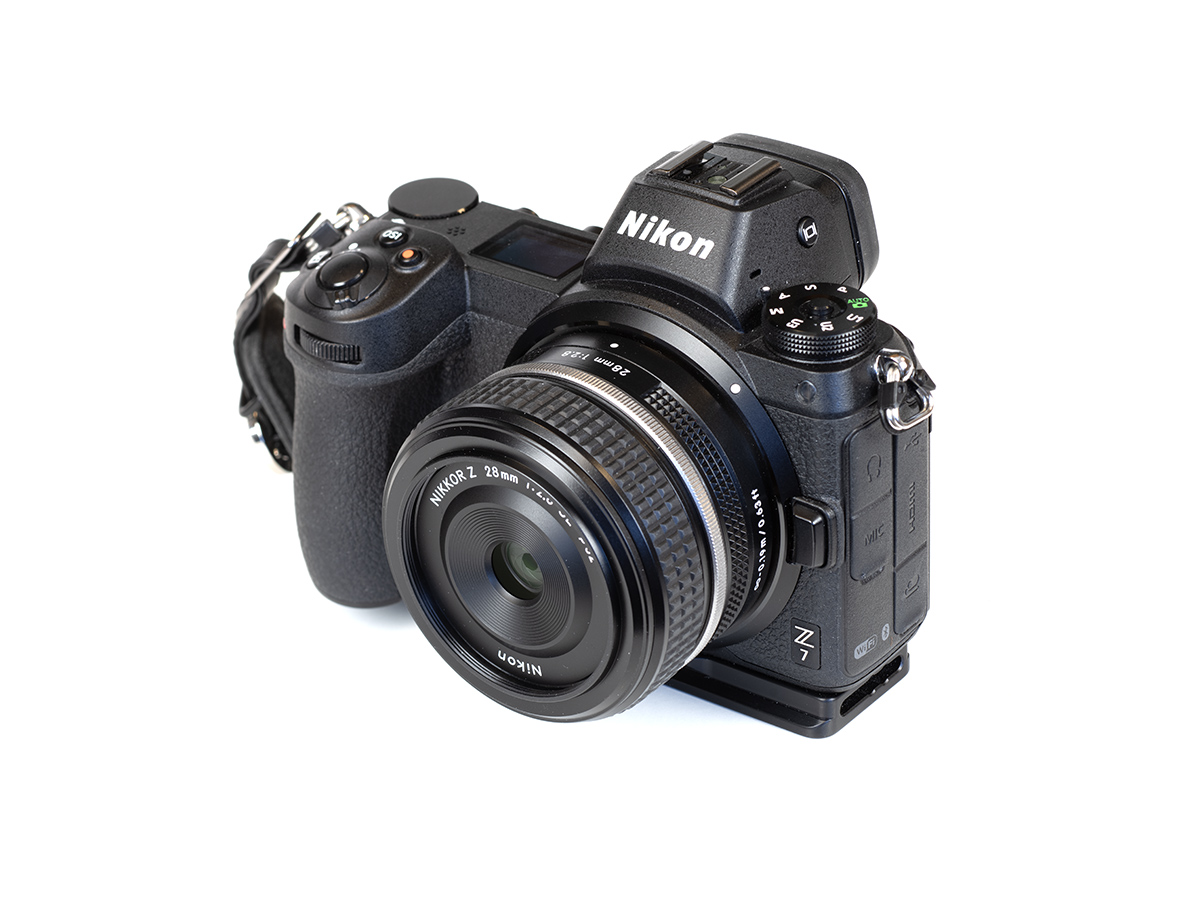
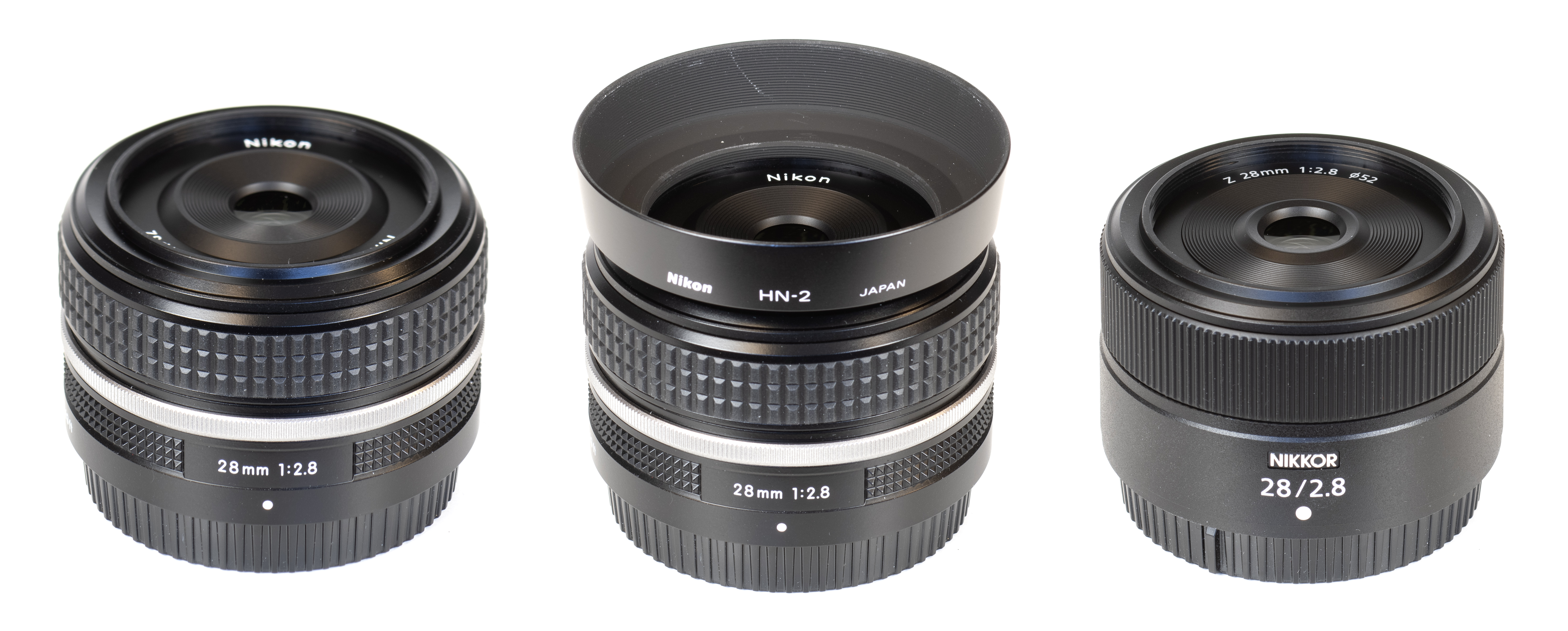
The Nikkor Z 28mm f/2.8 is another budget prime lens in Nikon’s lens lineup. It very much resembles the Nikkor Z 40mm f/2 that we reviewed just before this one. Similarly, it is available in two different flavors: with a modern-style look as shown below or as SE (“Special Edition”) which mimics the design philosophy of the “classic” Nikon era. The somewhat more elegant SE variant (shown in the left below) costs a little more – just over $300 USD – compared to the standard version at circa $230 USD. Once again, the difference is purely cosmetic and the optical system is the same. It’s a full-format lens and thus, a wide-angle prime lens.
The Nikkor has an all-plastic construction including the mount. It doesn’t feel overly premium but this cannot be expected at this price point. However, Nikon still managed to incorporate some degree of weather sealing. The Z 28mm f/2.8 is a simple thing. In terms of controls there’s just the control/focus ring. It lacks an AF/MF button. A lens hood is not included. The product image below shows the screw-in type HN-2, but Nikon doesn’t specify a dedicated lens hood.
The lens uses a stepping motor (STM) for autofocusing. It works fairly quickly and quietly.
| Specifications | |
|---|---|
| Optical construction | 9 elements in 8 groups (2x aspherical) |
| Number of aperture blades | 9 (rounded) |
| min. focus distance | 0.19m (max. magnification: 0.2x) |
| Dimensions | 70 x 43mm |
| Weight | 155g |
| Filter size | 52mm |
| Hood | optional |
| Other features | control ring dust- and drip-resistant |
| Mounts | Nikon Z |
Distortion
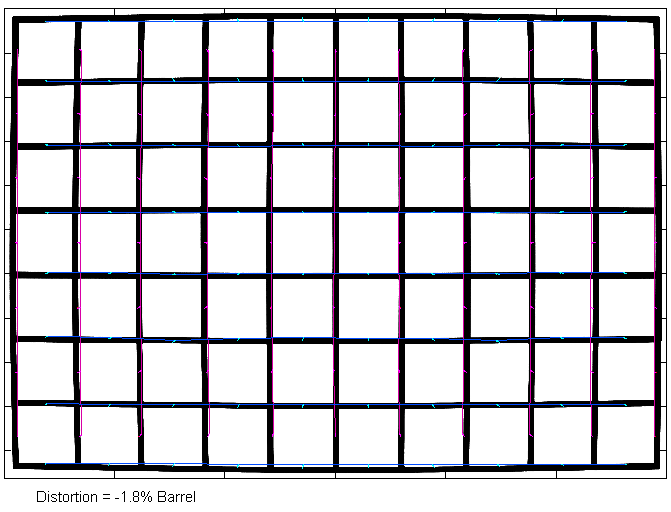
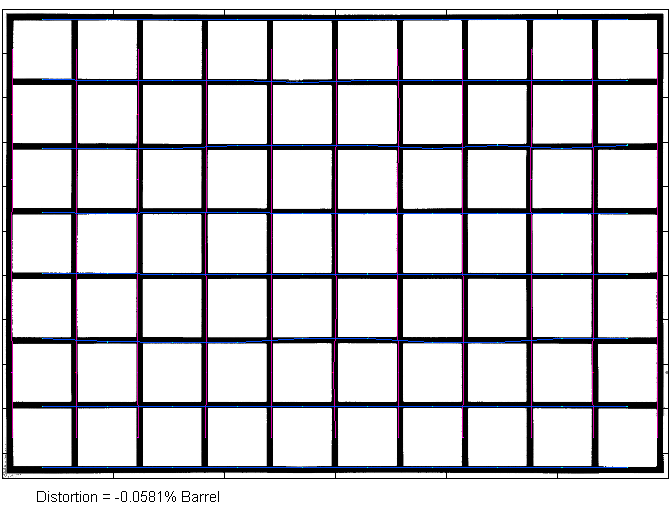
The Nikkor Z 28mm f/2.8 produces only a medium degree of barrel distortion in RAW images. This is nothing to worry about with activated autocorrection.
Vignetting
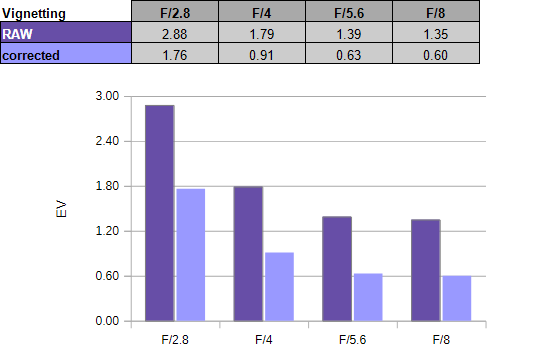
The RAW vignetting is very high at f/2.8, reaching 2.9 EV (f-stops) at f/2.8. Stopping down to f/4 reduces this by more than 1 EV (f-stop). However, the light falloff can still be very visible at f/4 and f/5.6 in certain scenes.
Activated autocorrection helps although a vignetting of 1.8 EV (f-stops) is still not glorious at f/2.8. Some vignetting remains at f/4. By real-life standards, the issue is mostly gone from f/5.6.
MTF (resolution at 45 mp)
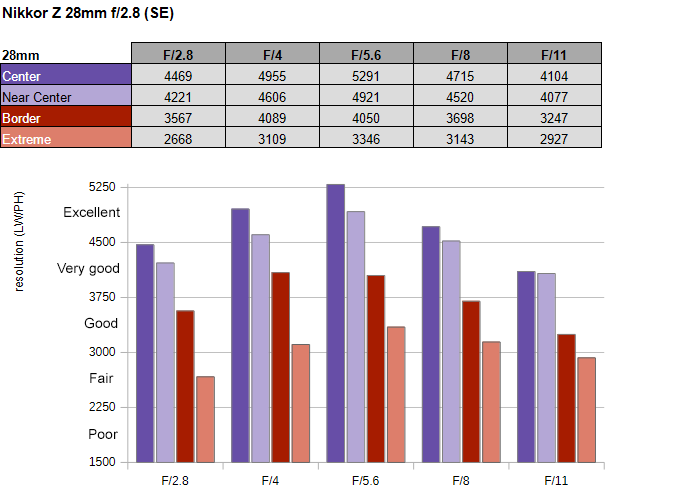
Prime lenses should be superior to zoom lenses but this isn’t really the case here – just like with the Z 40mm f/2. The broader center quality as well as the borders are actually very decent at f/2.8. However, the quality tanks in the image corners where softness becomes an issue. Stopping down gradually improves the results with the peak quality reached at f/5.6 The center quality is superb here and the corners deliver good results. As usual diffraction sets in from f/8 and more softness is visible from f/11.
Please note that the MTF results are not directly comparable across the different systems!
Below is a simplified summary of the formal findings. The chart shows line widths per picture height (LW/PH), which can be taken as a measure of sharpness. If you would like to know more about the MTF50 figures, you may check out the corresponding Imatest Explanations.
Chromatic Aberrations (CAs)
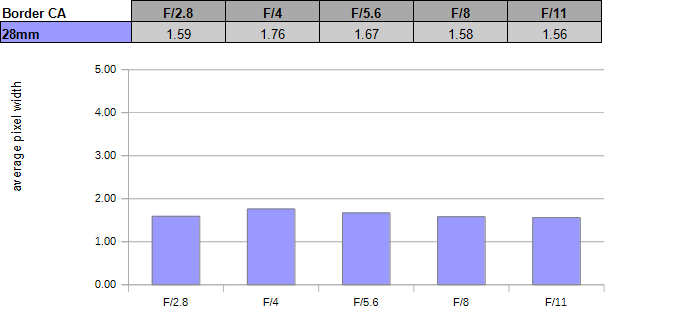
Lateral CAs are slightly on the high side throughout the aperture range. They reach a pixel width of around ~1.6px at the image borders. However, autocorrection should handle this, so you don’t have to worry about this.
Competition
There are a couple of alternatives to the Nikkor Z 28mm f/2.8. The most interesting option is the Viltrox AF 26mm f/2.8 Z EVO. It’s better optically and mechanically and smaller, too. Although in all fairness, the AF motor isn’t as refined as on the Nikkor. There’s also the Nikkor Z 26mm f/2.8 which is a pancake lens just like the Viltrox AF 26mm f/2.8 Z EVO. We haven’t tested it locally but the Z 28mm f/2.8 seems to have a slight edge if we can believe other sources.
Sample Images
Some vistas of countryside Germany here rather than the usual sights of Australia.


The verdict is a bit of a déjà vu if you followed our review of the Nikkor Z 40mm f/2. The Nikkor Z 28mm f/2.8 is not a bad lens but a prime lens should be better than this. Optically, it's very good in the image center and the borders are fine as well. However, the corner quality disappoints especially at f/2.8. Autocorrection helps address the other optical flaws although the underlying native quality isn't great regarding vignetting and lateral CAs.
The build quality is once again a reflection of its price point. It does the job, of course, but the lens body is an all plastic design down to the mount. It is, however, commendable that Nikon still implemented some weather sealing and the AF is actually pretty good.
The Z 28mm f/2.8 will probably not find its way onto many high-megapixel Nikon cameras so that's something that we have to keep in mind here. It'll perform quite nicely on 24-megapixel cameras. Even so, it's nothing special, really.
If you'd like to support our work, please consider shopping for this or other lenses via one of the following partners:
* Amazon (US)
* B&H (US)
* Adorama (US)
The Good
- It's cheap
The Bad
- Optically mediocre for a prime lens
- Plasticky construction
-
Optical Quality5
-
Build Quality5
-
Price Performance5