


The popular Canon EF 24-105mm f/4 USM L IS has been with us for more than 10 years – that’s quite an achievement even for a rather long-lived lens. However, even the longest marathon has to end and Canon finally thought it was time for an update – unsurprisingly they named it … tada … the Canon EF 24-105mm f/4 USM L IS II. Following the recent trend, the new lens added a little bit extra weight as well as size which is a good sign at least in terms of potential performance – bigger tends to be better in lens land. Unfortunately the lens also takes part in another trend – a price hike. At least in Europe, the mk I is/was comparatively affordable at “just” around 800 EUR, and it was even cheaper when purchased as part of a camera kit. The mk II is priced at 1100US$/1300EUR although this will come down a little over time as usual.
Canon L class lenses are aligned to professional use and this also applies to the EF 24-105mm f/4 USM L IS II. That being said, it doesn’t seem to be fully made of metal as you might expect at least. The inner lens tube seems to be made of plastic and we’ve got the impression that this is also applies for parts of the outer body. Still the quality perception is on a very high level and the weather sealing provides some additional peace of mind as well. Like most of its fellow standard zoom lenses, it extends when zooming towards the tele end. However, the inner lens tube shows no wobbling even when fully extended. We didn’t observe any zoom creeping but Canon implemented a transport lock nonetheless. Both the zoom and focus rings operate smoothly. An improved lens hood (with click lock) is also part of the package. On the optical side, Canon didn’t reinvent the wheel when looking at the lens’ optical design and even Canon’s own MTF curves don’t look overly exciting (…). However, unlike the predecessor, the mk II features Canon’s new ASC (Air Sphere Coating) which is supposed to suppress flare.
Obviously Canon didn’t want to experiment thus the AF system continues to rely on the speedy ring-type USM drive with full-time manual (FTM) focusing. Unfortunately we weren’t really impressed by its accuracy. We had to test two samples (more on this later) and both were often WAY off (back-focusing) especially at 24mm where the camera focused substantially beyond infinity at long-distance shots. While a lens should be able to do that (to compensate for potential thermal effects), it spoiled many of our real world sample images.
The old mk I version of the lens featured an image stabilizer already but it was only good enough for an equivalent gain of 2.5 f-stops. The updated lens is rated at 4 f-stops although we’d still recommend to avoid the extremes of that statement.
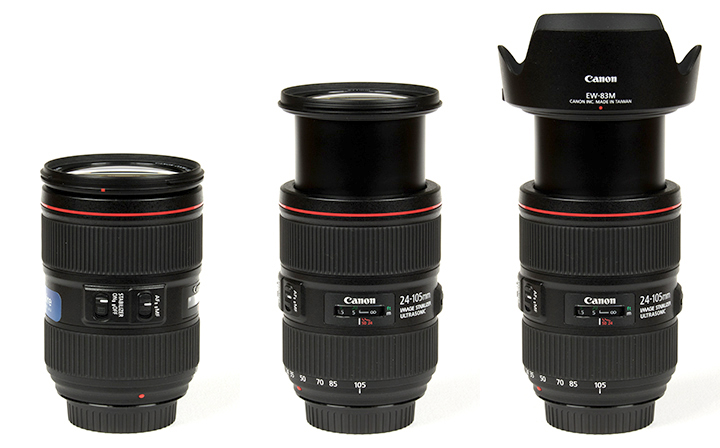
| Specifications | |
|---|---|
| Optical construction | 17 elements in 12 groups inc. 4x aspherical elements |
| Number of aperture blades | 10 (circular) |
| min. focus distance | 0.45m (max. magnification ratio 1:4.1) |
| Dimensions | 83.5 x 118mm |
| Weight | 785g |
| Filter size | 77mm |
| Hood | petal-shaped (bayonet mount, supplied) |
| Other features | weather-sealed image stabilizer |
| Mounts | Canon EF |
Distortion
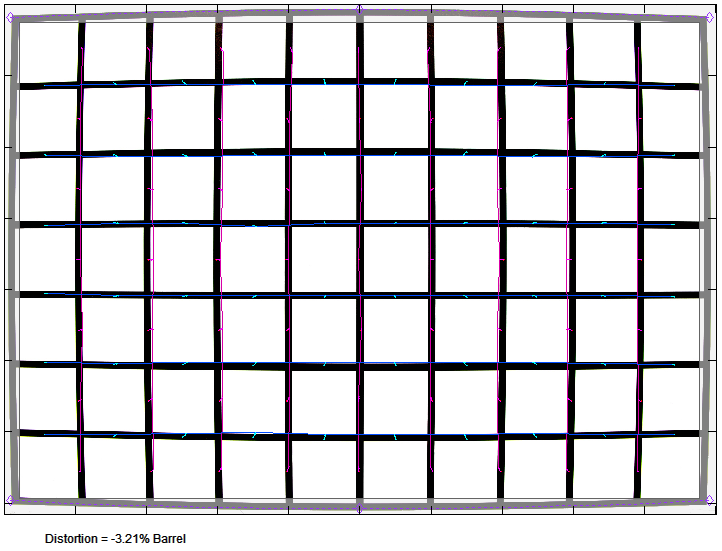
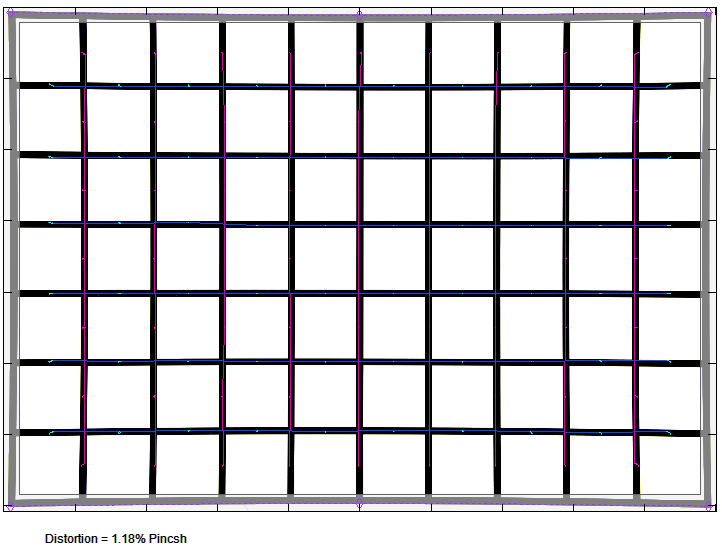
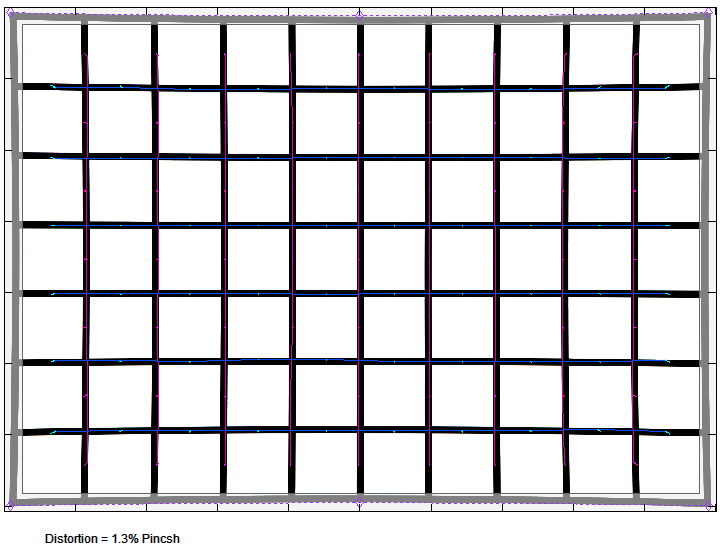
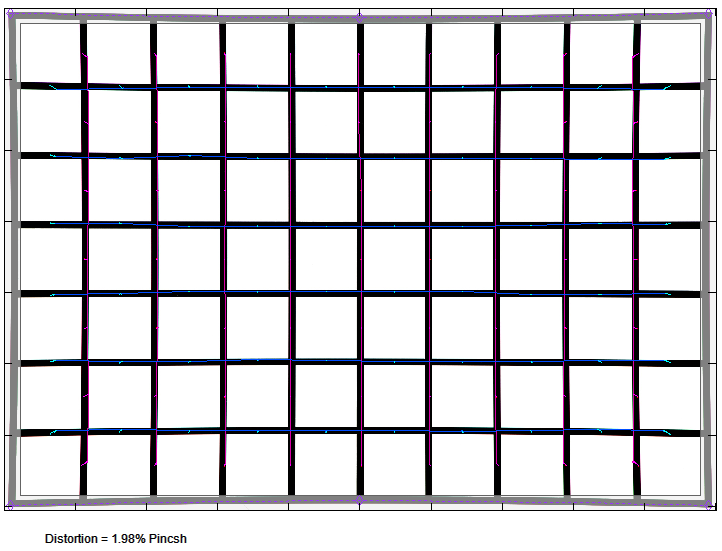
The Canon lens produces a strong barrel distortion of 3.2% at 24mm. In the middle range you can observe medium pincushion distortions whereas at 105mm the pincushion distortions are on the verge of getting annoying (1.98%) again. While this characteristic isn’t unusual in this class, it is nothing to write home about but at least a tiny bit improved over the mk I (at 24mm).
Vignetting
The Canon EF 24-105mm f/4 USM L IS II has a fairly typical vignetting characteristic for a full format standard zoom lens. At 24mm @ f/4, you can notice a heavy light-falloff of almost 2EV (f-stops). However, the issue is greatly reduced at f/5.6 and not a major issue beyond. The vignetting isn’t as pronounced at the other tested focal lengths although stopping down to f/5.6 remains advisable.

MTF (resolution at 50 megapixels)
Unfortunately the lens failed to impress us in the 50 megapixel scope. At 24mm, the center quality is very good at f/4 and it manages to reach excellent levels at f/5.6. Beyond diffraction is limiting the quality already. The border quality is just “Ok” throughout the relevant aperture range. The corners are downright soft at f/4 but at least they are catching up with the mediocre borders when stopping down. The sweet spot of the lens is around the 40mm mark. The outer image region could be better at f/4 but images are nicely sharp across the frame from f/5.6 onward. From here on it’s all downhill again … At 70mm the dead center is still sharp (albeit not bitingly so) at fully open aperture but there’s a rapid loss of quality toward the very soft corners. However, if you stop down to f/8 the quality is at least decent. The center quality remains alright at 105mm but the outer image field is soft again and stopping down doesn’t really help. All in all this is rather disappointing …
Honestly, we were a little shocked by these results. The first tested sample also showed a higher than usual optical decentering. Thus we repeated the exercise with a 2nd sample. This one was well centered (albeit still back-focusing like hell) but not really better. The results from this 2nd sample are shown below.
Please note that the MTF results are not directly comparable across the different systems! Below is a simplified summary of the formal findings. The chart shows line widths per picture height (LW/PH) which can be taken as a measure of sharpness. If you would like to know more about the MTF50 figures, you may check out the corresponding Imatest Explanations.

Chromatic Aberrations (CAs)
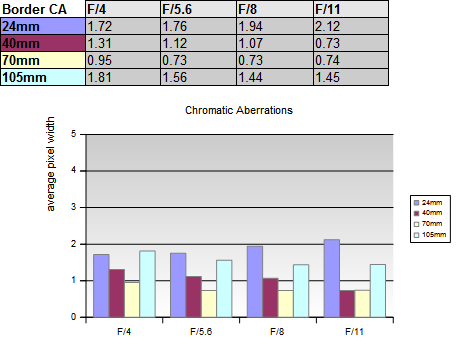
Lateral chromatic aberrations (color shadows at the image borders) are visible at the extreme ends of the zoom range but they manage to stay below an average pixel with of 2px at the borders. The issue isn’t quite as pronounced in the middle range.
Bokeh
Standard zoom lenses are rarely perfect when it comes to the quality of the bokeh (out-of-focus blur). However, while the Canon EF 24-105mm f/4 USM L IS II has its rough edges, it isn’t all that bad here.
Thanks to the 10 circular aperture blades, out-of-focus highlights have a nice disc shape – that is except at the image borders where you have to live with the usual “cat eyes”. The inner highlight disc isn’t perfectly smooth but still quite decent. A slight outlining effect is visible at f/4.
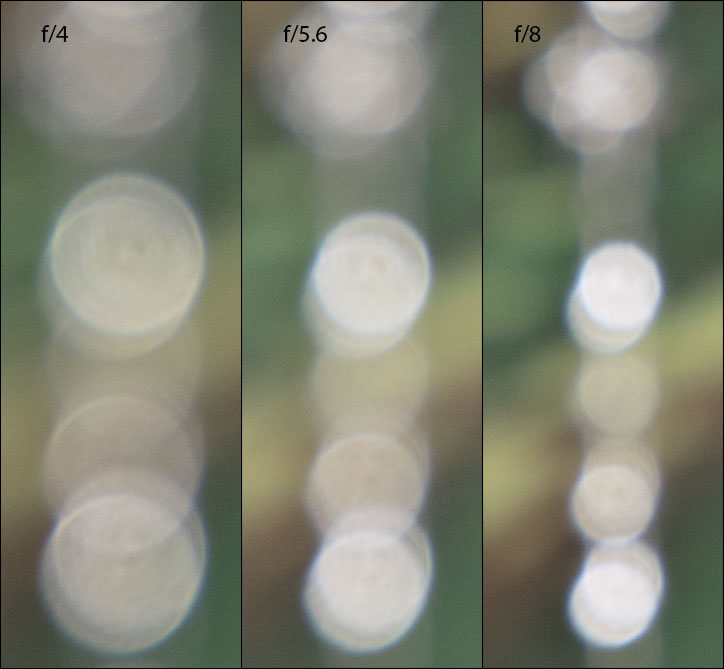
The quality of the “general” blur is actually quite good in the critical image background whereas the foreground is more on the rough side here.

Sample Gallery


Let's be honest - the Canon EF 24-105mm f/4 USM L IS (mk I) was not the greatest lens Canon ever produced. Unfortunately neither is the Canon EF 24-105mm f/4 USM L IS II. While there are differences on a detail level, the performance is roughly similar which is a little depressing given all the years that passed by since the mk I was designed. 50 megapixels are a torture ground for all lenses but it's too much for the Canon EF 24-105mm f/4 USM L IS II really. The center quality is sufficient but the corner quality just isn't there at the extreme ends. The amount of CAs is acceptable. The lens performs, of course, much better on 21 megapixel cameras with very decent results from f/5.6 at least. However, you have to live with the outlook that the glory ends once you decide to upgrade your camera. The amount of vignetting is average for this kind of lens thus there's quite some light-falloff at 24mm f/4. However, stopping down to f/5.6 resolves most of the issue already. Barrel distortions are also obvious at 24mm albeit not extreme. The lens is also no distortion wonder at 105mm. The quality of the bokeh is comparatively decent for a standard zoom lens at least.
The build quality of the Canon EF 24-105mm f/4 USM L IS II is much more convincing. The high-quality materials, tight tolerances and weather sealing are certainly good enough for professional use. The USM AF is extremely fast and silent. However, if you decide to invest in this lens make sure that the AF is properly calibrated. We tested two samples and both suffered from substantial back-focusing (to a degree that we haven't seen before). The image stabilizer with its potential gain of up to 4 f-stops, is a major improvement over the old lens.
So what's the final conclusion ? Honestly, we would recommend to skip this lens. We just didn't find any substantial improvement over the already not-so-great predecessor. Instead we would suggest to check out the Canon EF 24-70mm f/4 USM L IS or the Sigma 24-105mm f/4 HSM ART.
-
Optical Quality5
-
Build Quality8
-
Price / Performance5