


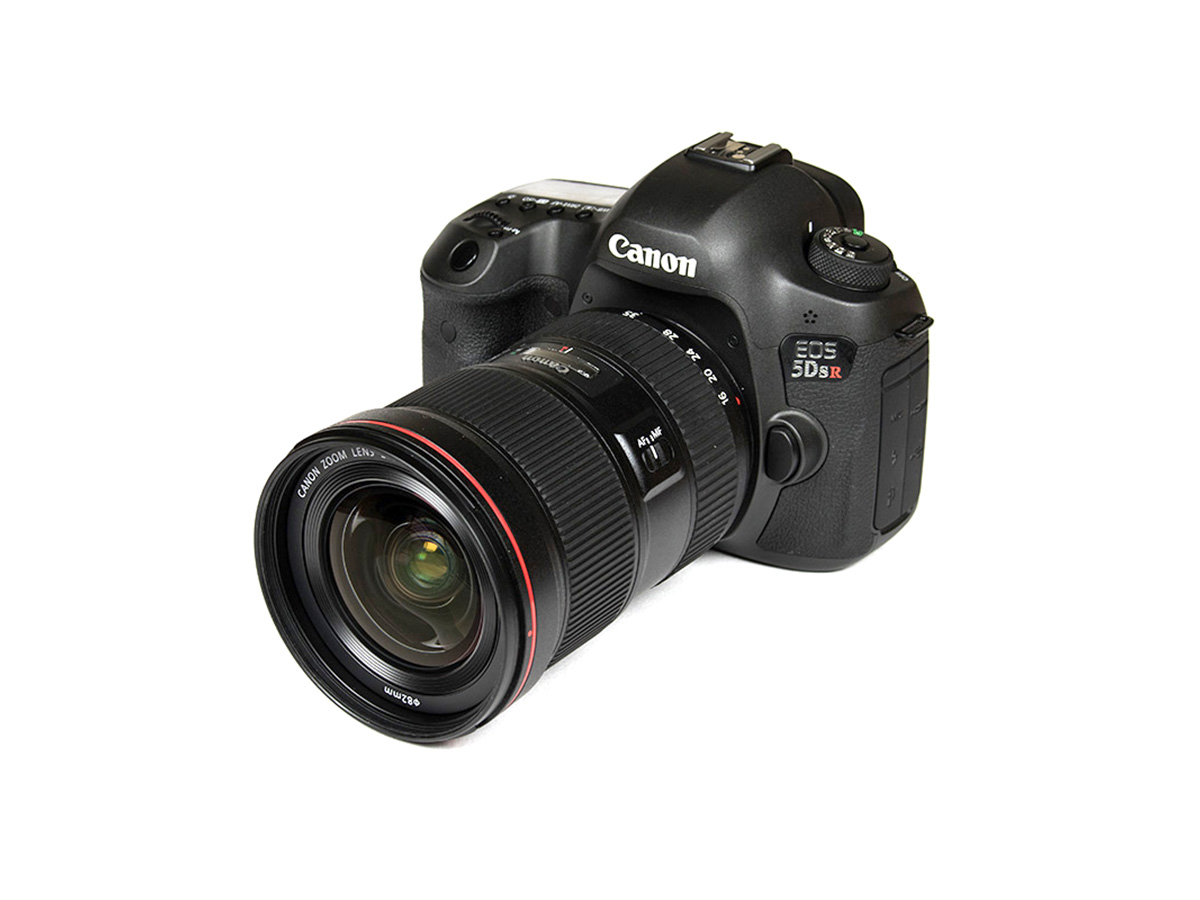
Just like the rest of the industry, Canon is facing a difficult time at time moment. The camera market is on a sharp downturn and besides the usual competition from Nikon, Sony is emerging as an aggressive player in the professional arena. Thus Canon concluded that the only option to keep or raise at least its market share is by providing more quality. In the ultra-wide segment they just released the Canon EF 16-35mm f/2.8 USM L III to push the boundaries a little further. Unfortunately this new lens comes with a bitter pill – a high price tag of 2400EUR/2200US$. This is a price hike of more than 30% compared to the mk II variant and it’s more than double the amount that you would have to pay for the brilliant Canon EF 16-35mm f/4 USM L IS. This will cause headaches among some of the potential buyers. That being said we’ve similar price increases especially over at Sony.
The build quality of the Canon lens is exceptionally high just as you would expect it from a Canon L lens. There’s no wobbling whatsoever and the zoom and focus rings operate smoothly. The lens is also designed to survive in harsh conditions with a sealing against dust and moisture. It is quite a brick though – it’s not only more than 20% heavier than its predecessor, it’s also 1.5cm longer. The outer length of the lens remains constant although the inner lens tube moves a little according to the zoom setting. Needless to say – the front element does not rotate during focusing or zooming operations. A rather small petal-shaped lens hood is also part of the package.
In terms of optical goodies Canon incorporated ASC-(Air Sphere Coating) and SWC-(Subwavelength Structure Coating) to the lens elements to minimize flare. A fluorine coating on the front element does also help to reduce smears. Two UD elements are supposed to reduce lateral CAs and one ground as well as two GMo (glass molded) aspherical elements shall reduce distortions and improve peripheral sharpness. Well, we’ll see whether the lens lives up to these promises.
The lens has a ring-type USM drive based on a front-focusing system resulting in an extremely fast AF speed. The AF performance in live-view mode is also impressive. Typical for ring-type USM lenses full-time manual focusing is always possible in one-shot AF mode. Surprisingly an image stabilizer is not included but at least in theory, this could translate to a slightly higher technical image quality.
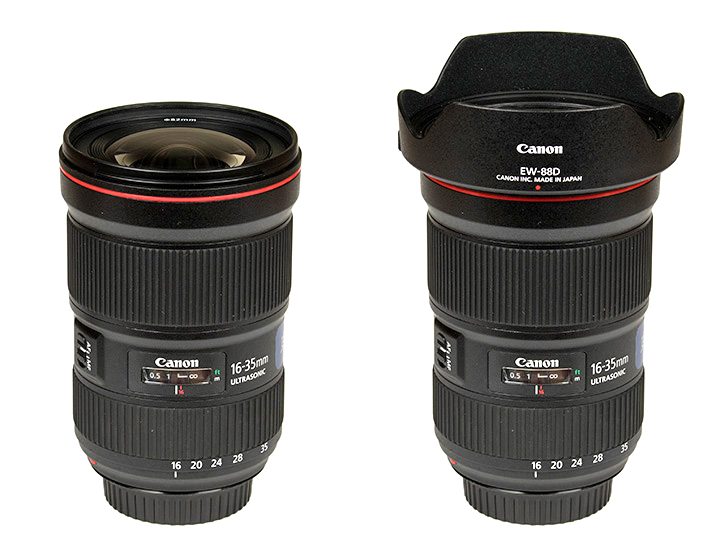
| Specifications | |
|---|---|
| Optical construction | 16 elements in 11 groups (3x asph. & 2xUD elements) |
| Number of aperture blades | 9 (circular) |
| min. focus distance | 0.28m (max magnification ~1:4 @ 35mm) |
| Dimensions | 88.5×127.5mm |
| Weight | 790g |
| Filter size | 82mm |
| Hood | petal-shaped (bayonet mount, supplied) |
| Other features | weather-sealed |
| Mounts | Canon EF |
Distortion
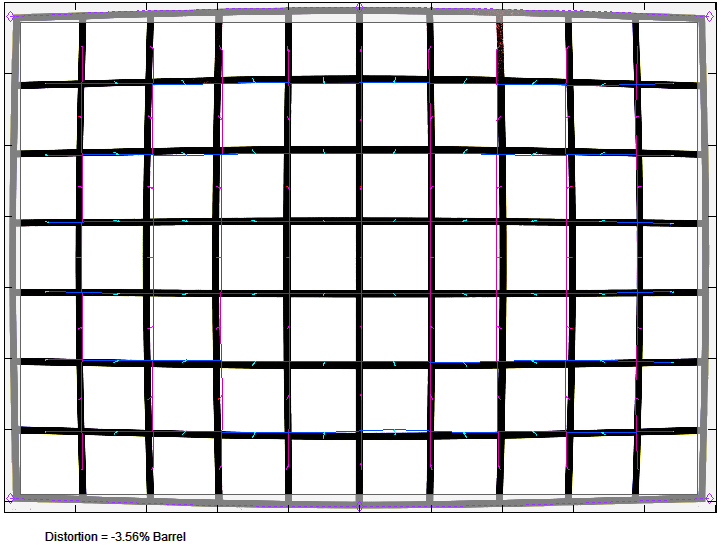
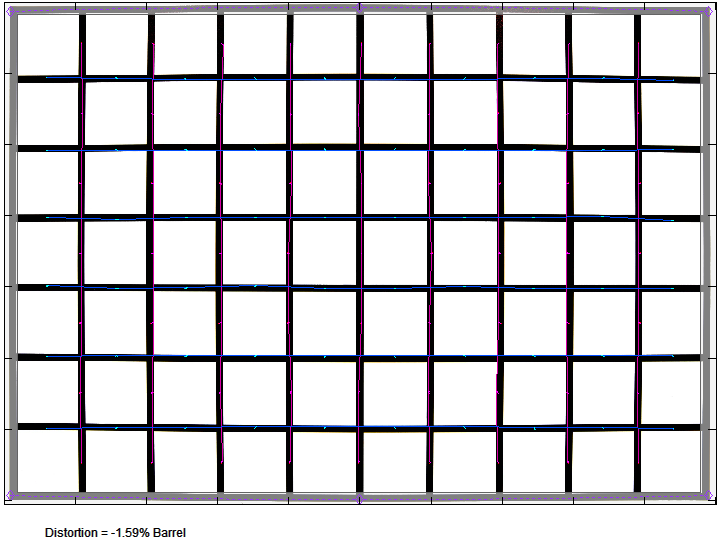
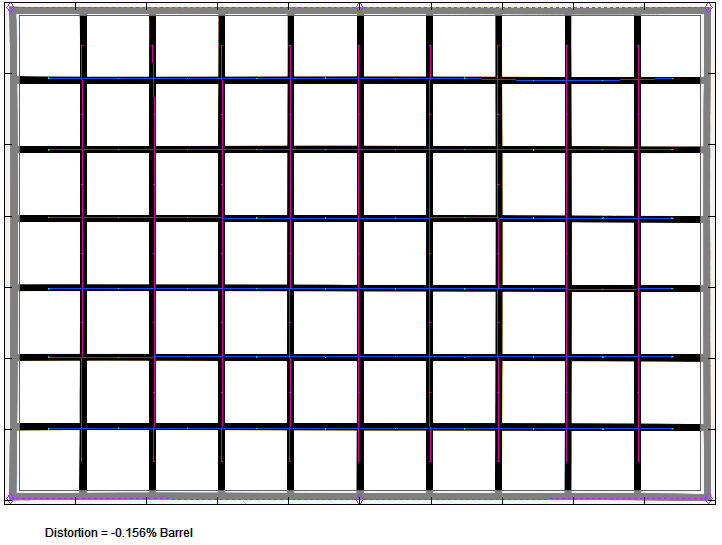
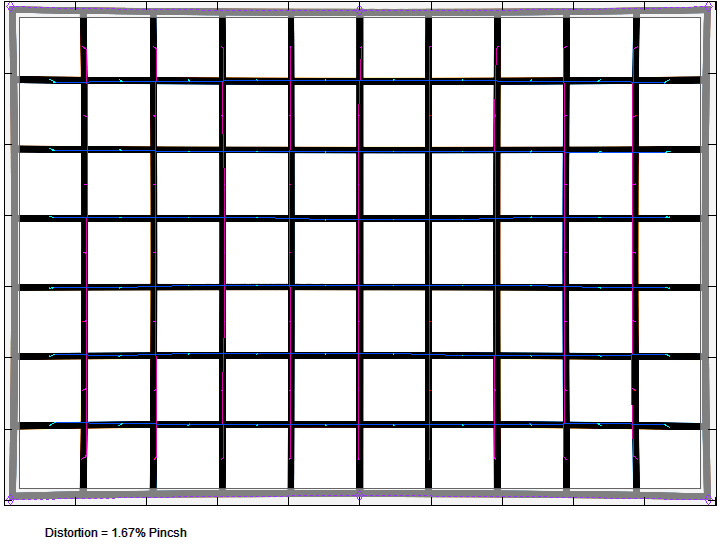
The distortion characteristic of the Canon EF 16-35mm f/2.8 USM L III is typical for a lens in this class. At 16mm you have to live with a rather strong barrel distortion (3.6%). This eases at 20mm (1.5%) and images are essentially free of distortions at 24mm. At 35mm there’s a medium degree of pincushion distortion (1.7%).
Vignetting
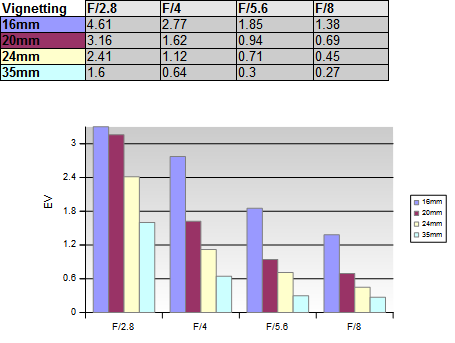
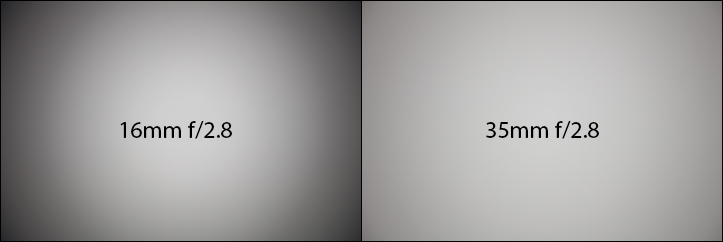
A major weakness is the high amount of light falloff in the image corners at 16mm @ f/2.8. A vignetting of 4.6 EV (f-stops) is WAY beyond our usual scale for full format lenses. Unless you have to go for f/2.8 or simply like the effect, you should stop down to at least f/5.6 to reduce the light falloff to a moderate degree. The situation has eased a bit at 20mm, but there’s no glory here either at full open aperture. At 24mm there’s still quite a bit of vignetting at f/2.8 but it’s reasonably well controlled from f/4. At 35mm the vignetting is moderate also thanks to a very gradual light falloff towards the corners.
Below as sample image taken at the extreme ends of the zoom range at fully open aperture.
MTF (resolution at 50 megapixels)
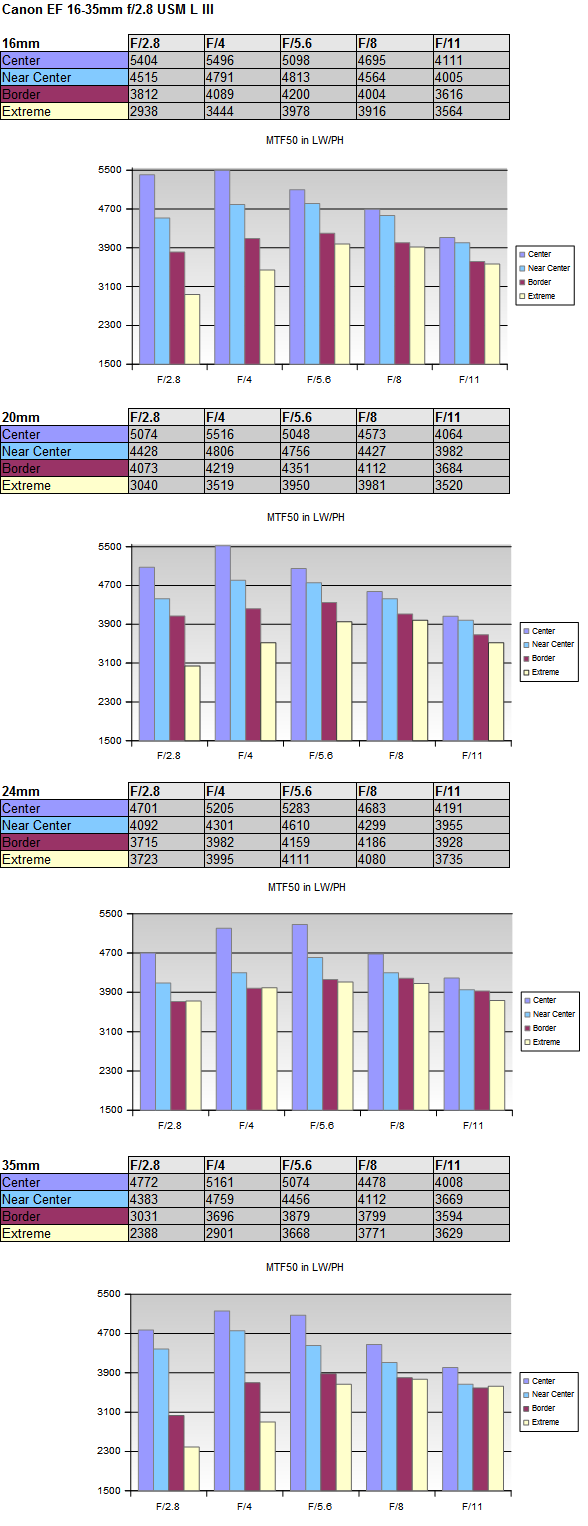
The resolution is pretty impressive on a high resolution camera. The center quality is outstanding across the board at least until diffraction kicks in at f/11. The near-center quality is very good to excellent at 16mm. The borders are also sharp whereas the corners are somewhat soft at f/2.8 here. The sweet spot is reached at f/5.6 where the corners are lifted to good to very good levels. The same characteristic applies to the 20mm setting. The corner softness at f/2.8 is gone at 24mm and the quality is very homogeneous across the mainstream aperture settings. The resolution of the outer image region decreases again at 35mm. The borders are just fair here and the corners are also quite soft. Stopping down to f/5.6 results improves the quality substantially again.
The centering quality of the tested sample was good.
Please note that the MTF results are not directly comparable across the different systems! Below is a simplified summary of the formal findings. The chart shows line widths per picture height (LW/PH) which can be taken as a measure of sharpness. If you would like to know more about the MTF50 figures, you may check out the corresponding Imatest Explanations.
Chromatic Aberrations (CAs)
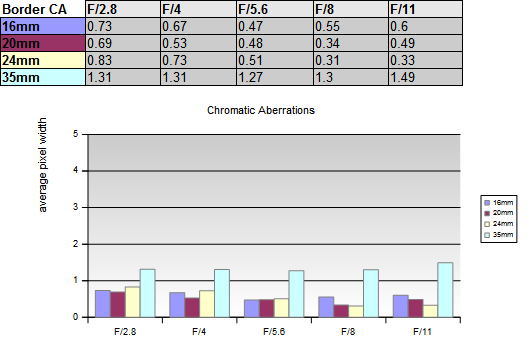
Lateral chromatic aberrations (color shadows at harsh contrast transitions) are extremely well controlled between 16mm and 24mm. The CAs are somewhat higher at 35mm, but they remain unobtrusive with an average pixel width of around 1.3px at the image borders.
Flare
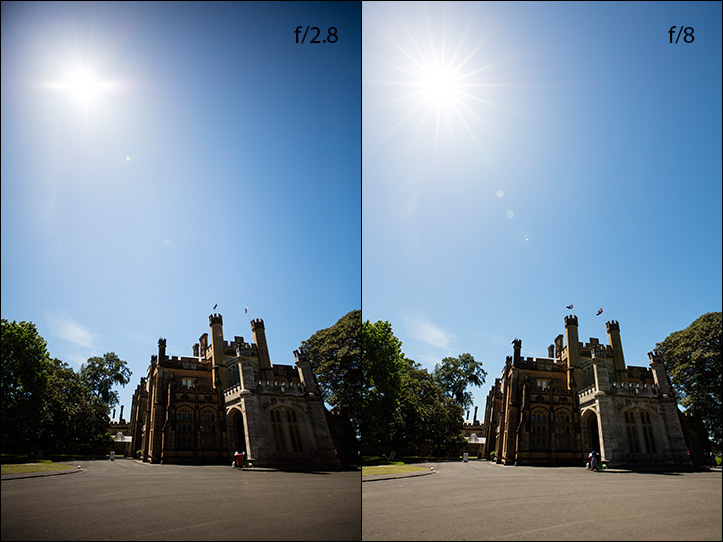
Ultra-wide lenses cover an immense field of view thus you may run into scenes where a strong light source such as the sun is either part of the composition or it affects the image via parasitary light from just outside the image frame. Glare and ghostings are frequent issues in such cases. As mentioned during the introduction Canon has applied ASC and SWC (coating) to the lens elements to reduce the problem. Did they succeed ? Well, mostly. Below is a rather extreme test scene (note: it’s not meant to be a nice image) with the sun positioned in one corner. As you may see the image contrast remains unaffected, which is great. However, a few ghostings remain – more so at f/8 than at f/2.8. In addition, please note that the sun shows a distinctive “star” effect at f/8 whereas it’s blurry sharp at fully open aperture. Generally we would rate the flare behavior as well above average (no lens is perfect here).
As a side note – the image was taken at 16mm thus you can also observe the extreme vignetting at f/2.8 in the image to the left.
Sample Gallery


The Canon EF 16-35mm f/2.8 USM L III is, of course, an improvement over its predecessors. If you stop down a bit you can achieve edge-to-edge sharp images at all focal lengths even on a 50 megapixel camera. That's quite an achievement! The image corners are a bit soft at f2/8 and the extreme ends of the zoom range though. However, in real life that's rarely a showstopper. If you are using a camera with a more moderate pixel count, you don't really need to worry because the lens is plenty sharp enough in this case. Lateral CAs are generally very well controlled. A substantial weakness is the amount of vignetting at the wide end though. When designing a lens you have to balance the different optical aberrations and Canon obviously decided to favor sharpness over vignetting this time. The vignetting at 16mm f/2.8 isn't pretty to say the least. Of course, you can argue that this can be used in a creative way but then again - the mk II lens delivered better results in this chapter. Image distortions haven't been improved either thus you have to live with some barrel distortions at 16mm. Strong back-light is managed nicely in terms of flare although room for improvement remains (as always).
The build quality is very high and absolutely pro-grade. The lens is weather-sealed although for perfect protection Canon recommends to use a front filter to stop dust/water from entering via the gap between the moving inner and static outer lens tubes. A few years ago we saw a trend towards smaller equipment but it seems as if the high quality requirements have reversed this. The Canon EF 16-35mm f/2.8 USM L III is not only heavier, it's also bigger than its predecessor. Whether this is helpful in the battle against smaller mirrorless systems remains to be seen. While you may not really need it most of the time, it's worth mentioning that the AF is extremely fast. A more surprising aspect is the lack of image stabilization though.
Which brings us to the question of whether to prefer the Canon EF 16-35mm f/2.8 USM L III over the Canon EF 16-35mm f/4 USM L IS. If you require that extra f-stop for shallow depth-of-field images, the answer is simple of course. Go for it. However, beyond this aspect things aren't quite so simple. Unless you have to deal with moving objects, the EF 16-35mm f/4 USM L IS has actually more potential for low-light photography due to its image stabilizer. Given the results at 21 megapixels (we didn't test the f/4 lens at 50 megapixels), it is also viable to state that there's probably little to gain in terms of resolution with the EF 16-35mm f/2.8 USM L III. The f/4 lens is also more compact and way more affordable. The choice is yours.
-
Optical Quality6.5
-
Build Quality9
-
Price / Performance8