


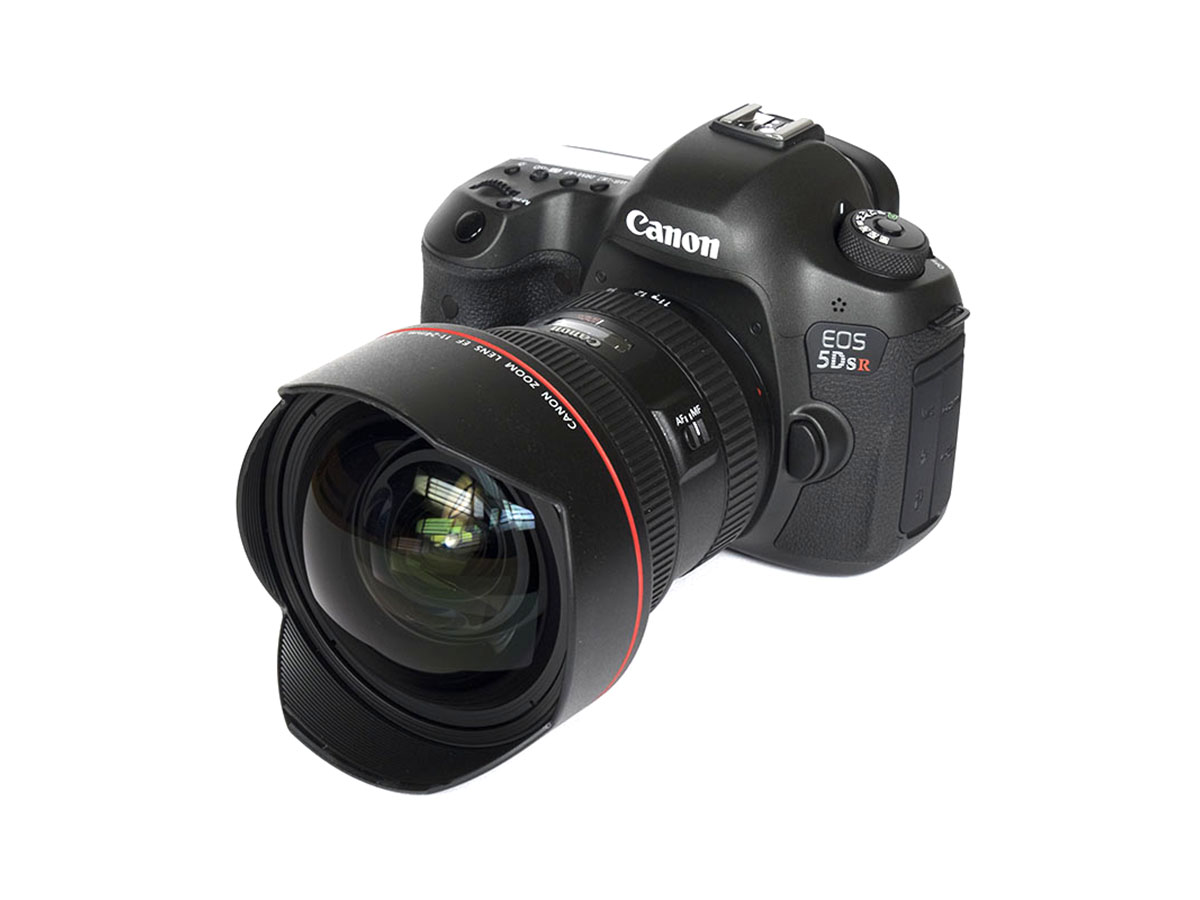
It was probably a bit of a hard task for the Canon engineers to find an unfilled gap in their lens lineup. They had to explore the extremes once more and this time they found something at the extreme wide end resulting in the Canon EF 11-24mm f/4 USM L. It is the widest, fully corrected full format zoom lens in existence – outside of labs at least. Needless to say but there’s a slight entry hurdle here… 3000 US$/EUR. However, at least you are getting something for your money – this thing is a brick and also about as heavy (1180g) so if you have been waiting for such a beast better book some extra sessions in your favorite gym.
Now to make the game a little bit more challenging, the Canon lens was now also the first lens tested on our new test bed using the Canon EOS 5Ds R (50mp). I can assure you already that the easy times are over now …
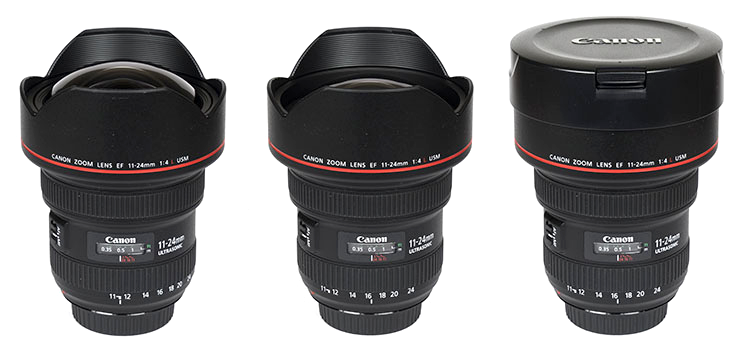
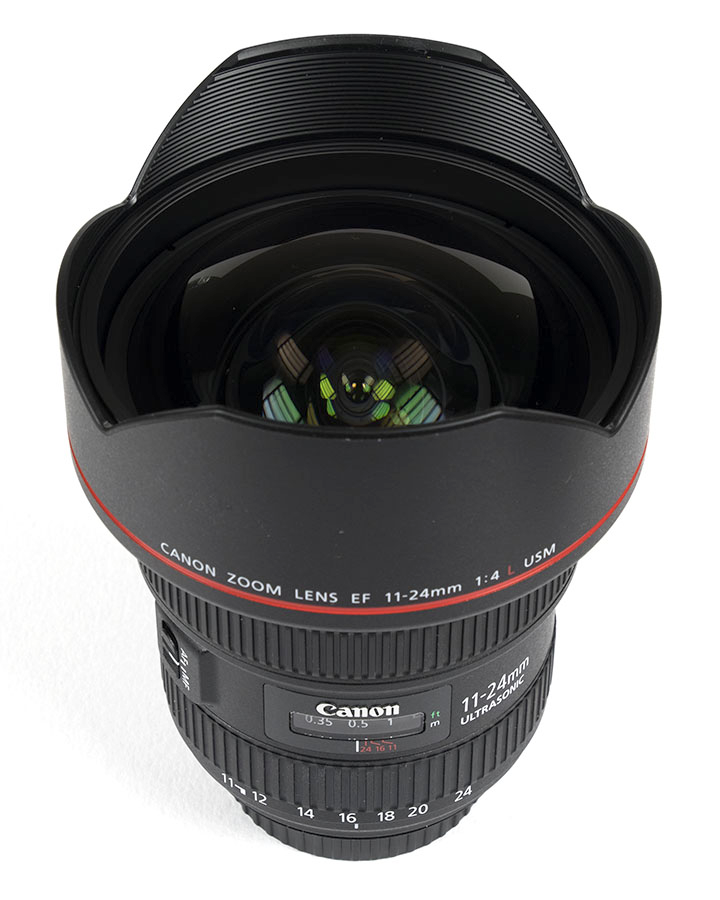
The build quality of this lens is superb just as you would expect it from a Canon L lens in this price class. There’s no wobbling whatsoever and the control rings operate smoothly. The lens is also designed to survive in harsh conditions with a sealing against dust and moisture. Fluorine coatings on the (immense) front and rear elements have been applied for reducing smears and fingerprints. The outer length of the lens remains constant thanks to the fixed lens hood although the inner lens tube moves a little according to the zoom setting. The front element does not rotate during focusing or zooming operations but this won’t help you with filters because the (vulnerable) bulb-like front element just doesn’t allow this. Conventional (front-)lens caps don’t work either so the lens cap is attached to the lens hood. Honestly we would have wished for something more posh than a plastic front cap here but it does the job, of course.
The lens has a ring-type USM drive based on a front-focusing system resulting in an extremely fast AF speed. Typical for ring-type USM lenses full-time manual focusing is always possible in one-shot AF mode.
| Specifications | |
|---|---|
| Optical construction | 16 elements in 11 groups (2x CaF2, 1x SUD, 1x UD and 4x aspherical) Subwavelength Coating (SWC) Air Sphere Coating (ASC) |
| Number of aperture blades | 9 (circular) |
| min. focus distance | 0.28m @ 24mm (max. magnification ratio 1:6.5) |
| Dimensions | 108x132mm |
| Weight | 1180g |
| Filter size | – |
| Hood | petal-shaped, fixed |
| Other features | weather-sealed |
| Mounts | Canon EF |
Distortion
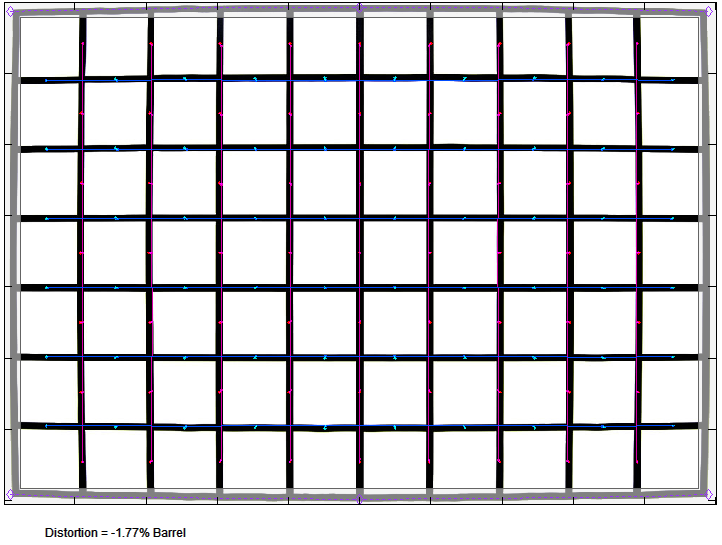
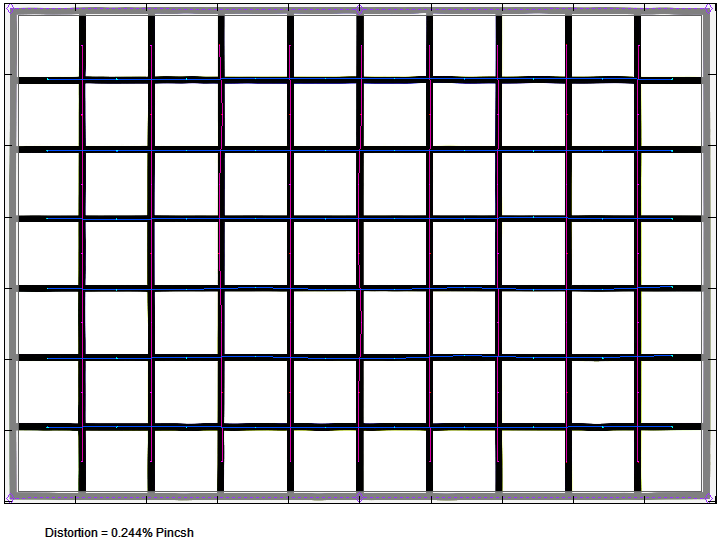
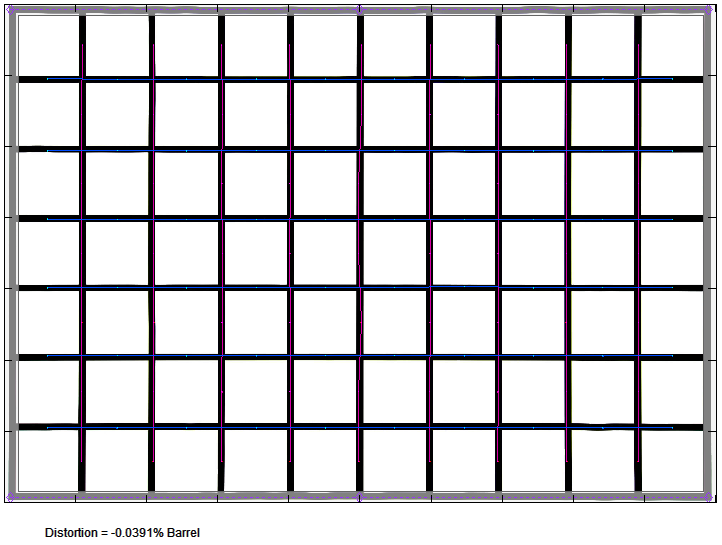
Canon emphasizes that while the lens has an extreme range, the distortions are low. We wouldn’t sign this as such. At 11mm we have measured a barrel distortion of 4.5% which is rather hefty actually. To be fair – Canon is exploring undiscovered lands here so we certainly applaud to them that it isn’t more than that really. The issue has eased substantially at 14mm (1.8% barrel distortion) and it’s negligible beyond.

Vignetting
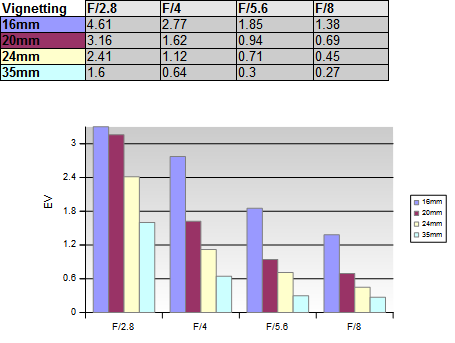
The amount of light falloff is, unsurprisingly, excessive at 11mm @ f/4 (3.3 EV/f-stops) but remember that the “natural” vignetting (“cosine fourth” law) takes its toll here as well. Stopping down to f/5.6 improves this drastically but better stick to f/8 or f/11 to tame the issue to a reasonable degree (unless you are after this effect). The same applies to the 14mm setting albeit at a slightly lesser degree. The 18mm and 24mm settings are much better at fully open aperture (1.8EV and 1.3EV respectively) and f/5.6 is sufficiently corrected already.
MTF (resolution at 50 megapixels)
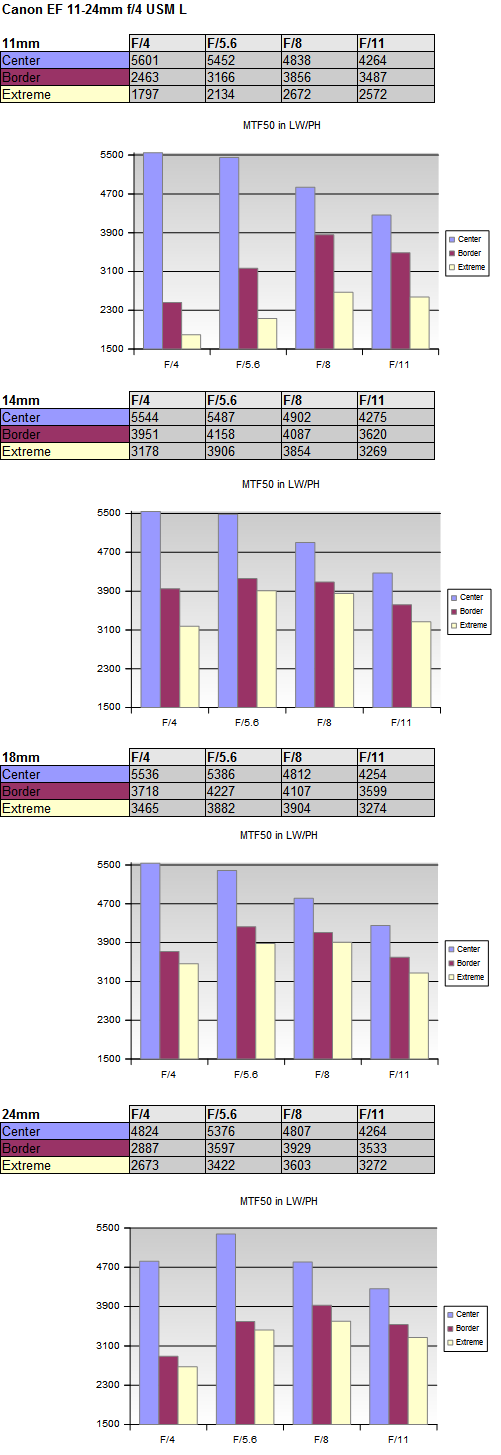
The resolution characteristic varies substantially across the zoom range. Of course, the most difficult setting remains the 11mm setting. The center quality is absolutely stellar even at f/4. However, the borders/corners are soft here. The extreme corners show CAs with a width of up to 8 (!) pixels which has certainly also affected our tool here . Stopping down lifts the quality in the outer image region but not quite as much as you would have hoped. The best quality is reached at f/8 with good to very good borders and fair corners. At f/11 diffraction is already limiting the results.
The situation changes completely at 14mm and 18mm. The center remains outstanding but the borders/corners are MUCH better. The borders are good to very good at f/4 whereas the corners are fair here. However, the corners are boosted to sharp quality at f/5.6 already.
The performance goes a little downhill at 24mm again with softer results at f/4 and f/5.6 but f/8 is decent actually.
The centering quality of the tested sample was good but not perfect.
Please note that the MTF results are not directly comparable across the different systems! Below is a simplified summary of the formal findings. The chart shows line widths per picture height (LW/PH) which can be taken as a measure of sharpness. If you would like to know more about the MTF50 figures, you may check out the corresponding Imatest Explanations.
Chromatic Aberrations (CAs)
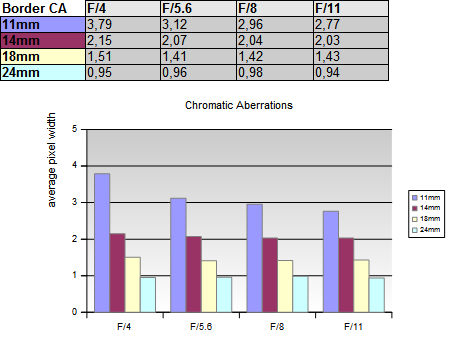
We got used to rather low lateral chromatic aberrations (color shadows at harsh contrast transitions) lately but the Canon EF 11-24mm f/4 USM L is an extreme lens so it doesn’t really come as a surprise that the results are a bit soso at least at 11mm where we measured an average CA pixel width of around 3px at the image borders. As already mentioned this is getting amplified in the far corners with an excessive CA width of up to 8 (…) pixels. However, remember again that this is based on the EOS 5Ds R so the CAs are magnified according to the pixel density here. The CAs are much better at 14mm (around 2px) and not much of an issue beyond.
Flare
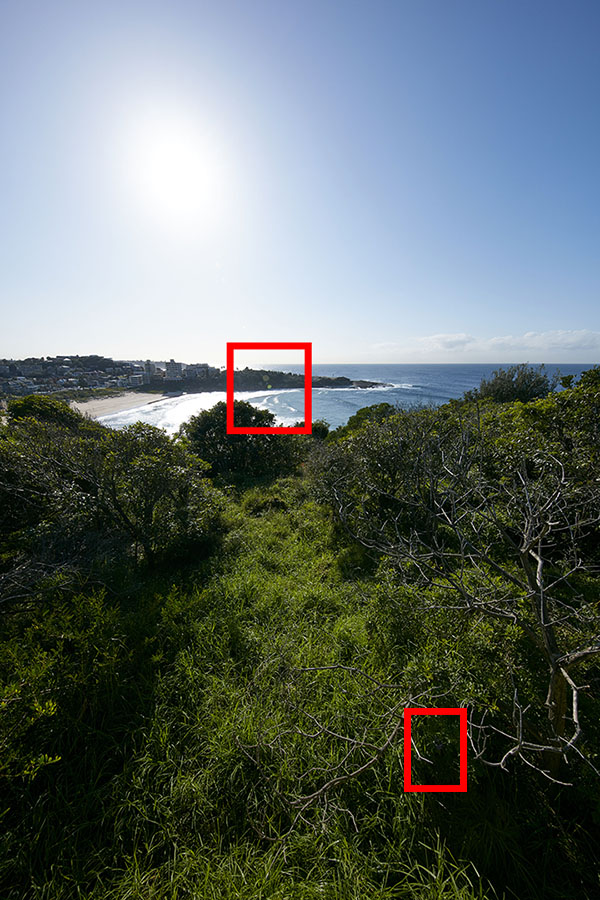
Such extreme ultra-wide lenses, especially with a bulb-like front element, are very prone to flare in back-light. However, Canon applied its new magic – Subwavelength Coating (SWC) as well as Air Sphere Coating (ASC). The result is actually pretty much surprising. We took a couple of shots straight into the sun and the results only suffered from low glare and a few ghostings – much less so than e.g. the Nikkor AF-S 14-24mm f/2.8 ED or some others. Of course, nothing is perfect and if you are pushing it, you will see more issues than in this sample shot (taken at f/11) below.
Sample Gallery


Canon's latest additions to the ultra-wide arena have been impressive. The Canon TS-E 17mm f/4 L is awesome and the EF 16-35mm f/4 USM L IS is best in class. So is Canon's mojo sufficient to deliver greatness with the Canon EF 11-24mm f/4 USM L once more... even on the EOS 5Ds R ? Well, they succeeded... only partially. Now that's a bit of a harsh statement for a unique lens, of course.
The center quality is nothing short of outstanding straight from f/4 and throughout the focal length range. However, the outer image region isn't all that hot at 11mm and especially at max. aperture and the high level of lateral CAs (extreme in the corners) doesn't help either here. Moving on to the 14mm and 18mm the results are much improved with good results even in the extreme corners. And let's be honest - most will use the middle range more often than the extremes on this specific lens. A decent scene composition is already very difficult at 14mm or 18mm and you will need to get used to having 11mm at hand as a new option really. The 24mm setting is a bit worse again but it remains quite good when stopped down a bit.
The mentioned flaws are, of course, not QUITE as apparent when using the lens on a camera with smaller resolution sensors. Those who are still shooting at 20 megapixels can enjoy sharp results (edge-to-edge) at most mainstream settings except at 11mm f/4.
The 11mm setting is also the (expected) weak spot in terms of high vignetting as well as heavy barrel distortion. These characteristics are much better again from 14mm onward. Activated auto-correction in your favorite RAW converter (or in the camera for JPEGs) will solve most of these issues anyway. Most ultra-wide angle lenses suffer from extreme flare in back-light conditions. Now the Canon EF 11-24mm f/4 USM L isn't perfect here - perfection simply doesn't exist here anyway - but it is a magnitude better than most other lenses that are at least capable of touching a similar focal length range. While we haven't tested the quality of the bokeh formally, we'd say that it is, again, better than most in this class (where most lenses perform dismal in this respect) although you will be able to see a bit of smearing and outlined highlights.
The build quality is exceptionally high and absolutely pro-grade. However, even though the lens body may be tough, the huge front element remains vulnerable. Due to its bulb-like shape protection filters are not possible. The new fluorine coatings will at least help to keep it reasonably clean most of the time. Remember that this is a massive lens both in size (well, diameter) and weight so it isn't exactly aligned to casual shooting really. Unsurprisingly the AF is very fast and near silent thanks to a ring-type USM drive.
That all being said... what's the conclusion then? Honestly at this stage we will not provide further guidance because we just haven't tested a sufficient amount of lenses on the EOS 5Ds R yet. However, while many lenses can rule the common 20mp sensors, we can already say that Canon's new 50mp sensor is here to rule em all - less so in the image center but certainly so in the outer image region.
-
Optical Quality6
-
Build Quality9
-
Price / Performance7