


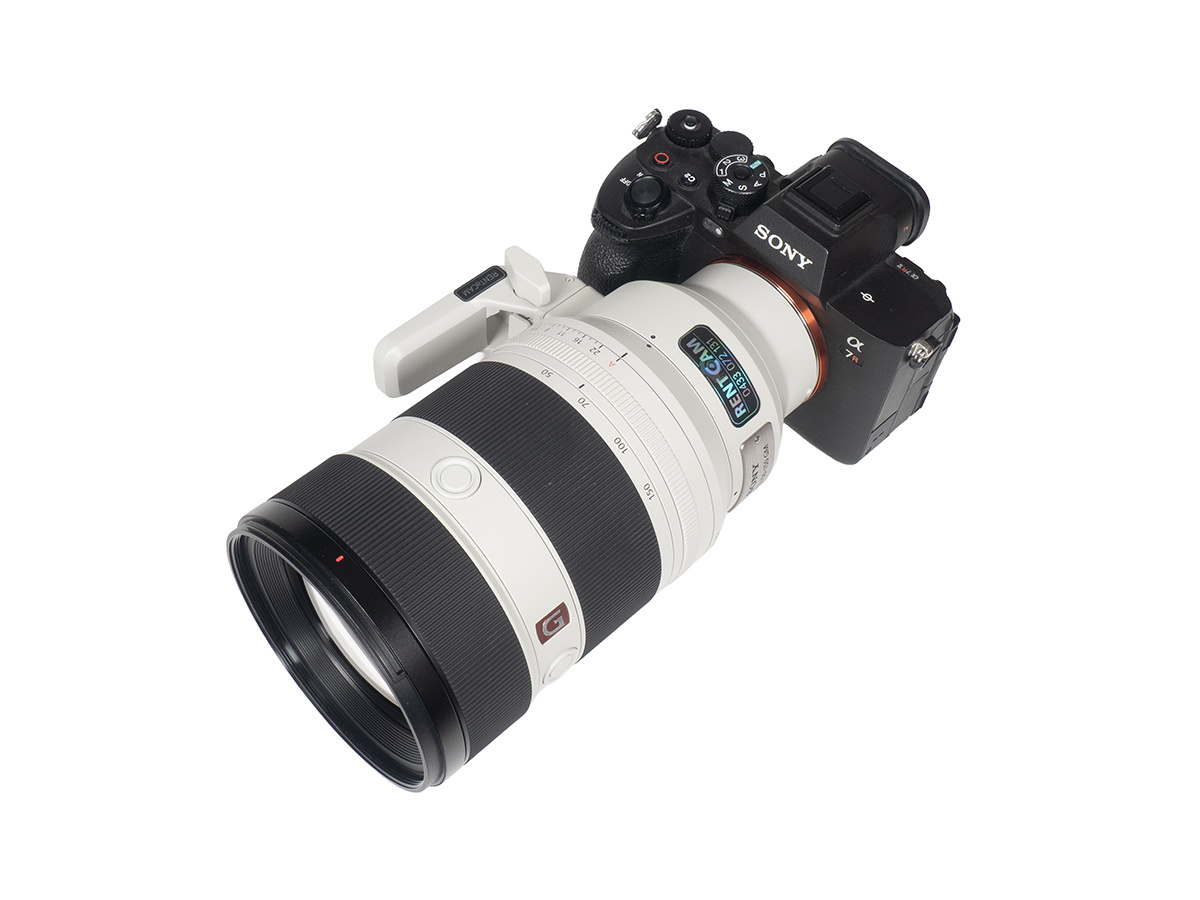
Decades ago, fast zoom lenses had a maximum aperture of f/4. When AF SLRs emerged, the speed increased to f/2.8, resulting in a set of ultra-wide, standard, and medium telezoom lenses affectionately known as the holy trinity. It appears that the manufacturers are now readying the next phase centered around f/2 lenses, thus almost matching ultra-fast prime lenses. So that’ll then be the godly trinity? Both Canon and Sony have already released their own interpretation of a 28-70mm f/2. And Sony also unleashed the Sony FE 50-150mm f/2 GM upon us, which we’ll discuss in this review. As you may expect, the price tag is rather unholy at around $4000 USD.
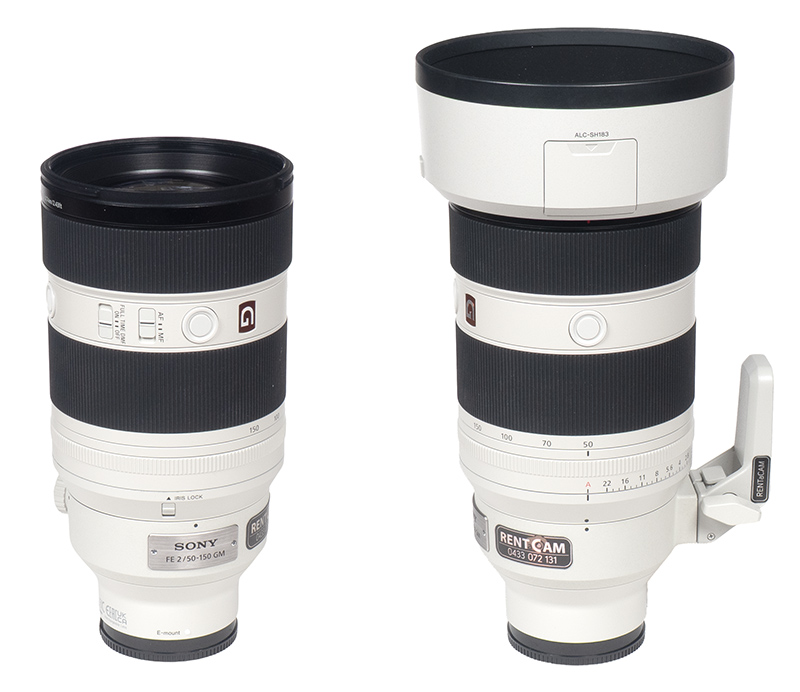
Of course, you are getting quite a bit of a lens for this kind of money. The FE 50-150mm f/2 GM is exceptionally well built. It uses a hybrid construction based on metal for the chassis and high-grade engineering plastics for the outer barrel. It is, of course, dust- and weather-resistant, and it doesn’t extend during focusing. The rubberized focus and zoom rings turn smoothly. Despite the large aperture, Sony still managed to keep the weight at a reasonable 1.34 kg. For comparison, the FE 70-200mm f/2.8 GM OSS II comes in at just over 1 kg. The lens comes with the usual set of controls, such as a de-clickable aperture ring with a lock switch, 3 Fn buttons, an AF/MF switch, and a dedicated DMF switch. As you can see below, a dedicated tripod mount has been incorporated. The tripod head can be detached for more convenient hand-held shooting. A comparatively small barrel-shaped lens hood is part of the package.
The FE 50-150mm f/2 GM uses four XD (“eXtreme Dynamic”) linear motors, so autofocusing is very snappy and virtually silent. Unfortunately, the lens is not compatible with Sony’s teleconverters. Given the fast speed of the lens, it would have been the ideal base here. There’s also no image stabilizer – probably to manage the complexity of the optical system. At 19 elements in 17 ground plus a floating system, it is already complex enough.
| Specifications | |
|---|---|
| Optical construction | 19 elements in 17 groups (2x XA, 2x Super ED, 3x ED) Nano AR Coating II fluorine coating on the front element Floating focusing system |
| Number of aperture blades | 11 (rounded) |
| min. focus distance | 0.4m (W)-0.74m (T) (max. magnification 1:5) |
| Dimensions | φ 102.8 x 200mm |
| Weight | 1340g (without tripod mount) |
| Filter size | φ 95mm |
| Hood | barrel-shaped (bayonet mount, supplied) |
| Other features | focus limiter de-clickable aperture ring aperture lock 3x Fn buttons DMF switch dust- and moisture-resistant |
Distortions
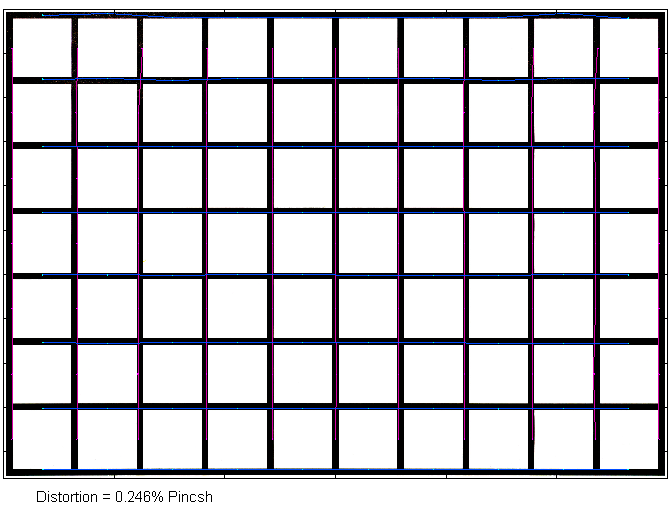
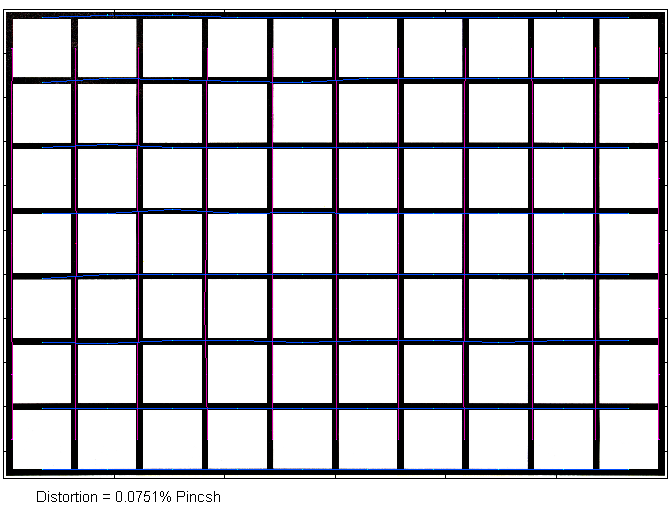
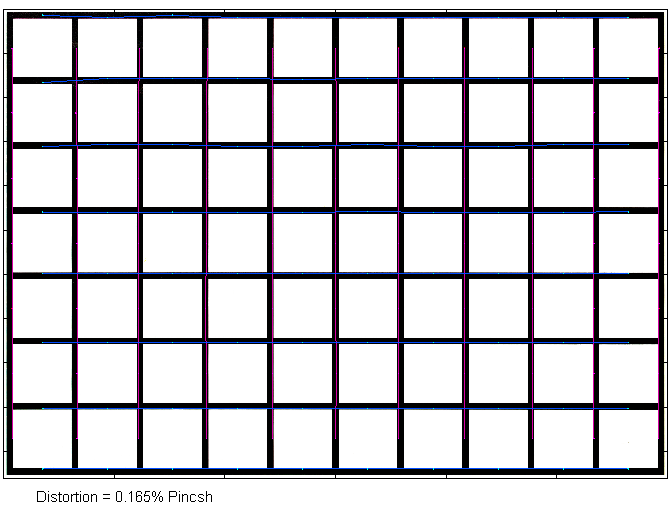
The Sony FE 50-150mm f/2 GM produces medium distortions in RAW images. At 50mm they are barrel-style, and they switch soon thereafter to pincushion distortion. The neutral point is around the 70mm mark.
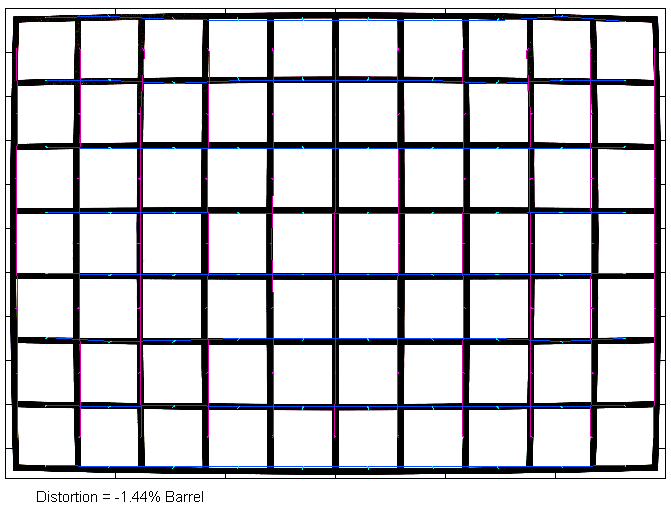
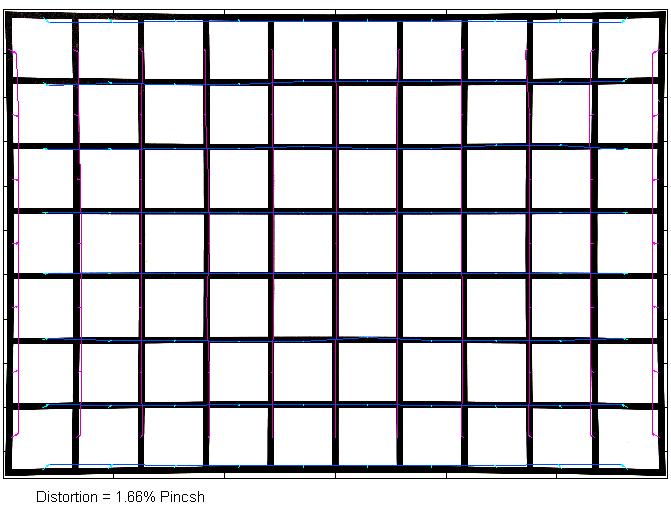
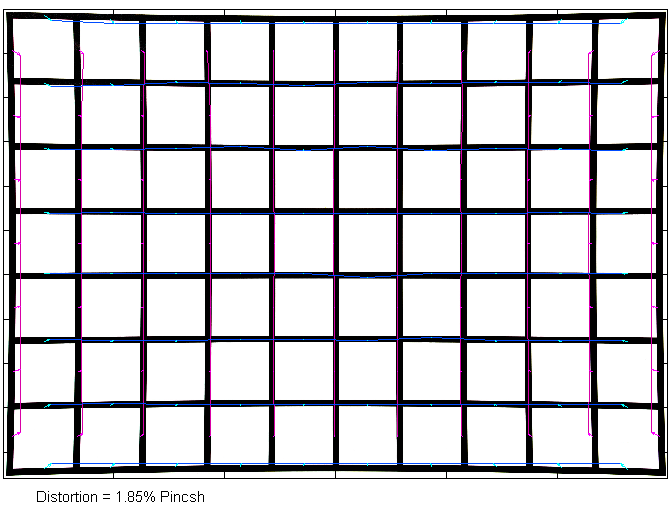
Autocorrection handles this nicely with only negligible distortions throughout the zoom range.
Vignetting
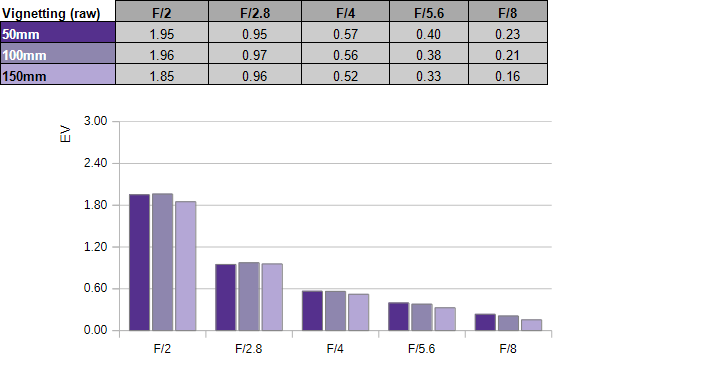
As you might expect, the RAW vignetting is clearly visible at f/2 with a light falloff of 2 EV (f-stops). Stopping down to f/2.8 reduces this by a stop, and the issue is mostly gone from f/4.
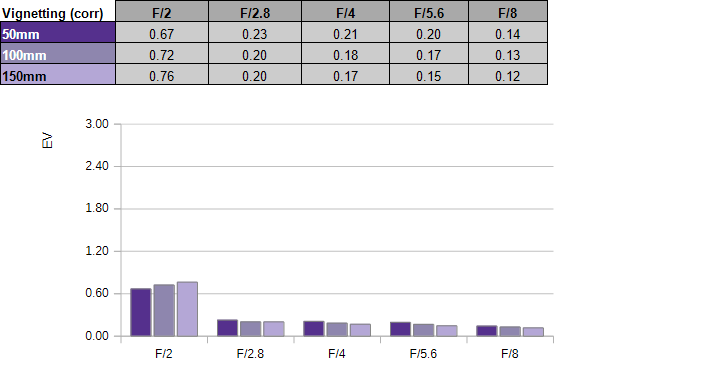
Autocorrection reduces this to 0.7 EV (f-stops) at f/2, which isn’t overly relevant anymore. The vignetting is basically gone from f/2.8 in this case.
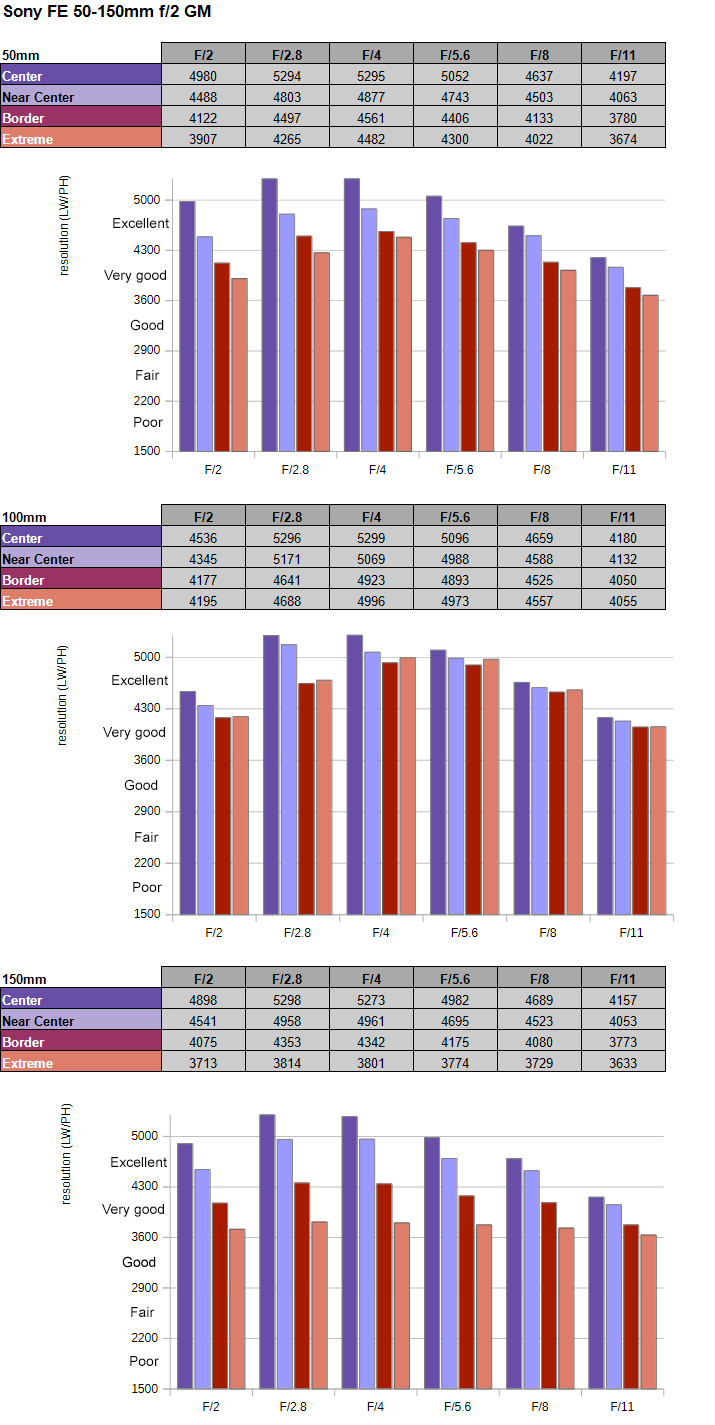
MTF (resolution) at 42 megapixels
The Sony FE 50-150mm f/2 GM produced (mostly) great resolution results in the lab. At 50mm, the center quality is already outstanding at f/2. The near center is excellent here, followed by a very good outer image field. Stopping down improves the quality a bit until reaching its peak at f/4, where the whole image field is tack sharp. At 100mm, there is a bit of a drop at f/2 (verified multiple times). The center quality is still excellent, although not breathtakingly high here. However, stopping down to f/2.8 lifts the quality to very lofty heights, with stunning quality reached at f/4. Interestingly, the center quality increases a bit again at 150mm f/2, and the near center is also excellent straight from the maximum aperture. The border quality is easily very good. The extreme corners are a little more suppressed without being anywhere near soft, though. Stopping down improves the overall quality a little. Generally, diffraction sets in at f/8, although f/11 remains usable.
The field curvature is negligible. The centering quality of the tested sample was good.
Please note that the MTF results are not directly comparable across the different systems!
Below is a simplified summary of the formal findings. The chart shows line widths per picture height (LW/PH) which can be taken as a measure of sharpness. If you would like to know more about the MTF50 figures, you may check out the corresponding Imatest Explanations.
Chromatic Aberrations (CAs)
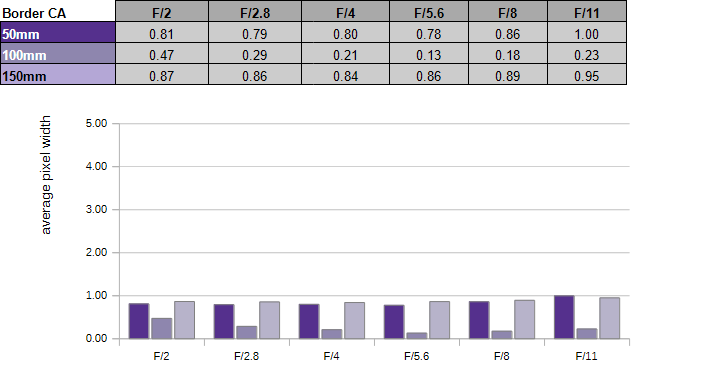
Lateral CAs are generally well managed. They are slightly elevated at the extreme ends of the zoom range, but at around 0.9px on average at the image borders, it’s not something to overly worry about. Autocorrection handles this nicely without any loss in image quality.
Bokeh
The inner zone of out-of-focus highlights is quite clean. You may spot a bit of an onion-like substructure and grain, but this won’t really matter much in real-world images (the uniformly black background in our test emphasizes this). There is no relevant outlining at f/2, although a bit of outlining develops when stopping down.
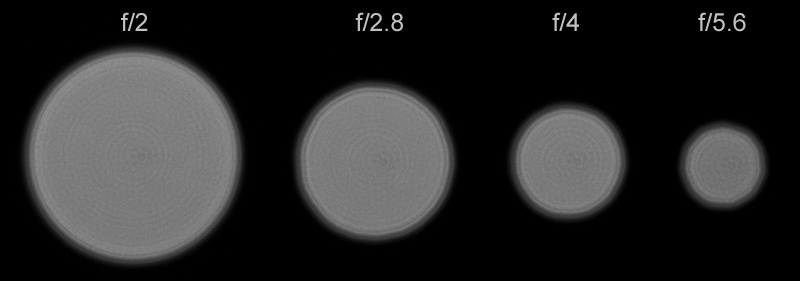
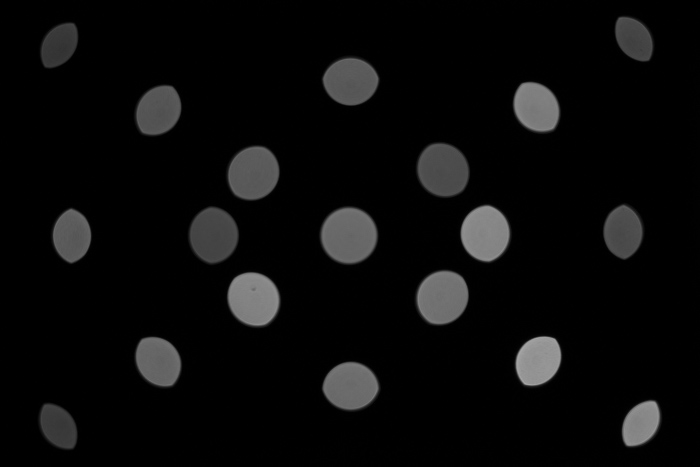
When looking at the highlight rendering across the whole image field, the circular shape of the discs remains intact only in the dead center. The shape deteriorates towards the mid-field already, and “cat eyes” are obvious at the borders. Stopping down to f/2.8 restores the circular discs in the mid-field. The border discs are back to normal at f/4, but the corner discs require f/5.6 here.



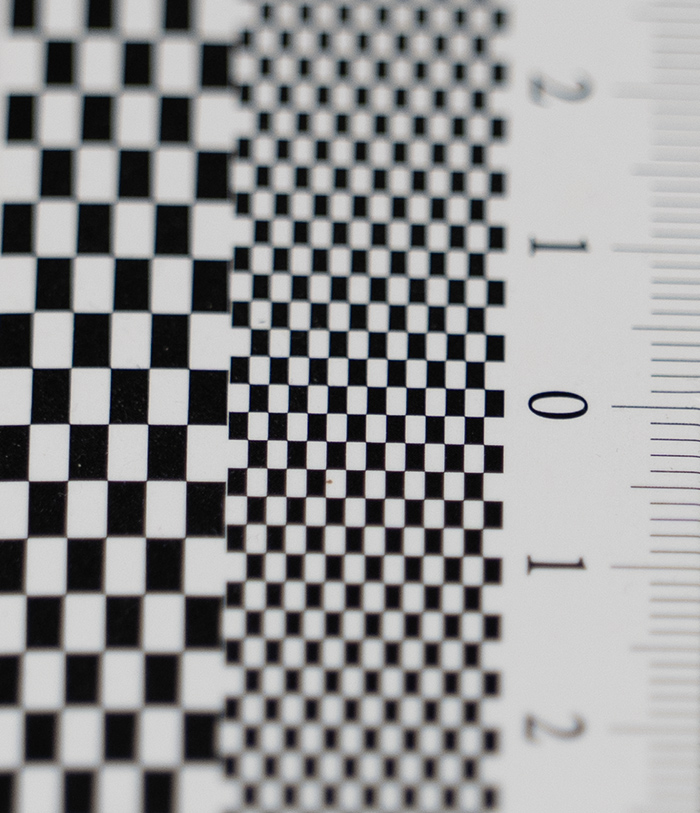
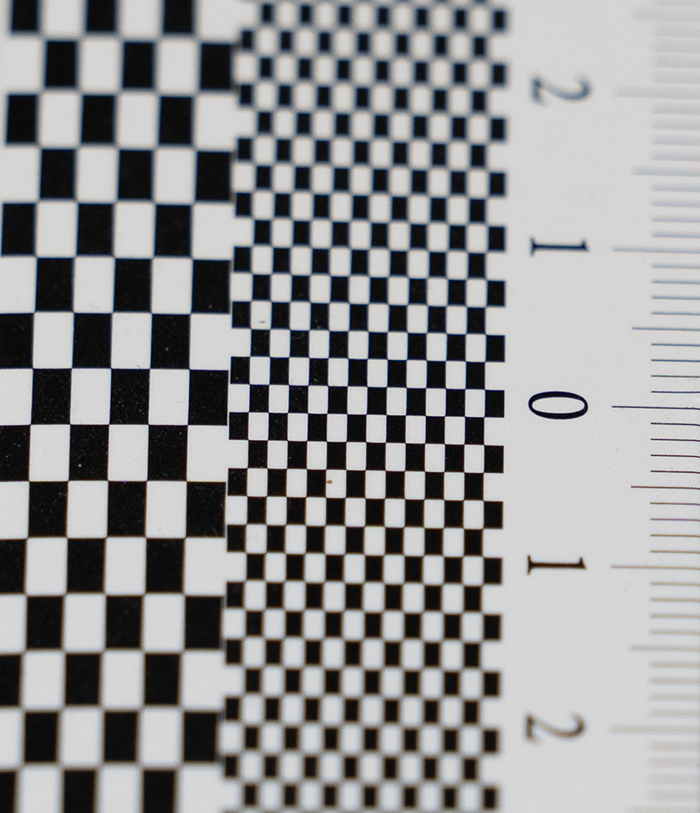
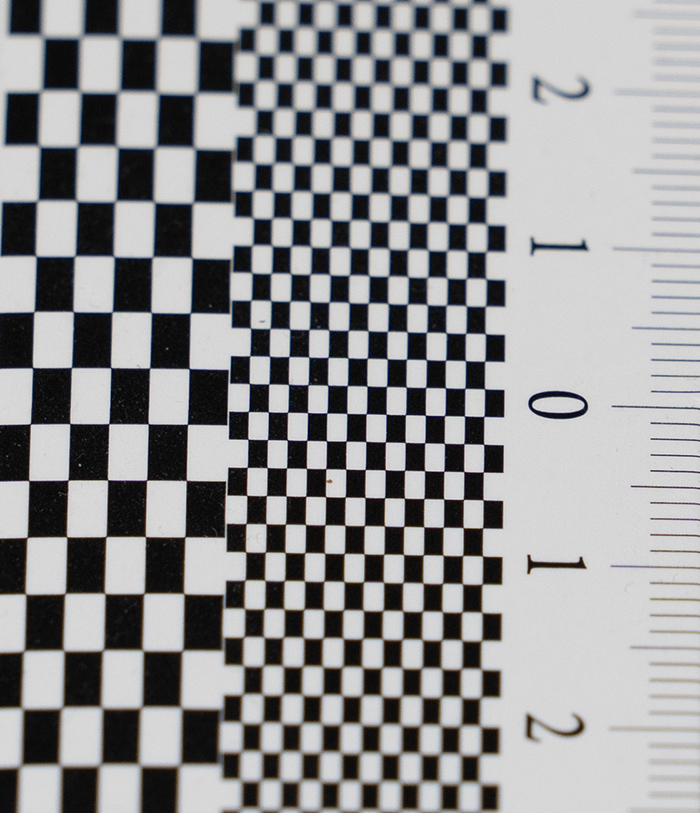
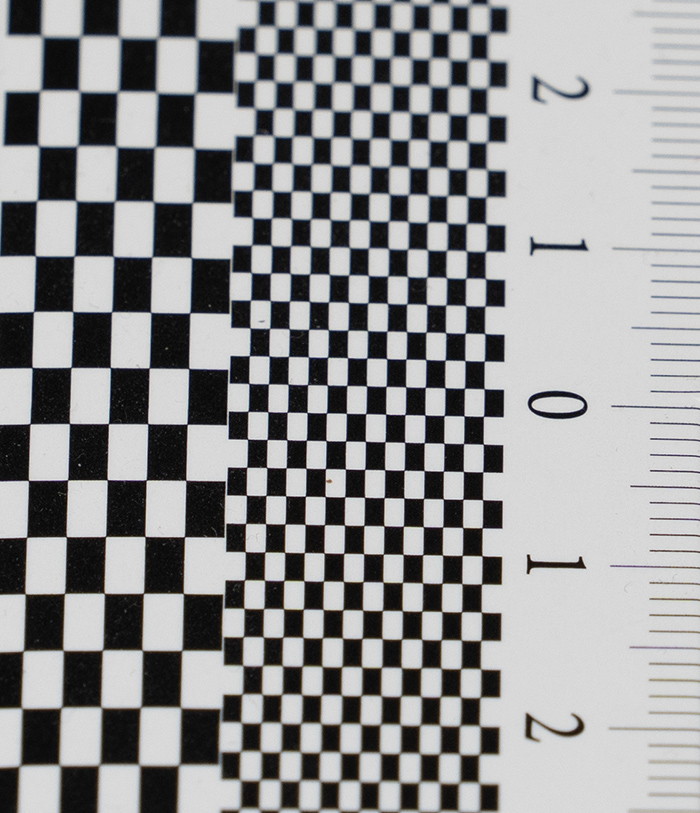
The rendering quality in the focus transition zone is generally good though not perfect. The background blur (shown to the left below) renders hard contrasts a bit harsh. The foreground blur (shown to the right) is very smooth in comparison.
For the non-believers – check THIS IMAGE in our sample gallery. The background blur is not ideal there, for sure.

Bokeh Fringing / LoCA
LoCAs, or bokeh fringing, is a color fringing effect on the Z-axis. It shows up with a purplish tint in front of the focus point and a greenish tint behind, and it’s nearly impossible to fully correct in post.
However, images produced by the Sony lens are already quite clean at f/2, with traces remaining at f/2.8 and f/4.
Competition
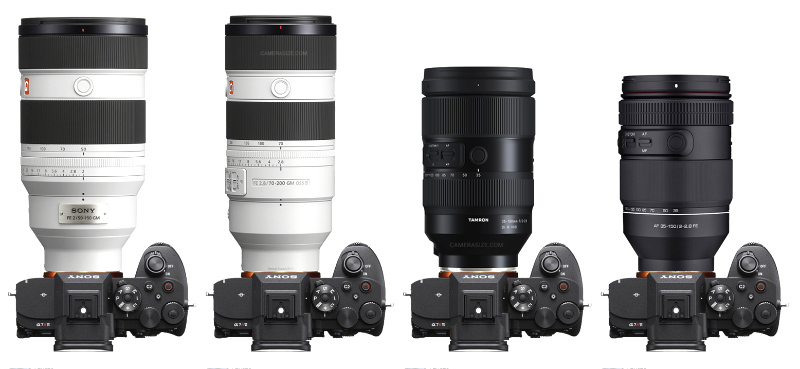
The Sony FE 50-150mm f/2 GM (to the left below) is currently unique with its specs. Lenses that may come close are the Samyang and Tamron 35-150mm f/2-2.8 (the two lenses to the right). While surely more versatile, these aren’t quite as exciting at the long end, though. However, many will probably compare it to the Sony FE 70-200mm f/2.8 GM II. In terms of sheer optical performance, there’s little between the two, so it comes down to whether you require the faster aperture and whether you can stand the price tag.
Sample Images


The Sony FE 50-150mm f/2. GM is certainly a dream lens in terms of specs. It's finally a zoom lens that can truly match the speed of prime lenses in (most of) the overlapping range. The optical performance is mostly superb except for a slight drop at 100mm f/2 and in the corners at 150mm. Image distortions, CAs and vignetting are low to moderate in RAW files, and easily autocorrected. Axial CAs are also very well controlled. The quality of the bokeh is the aspect where the lens struggles a bit. The background blur can be a bit busy in critical scenes, and "cat eye"-shaped out-of-focus highlights can be a thing at f/2. This doesn't negate the fact that you can achieve a very soft background if the focus spread is sufficient, of course.
In terms of build quality, the Sony lens is a tank. It feels exceptionally sturdy. Given the specs, the lens isn't lightweight at 1.3 kg, but I think nobody expected it to be a featherweight. It's not any longer than a 70-200mm f/2.8 either. The AF speed is very fast and silent. On the downside, it doesn't accept teleconverters. Some may miss an optical image stabilizer, although we actually like that Sony has been more conservative in this respect.
Overall, the Sony FE 50-150mm f/2. GM is certainly a game changer (although we don't like the overuse of this word in social media, really). It can indeed replace the prime lenses in its range. Most of the time, you won't be able to tell the difference anymore. As such - highly recommended!
If you'd like to support our work, please consider shopping for this or other lenses via one of the following partners:
* Amazon (US)
* Amazon (Europe)
* B&H (US)
* Adorama (US)
The Good
- Uniquely fast tele zoom lens
- High performance
- Relatively compact for an f/2 zoom lens
The Bad
- Background bokeh can be slightly busy in difficult scenes
- Not compatible with teleconverters
- Not cheap
- Expensive front filters (95mm)
- Tripod foot still not Arca-Swiss compatible
-
Optical Quality8.5
-
Build Quality9.5
-
Price Performance8