


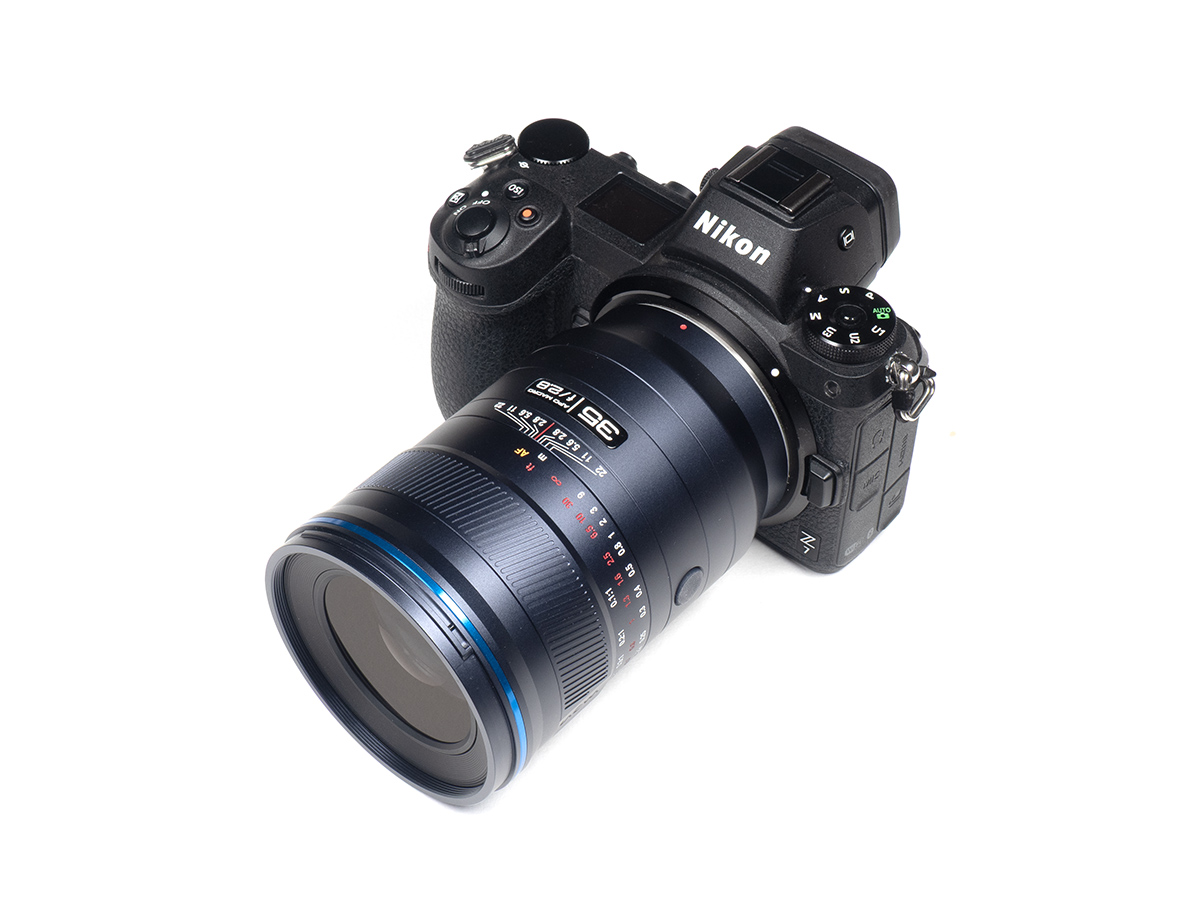
Laowa is an interesting brand. They like to step into the unknown with several exotic lenses in their lineup. Most of the lenses are still fully manual but they are now slowly transitioning to full electronic coupling including autofocus. Their primary area of expertise is macro lenses with no less than 18 (!) offerings at the time of this review. And here’s the next one then – the Laowa AF 35mm f/2.8 APO macro. An AF version is available in Sony E, Nikon Z, Fujifilm X and Canon EF mounts. The latter shows that this is actually a hybrid design for both mirrorless and DSLR cameras. I’m not sure whether this is really a smart decision by Laowa because this makes the lens rather long-ish for the mirrorless systems but it is what it is. A fully manual version is also available in Canon RF and L-mount. The retail price is $449 USD.
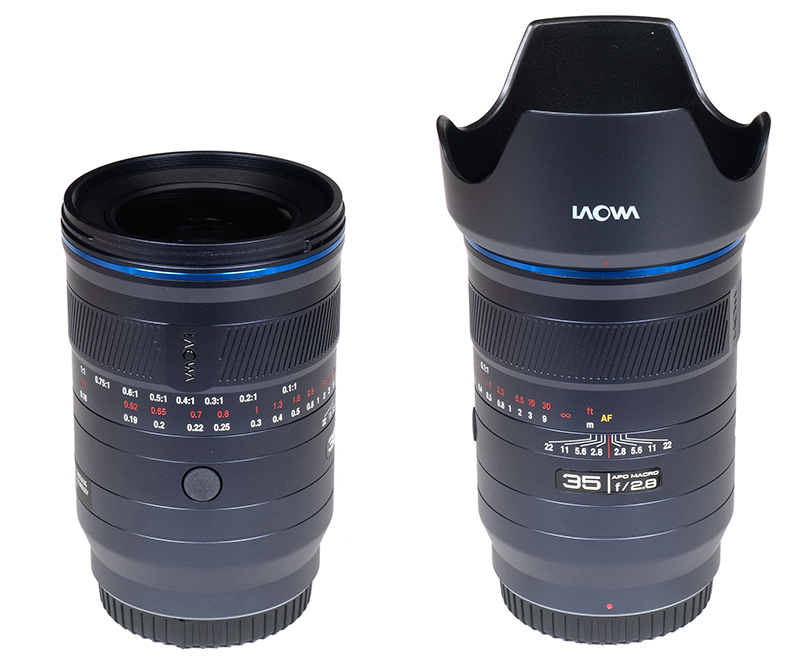
In terms of build quality it follows the design philosophy that we’ve seen in previous Laowa AF lenses. The outer shell is made of metal with a gunmetal-colored finish. The textured focus ring has a small indentation with the Laowa brand name. The focus ring is a bit special. Actually, quite a bit. There is no conventional AF/MF switch. Instead the focus ring itself has an AF position (past infinity focus). You just turn it into manual focus from here. The AF is not available throughout the focus range but only from 0.5m to infinity. Additionally, AF can also be used for prefocusing when the camera is set to AF mode while the lens is in MF mode. The latter is confusing because the focus distance markings on the lens are not aligned with the actual focus distance anymore. In real-life it probably won’t matter too much because you’ll most likely use AF at conventional focus distances and manual focusing for macro photography anyway. A petal-shaped lens hood is provided.
The AF is quite snappy and silent. Wide-angle macro lenses tend to have a very close working distance (front element to object) if you want to shoot at maximum object magnification (here 1:1). In case of the Laowa lens this translates to 4.86cm. This can be a limiting factor in some scenarios – e.g. with life critters.
Note: Our pre-release sample had a firmware bug. Make sure to download the latest firmware from the Laowa website.
| Specifications | |
|---|---|
| Optical construction | 13 elements in 10 groups (3x aspherical, 2x ED) |
| Number of aperture blades | 9 (13 in the MF version) |
| min. focus distance | 0.18m Max. magnification ratio 1:1 Min. working distance: 4.86cm |
| Dimensions | 79 × 87.4mm |
| Weight | 570g |
| Filter size | 72mm |
| Hood | petal-shaped (bayonet mount, supplied) |
| Other features | AF version: Sony E, Nikon Z, Fujifilm X, Canon EF MF version: Canon RF, L-mount Fn button |
Distortion
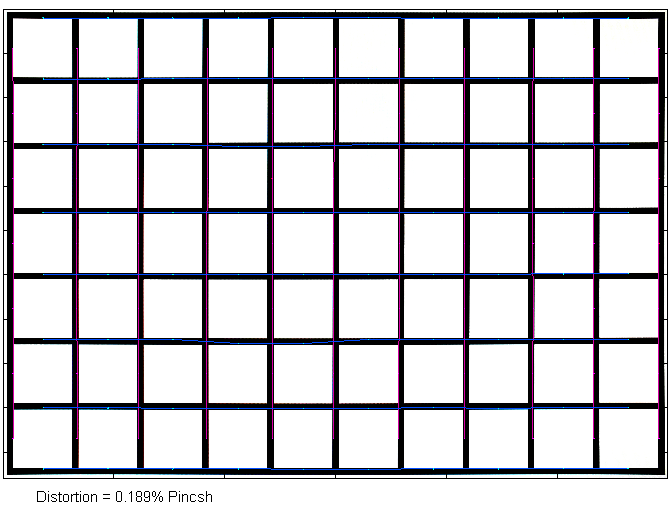
Most Laowa lenses have been fully corrected optically. The 35mm f/2.8 APO macro doesn’t require any distortion autocorrection either as you can see below.
Vignetting
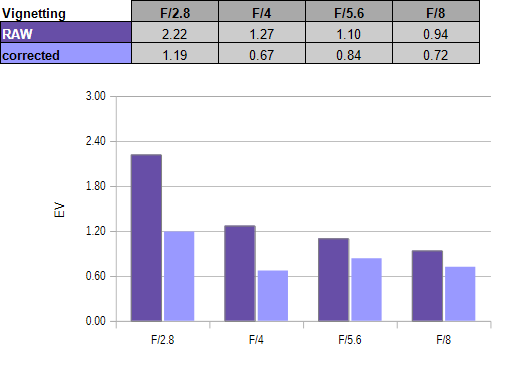
The vignetting in RAW images is quite heavy at over 2.2 EV (f-stops) at f/2.8. This is reduced by about 1 EV when stopping down to f/4. However, there’s still somewhat noticeable vignetting at f/8. Autocorrection does help here. At f/2.8, the vignetting is reduced to 1.2 EV (f-stops) at fully open aperture. Beyond f/2.8, the light falloff is fairly well controlled then.
MTF (resolution)
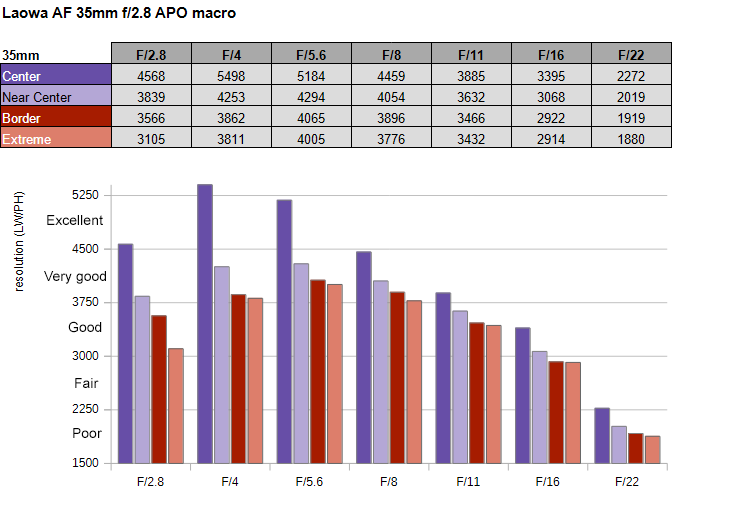
The Laowa AF 35mm f/2.8 APO macro delivered mostly decent resolution results in the lab. At f/2.8 the dead center is very good to excellent. There’s a noticeable drop towards the borders and corners. The corners only manage good results. Stopping down to f/4 lifts the quality substantially. The center reaches outstanding quality here followed by a very good near-center performance. The outer image field is good to very good here. The best results overall are achieved at f/5.6 with the borders/corners reaching very good quality. Diffraction has an impact from f/8 although you probably won’t notice it until f/11. f/16 is still OK, but f/22 is a pixel soup – this is not the fault of the lens but just physics.
The centering quality of the tested sample was good. The field curvature is medium at longer focus distances.
Please note that we can only test the resolution at a rather conventional focus distance. The results may vary at true macro distances.
Please note that the MTF results are not directly comparable across the different systems!
Below is a simplified summary of the formal findings. The chart shows line widths per picture height (LW/PH) which can be taken as a measure for sharpness. If you are keen to know more about the MTF50 figures, you may check out the corresponding Imatest Explanations.
Chromatic Aberrations (CAs)
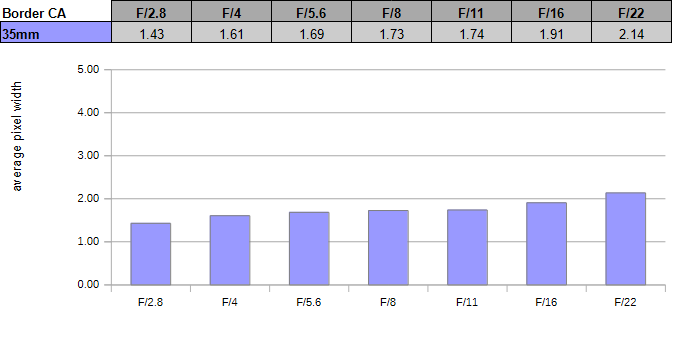
The lateral CAs (color shadows at hard contrast transitions) are slightly elevanted with an average CA pixel with between 1.4px at f/2.8 and more than 2px at f/22. The autocorrection profile doesn’t seem to cover the correction of the CAs so you’ll have to do it manually or leave it to the capabilities of your RAW converter.
Bokeh
While a 35mm f/2.8 may not be terribly fast at conventional focus distances, you will have to deal with a very shallow depth-of-field in macro photography. So let’s check the bokeh of the Laowa lens.
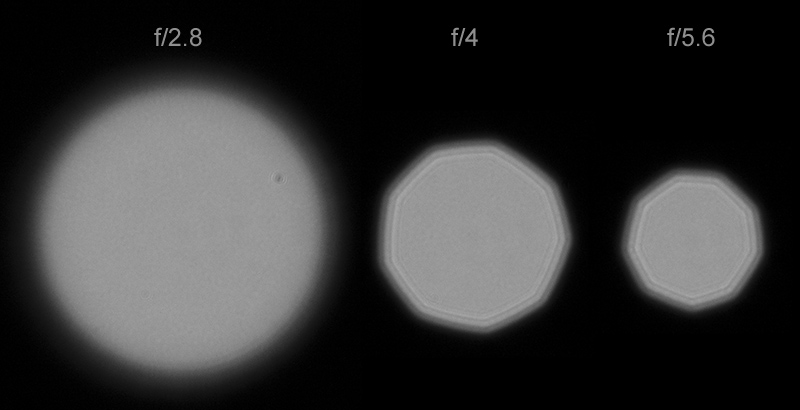
Out-of-focus highlights have a very unusual characteristic that I can’t really explain to you. The center highlight at f/2.8 has a very feathered edge transition as you can see below. We have only seen this with APD lenses but the Laowa AF 35mm f/2.8 APO macro isn’t classified as one. The inner zone of the disc is very smooth. Stopped down to f/4, the characteristic changes rather dramatically. The 9-edged aperture blade becomes obvious and the disc edge shows some obvious outlining. This continues at f/5.6.
Note: I repeated this test a couple of times to confirm that the soft rendering at f/2.8 is “a thing”.
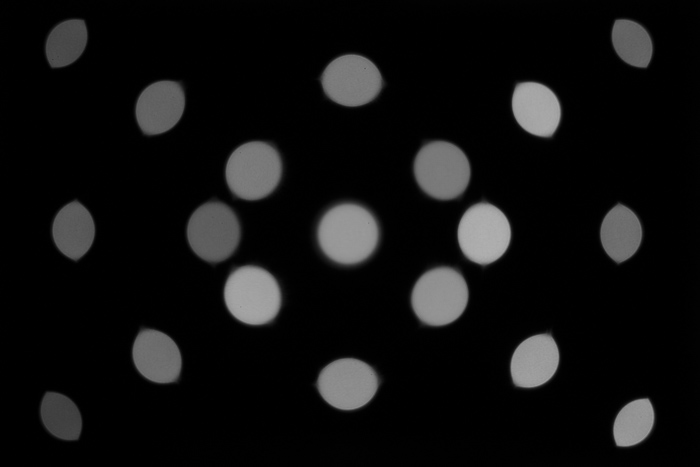
The soft circular highlight shape is only maintained in and near the image center. It fades from the midfield and the disc shape deteriorates to “cat eyes” at the borders and corners. Stopping down to f/4 restores most of the highlight discs to their near-circular form. The corner discs are restored from f/5.6.
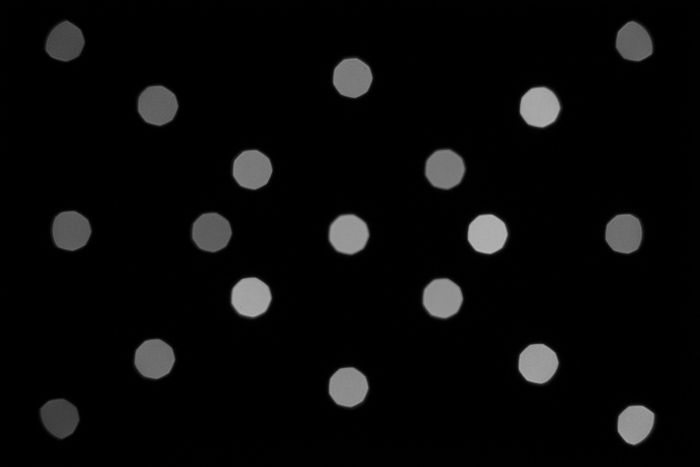
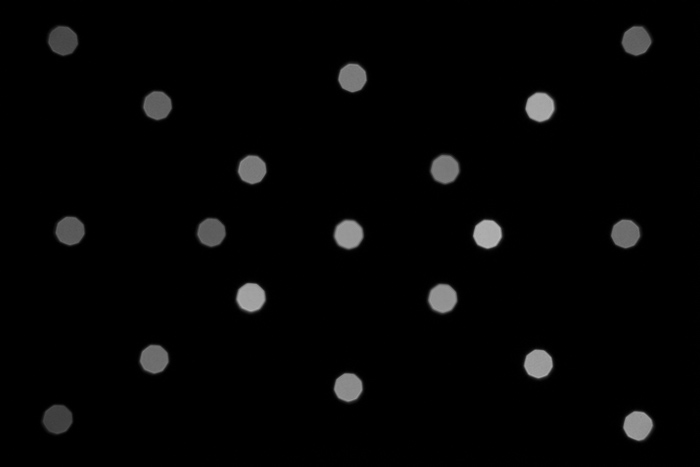
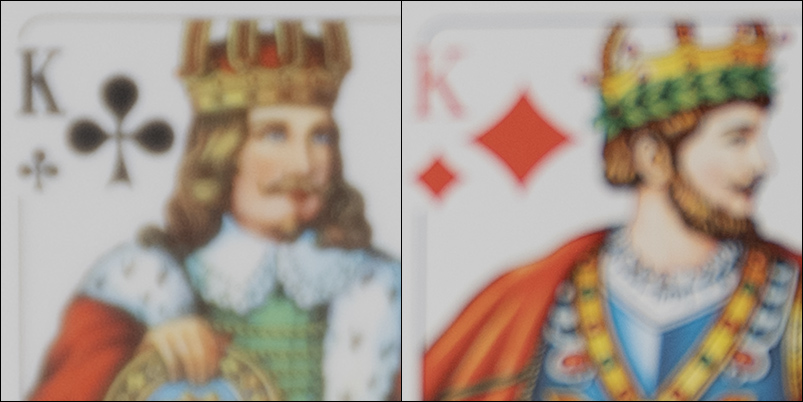
The general rendering in the focus transition zone towards the background is smooth although slightly asymmetrical and a bit lower in contrast (to the left below). The less important foreground blur is more contrasty and somewhat harsher.
Bokeh Fringing / LoCA
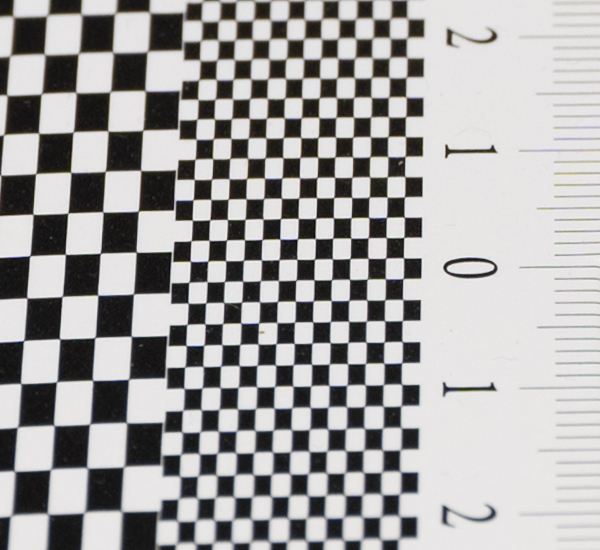
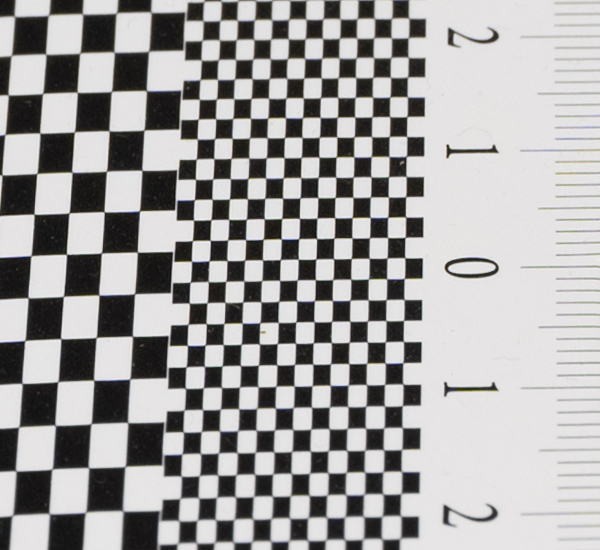
Bokeh fringing is an axial color fringing effect. It can show up as purple halos in front of the focus point and greenish halos in the background.
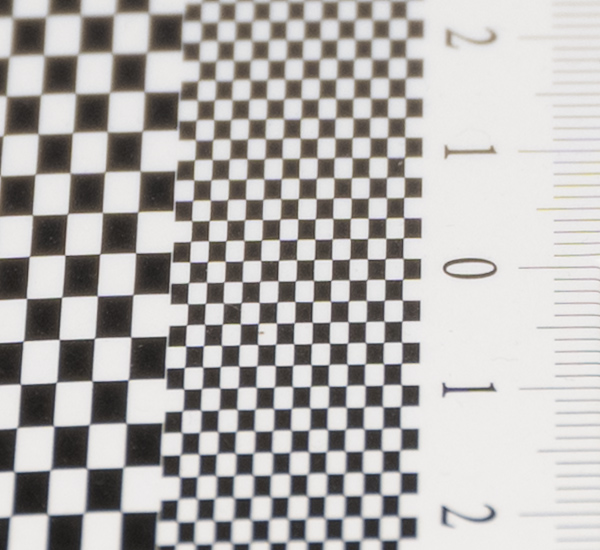
Laowa claims that the 35mm f/2.8 is an APO lens. We wouldn’t confirm this at f/2.8 at least. You may spot below that there’s a bit of color fringing going on at the front and rear of the focus point. However, the fringing is basically gone at f/4 already.
Stars
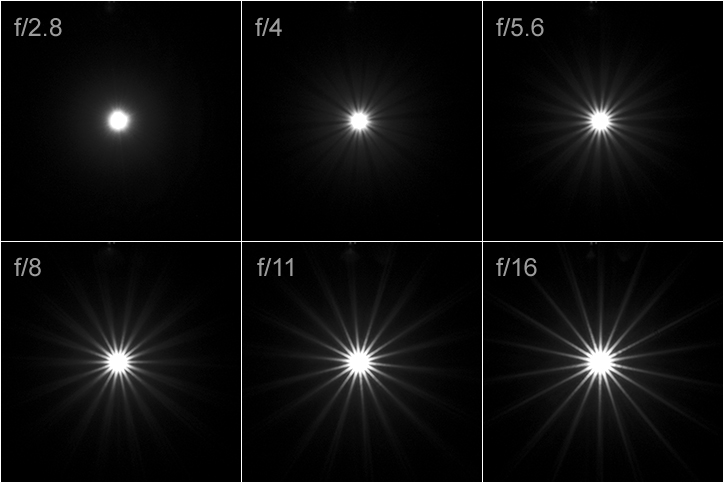
Sun stars are diffraction spikes from the aperture that show up if a bright spot light source is part of the scene (usually lights during the night or the sun). At f/2.8 the aperture is circular thus, as usual, a pointy light source is just a “blob”. This changes a bit at f/4 and “nicer” rays start to appear at f/5.6. They increase in intensity at f/8 and are best at f/11 and f/16. As you can see below the rays are very pointy which is what we want here. The 9 aperture blades of the lens result in 18 rays.
Competition
In Nikon Z mount there is currently no other wide-angle macro lens featuring autofocus. There are, of course, heaps of conventional 35mm AF lenses. If you want something truly exotic Laowa is also offering a 35mm f/2.8 Zero-D Tilt-Shift 0.5x macro. It has no AF but offers tilt-shift functionality.
Sample Shots


The Laowa AF 35mm f/2.8 APO macro is a solid lens with some quirks. Optically, it delivers convincing results from f/4 to f/11. The corners could be a bit sharper at f/2.8, though. Image distortions are not an issue as with most Laowa lenses. The RAW vignetting is a tad high but well autocorrected. Lateral CAs are OK, and axial CAs are low. The quality of the bokeh is mostly fine which is an important factor for a macro lens.
Speaking of the quirks - they are primarily on the mechanical side. It is a hybrid design for both DSLRs and mirrorless cameras meaning that it is physically a bit long on mirrorless cameras. Laowa has also opted for the rather unusual way to switch between AF and MF by turning the focus ring. This is accompanied by limiting the AF to 0.5m to infinity. The distance markings on the lens can be misleading in semi-AF mode (or however you may call it). In real-life this is probably a lesser issue than it sounds once you are used to it. In terms of material quality, Laowa is certainly up there with an all-metal lens body and the typical Laowa gunmetal finish.
35mm macro lenses aren't overly popular due to the close working distance, but if you like the idea of combining a macro and wide-angle lens, the Laowa could be something on your list.
The Good
- Focuses down to a 1:1 object magnification
- Doesn't require much digital autocorrection
- Nice finish and quality perception
- Good bokeh
- Nice sun stars
The Bad
- Restrictions on the AF range
- Rather big on mirrorless cameras
- Confusing focus distance markings
-
Optical Quality7
-
Build Quality7
-
Price Performance8