


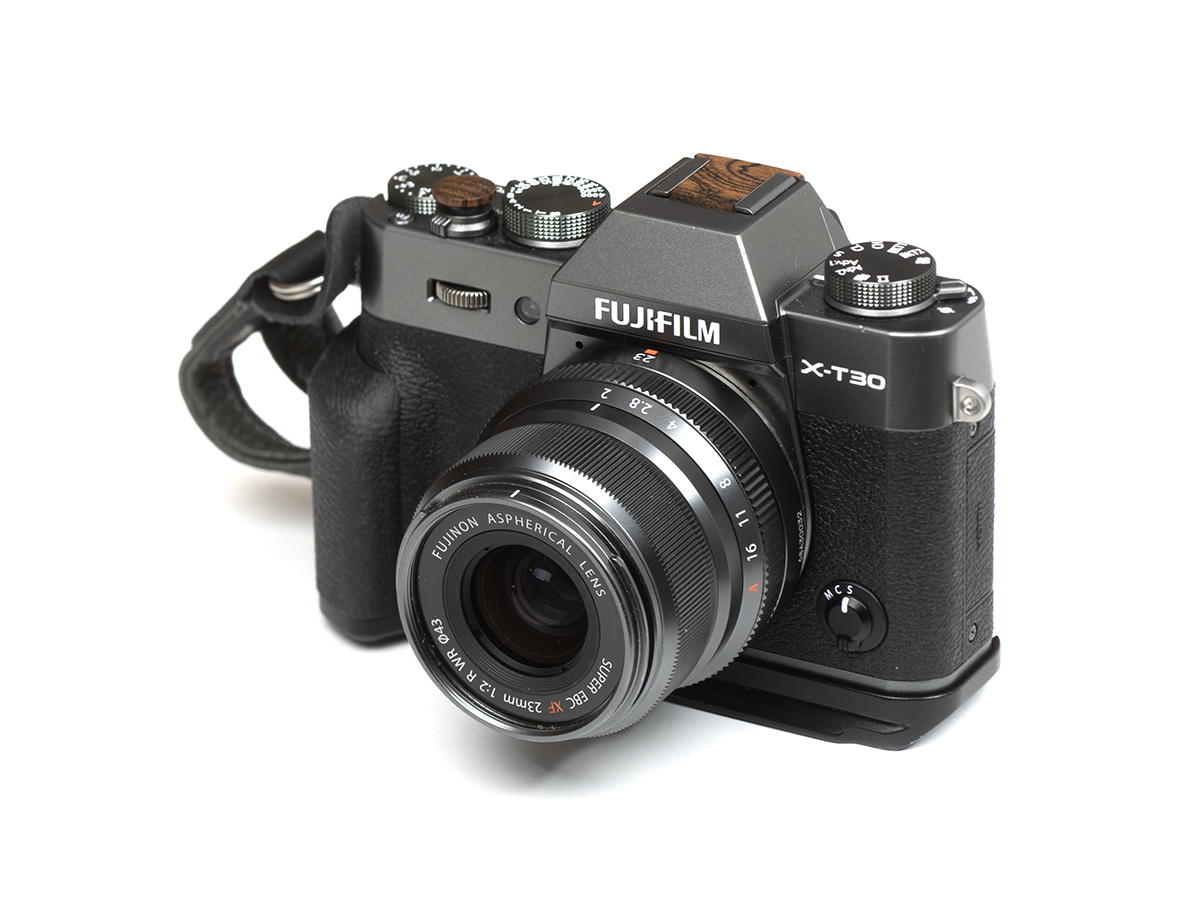
Let’s take another look at one of the older “Fujicrons” – the Fujinon XF 23mm f/2 R WR. It offers a field of view that is equivalent to 35mm on a full-frame camera. This focal length was already covered by the XF23/1.4 R, which is, however, a bit bulky and also rather expensive. For anyone who doesn’t need the speed or is concerned by the size or price, the f/2 lens is a welcome alternative.
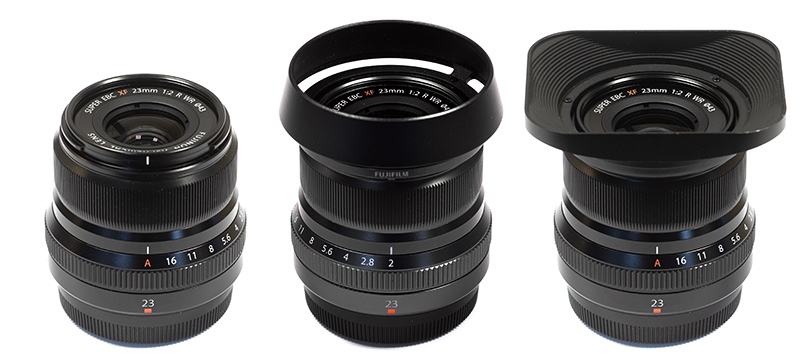
The Fujinon offers the same high level of build quality that we have seen on the XF 35/2 already. So, there’s a sturdy metal body based on a metal mount, weather-sealing, a broad focus ring and a dedicated aperture ring that offers click stops in 1/3 EV increments. The only thing that falls short of the high quality perception is the provided dome-shaped plastic hood. It does the job, but the material mix looks and feels a bit odd. A higher quality alternative is the LH-XF35-2, a metal hood that fits both the XF 35/2 and this lens, but one has to invest another 60 EUR/USD for it, quite a bit for a small piece of metal.
The XF 23mm f/2 R WR uses on older style micro-motor. It’s still fast because it doesn’t have to shift much around.
| Specifications | |
|---|---|
| Equiv. focal length | “35mm” (full format equivalent) |
| Equiv. aperture | “f/3” (full format equivalent, in terms of depth-of-field) |
| Optical construction | 10 elements 6 groups (2x aspherical) |
| Number of aperture blades | 9 (circular) |
| min. focus distance | 0.22m (max. magnification ratio 1:7.7) |
| Dimensions | 60 x 51.9mm |
| Weight | 180g |
| Filter size | 43mm |
| Hood | supplied, dome-shaped, bayonet mount Optionally LH-XF35-2 |
| Other features | weather-sealing aperture ring |
Distortion
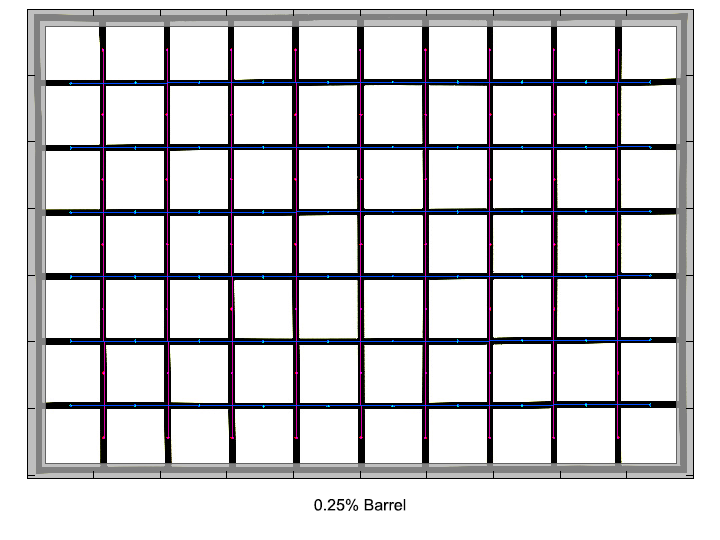
The lens shows only a tiny and unnoticeable amount of barrel distortion – both in JPEGs as well as raw files. This is a positive surprise, since on many XF lenses Fuji relies on software correction of distortion instead. However, we have seen similar on the fast XF 23/1.4 already, which also shows virtually no distortion.
Vignetting
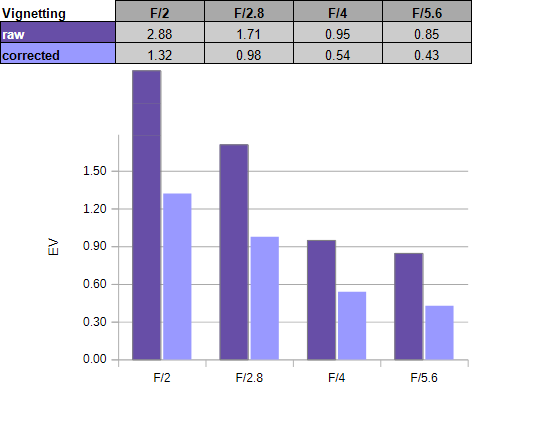
Unfortunately, we cannot report the same about vignetting. Auto-correction takes care of the issue to some extent, reducing the light falloff to roughly 1.3 stops at the largest apertures and around 0.4 EV stopped down to f/8. However, the native vignetting characteristic of the lens, which becomes visible when autocorrection is switched off, is less exciting: more than 2.8 stops wide open and still around 0.9 stops even when stopped down.
MTF (resolution at 26 megapixels)
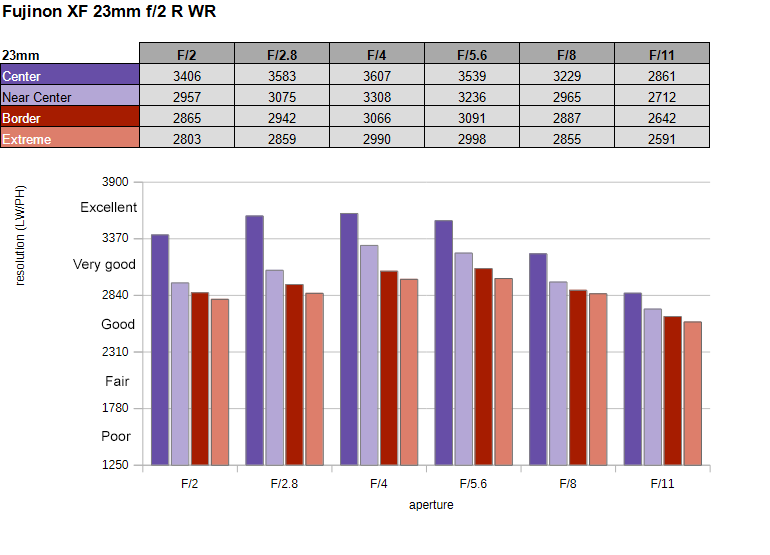
Things look better in terms of resolution: in the dead image center, the lens delivers very good excellent sharpness straight at f/2 although the quality drops near the center quite a bit already. The border and corner resolution is good to very good. Stopping down gradually improves the results with peak performance reached between f/4 and f/5.6. The center quality is excellent here and the outer image field sharpened up a bit as well. Diffraction impacts the quality at f/8. f/11 remains usable.
Please note that the MTF results are not directly comparable across the different systems!
Below is a simplified summary of the formal findings. The chart shows line widths per picture height (LW/PH) which can be taken as a measure for sharpness. If you are keen to know more about the MTF50 figures, you may check out the corresponding Imatest Explanations
Chromatic Aberrations (CAs)
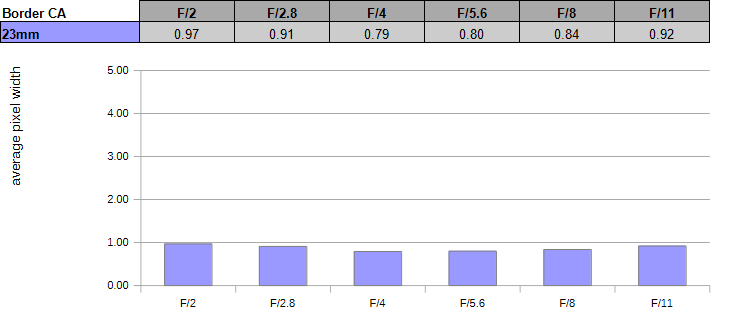
Lateral CAs (color shadows at hard contrast transitions) are well controlled with average values of roughly 0.8 pixels at the image borders throughout the tested aperture range.
Bokeh
An 23mm f/2 isn’t ideal for shallow depth-of-field photography but it is still a fast APS-C format lens, so let’s check the bokeh.
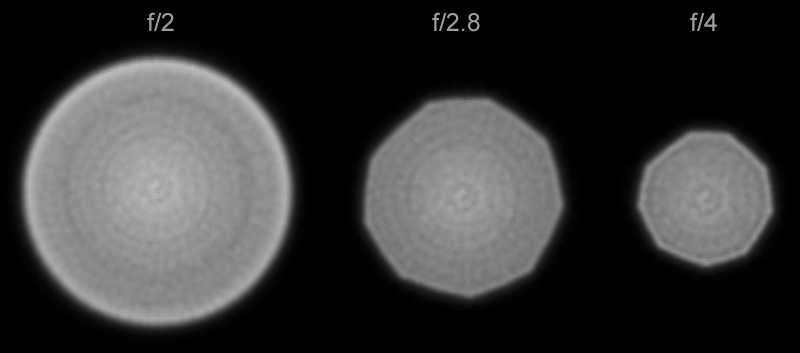
Out-of-focus center highlights have a fairly grainy inner zone and we can also spot some onion-ring – probably curtesey of the aspherical elements in the optical system. The edge of the disc also shows a fairly strong outlining at f/2. The edgy aperture shape is clearly visible from f/2.8.
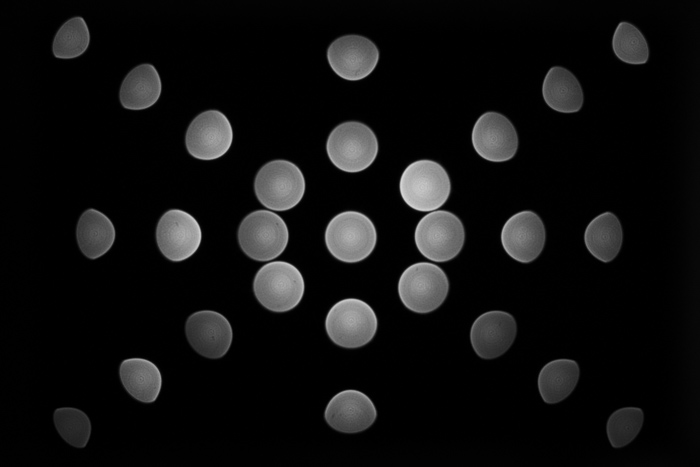
The circular highlight shape is only maintained near the center when shooting at f/2. The mechanical vignetting is causing “cat eyes” from the midfield into the corners. You may also spot the rather extreme disc outlining (one-sided) here. Stopping down to f/2.8 fixes all but the far corner highlights and their “natural” shape is restored from f/4.
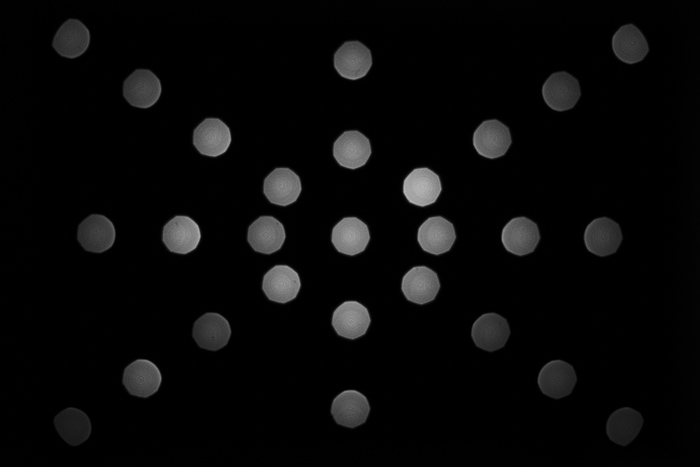
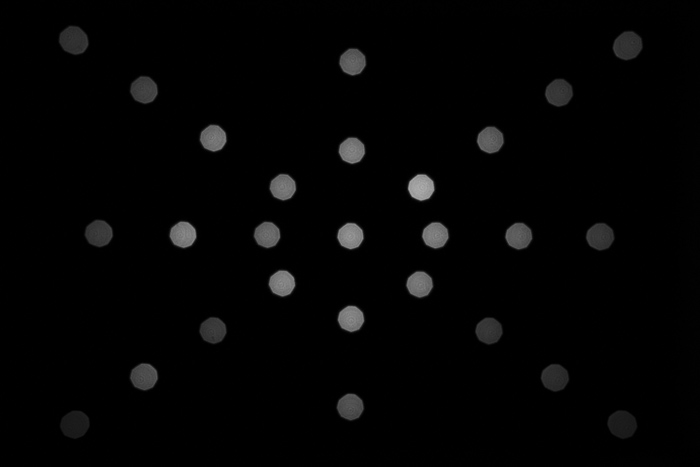
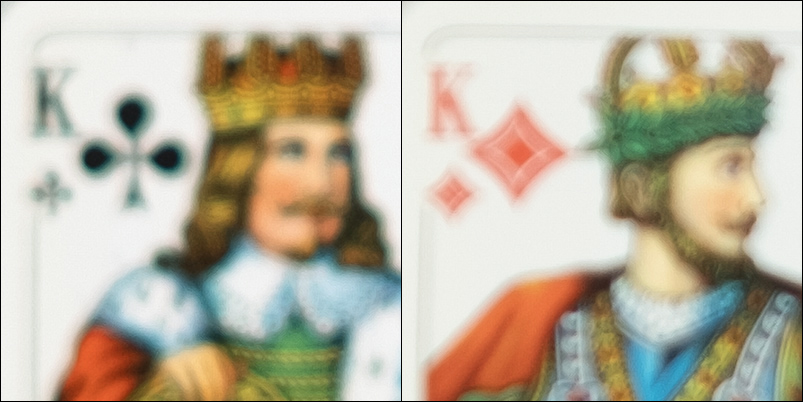
The general rendering in the focus transition zone is OK for such a lens. The background blur (shown to the left) is quite smooth although a bit hazy. The foreground blur (to the right) is more rough with more distinctive edges.
Bokeh Fringing
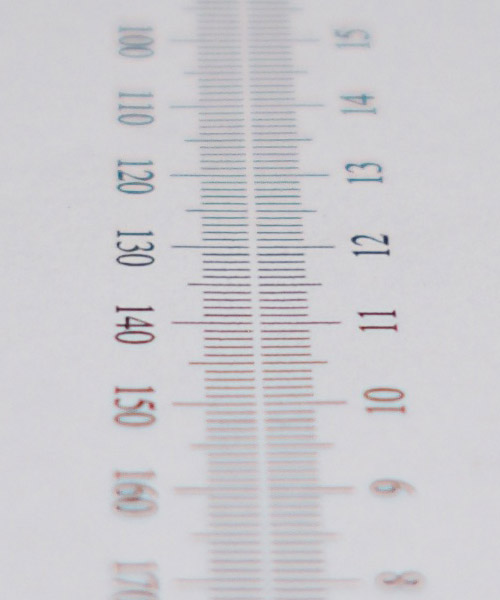
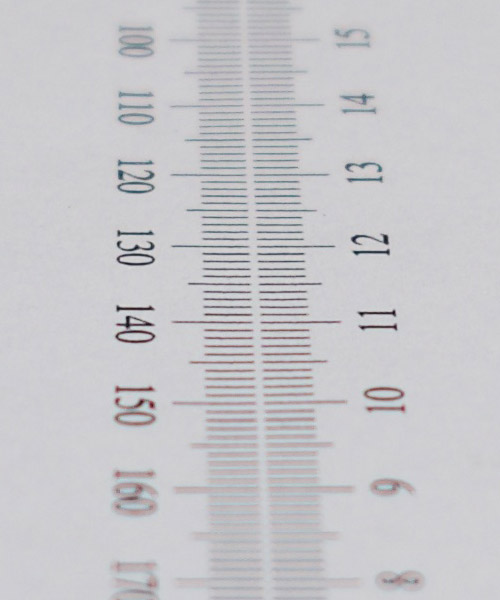
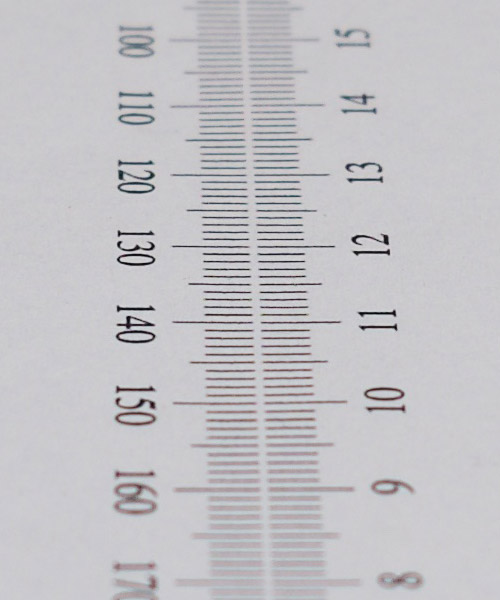
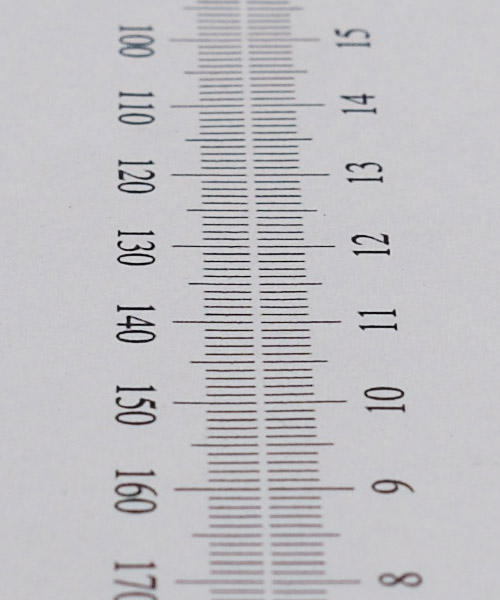
Bokeh fringing (non-coinciding focal planes of the various colors) is a common issue with relatively fast glass. As you can notice below the halos have different colors – magenta (red + blue) in front of the focus point and green beyond. Unlike lateral CAs, bokeh fringing cannot easily be fixed in post processing.
Typical for most fast primes, the Fujinon shows some bokeh fringing at large aperture settings. Some traces remain at f/4 and the issue is gone from f/5.6.
Competition
It is getting crowded in X-mount as well now. There is Fujifilm’s own XF 23mm f/2.8 R WR – a pancake lens. It’s a bit slower but optically a bit better. The XF 23mm f/1.4 R LM WR is Fujifilm’s crown jewel in this range but at double the price it’s not really in the same league. An interesting contender is the Sigma 23mm f/1.4 DC DN Contemporary. While being much faster, it is still fairly similar in price. There’s also the Sirui Sniper 23mm f/1.2 which is faster still but it’s a bit of an unknown entity to us.
Sample Shots


The Fujinon XF 23 f/2 R WR is a nice little prime with lots of strengths but some weaknesses as well. The build quality is exceptional, except for the included plastic hood. Apart from that, the lens just feels sturdy while remaining compact and light-weight. AF is very fast and virtually silent. Sharpness is generally high. Image distortion and lateral CAs are well controlled. The vignetting is a bit steep at f/2, though. Autocorrection takes care of that to a good part. Bokeh is ok, but not great. However many wide-angle lenses struggle in this regard.
In summary, the lens still delivers a solid performance. However, watch out for sample variations.
If you'd like to support our work, please consider shopping for this or other lenses via one of the following partners:
* Amazon (US)
* B&H (US)
* Adorama (US)
* KEH (used gear, US)
The Good
- Excellent build quality
- Fast AF
- Consistent sharpness
The Bad
- Not the greatest bokeh around
-
Optical Quality7
-
Build Quality9
-
Price / Performance7