


Introduction
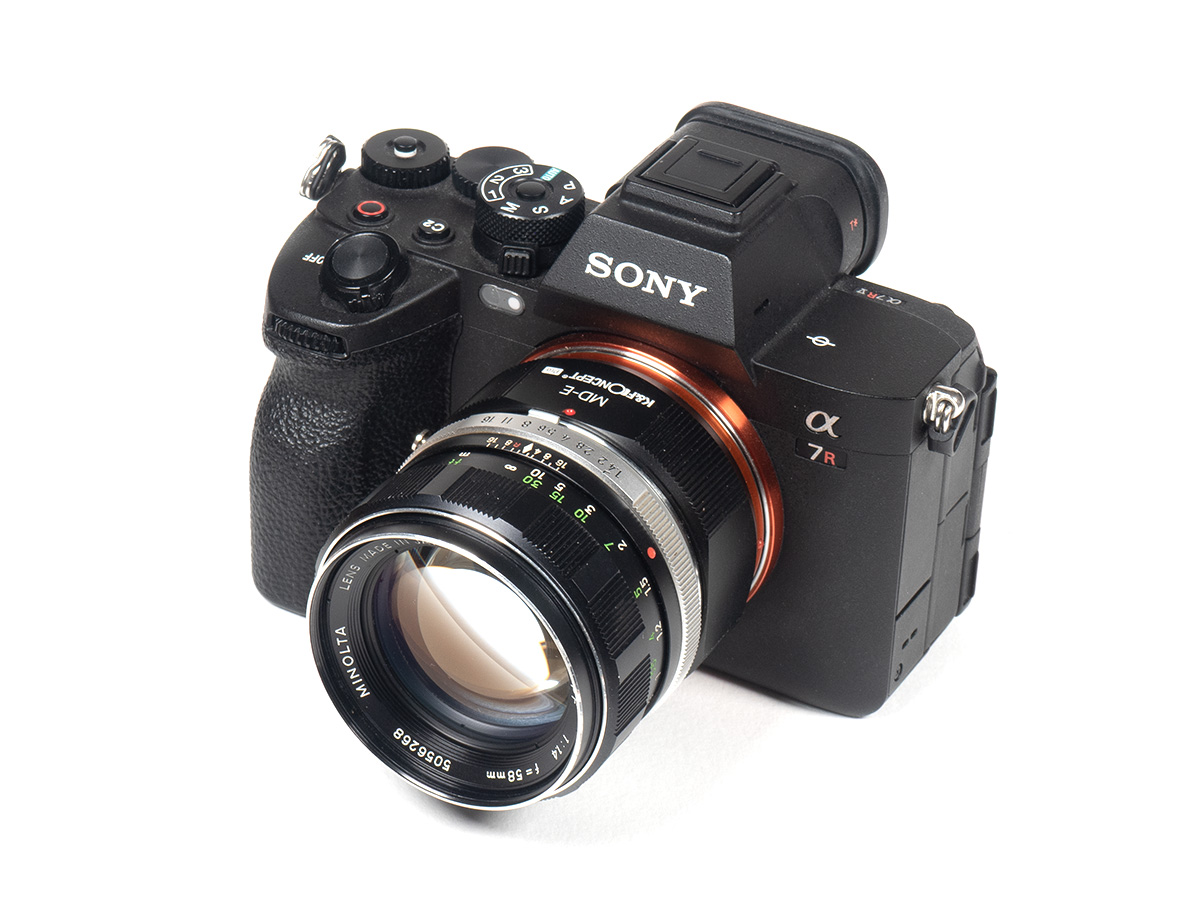
The Minolta MC Rokkor-PF 58mm f/1.4 is a “legendary” piece of glass among vintage lens enthusiasts. It is sometimes referred to as the “bokeh king” of its era. Some love its “dreamy” wide-open rendering and its transition into a (fairly) sharp performer once stopped down.
There are two versions of the MC 58mm f/1.4. The tested sample is an “MC I” first released in 1966 with a flatter, more traditional metal knurled focus grip. This was followed by the MC II, released in 1969, which has a “hills and valleys” focus grip. Just like most other vintage lenses that we tested to date, you should be able to find used samples anywhere between $80 and $150 USD. Minolta MD adapters to mirrorless camera mount can be easily found on eBay.
The MC in the lens name doesn’t relate to multi-coating but to Meter Coupled. It allowed the lens to communicate the selected aperture to the camera’s light meter, a high-tech convenience at the time. You may wonder about the “58mm” here. Before 50mm became the universal “standard,” many manufacturers favored 58mm. This slightly longer focal length made it easier for engineers to clear the flipping mirror of SLR cameras while maintaining a large f/1.4 aperture.
There’s also an interesting story around the “PF”. During this era, Minolta used a two-letter coding system to describe the lens construction:
- P = Penta (5 groups)
- F = Six (6 elements)
Therefore, the PF reflects the fundamental optical layout.
Unlike some 58mm lenses of that era (like the Takumar 50mm f/1.4), the Minolta PF 58mm does not use Thorium elements, so you don’t have to worry about the glass yellowing over time. The faster 58mm f/1.2 is radioactive.
| Specifications | |
|---|---|
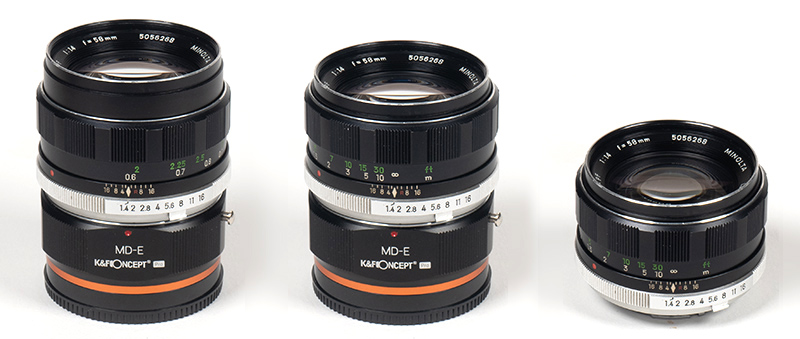
| Optical construction | 6 elements in 5 groups |
| Number of aperture blades | 6 |
| min. focus distance | 0.6m (max. object magnification ?) |
| Dimensions | 65 x 42mm |
| Weight | 275g |
| Filter size | 55mm |
| Hood | – |
| Other features | – |
| Mount | Minolta MD (SR Mount) |
Distortions
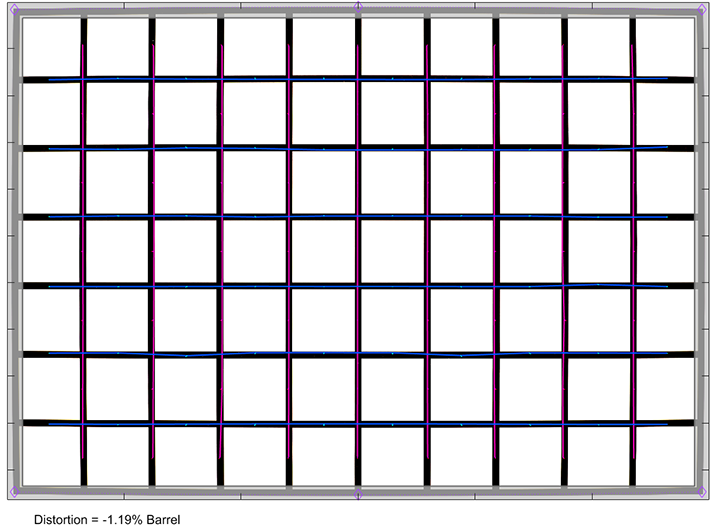
Back in the day, there was, of course, no image auto-correction; thus, designers had to optimize the real thing. The 58mm f/1.4 shows just a bit of barrel distortion. At just 1.2%, it can usually be ignored, though.
Vignetting
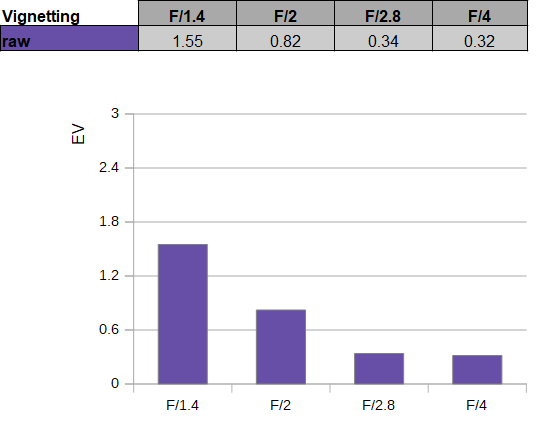
The vignetting is moderate for a fast prime lens. The light falloff peaks at ~1.5EV (f-stops) at f/1.4. Stopping down to f/2 cuts this almost by half, and it’s negligible from f/2.8 onward.
MTF (@ 42mp on Sony Full Format)
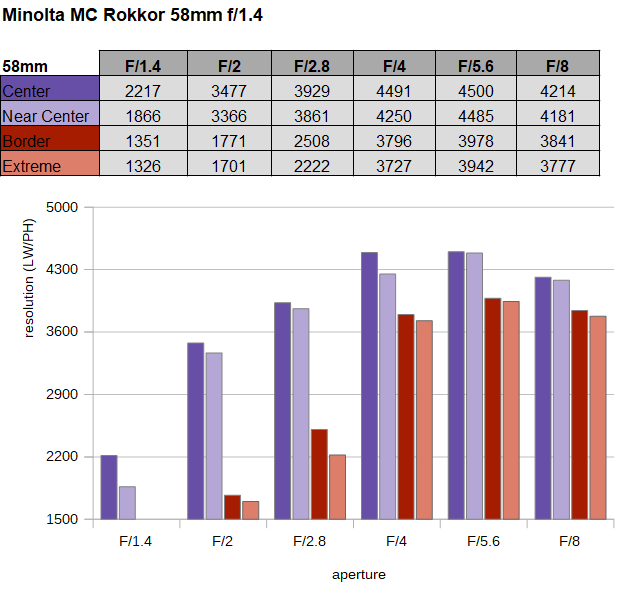
Released 60 years ago at the time of this review, it was an era before UD elements and aspherical elements just started to emerge but only in high-end lenses. Thus, if you are after a sharp, cheap vintage lens, this isn’t one of them. At f/1.4, it is about as “dreamy” (aka blurry) as it gets. If that’s the effect that you are after, this isn’t a bad thing, though. Stopping down to f/2 results in a dramatic image quality improvement already. The broader center is almost very good, although there isn’t much in it in the outer image field. f/2.8 improves this further, but the real deal starts from f/4, where this old lady is almost comparable to modern lenses across the image field.
Please note that the MTF results are not directly comparable across the different systems!
Below is a simplified summary of the formal findings. The chart shows line widths per picture height (LW/PH) which can be taken as a measure of sharpness. If you want to know more about the MTF50 figures, you may check out the corresponding Imatest Explanations.
Chromatic Aberrations (CAs)
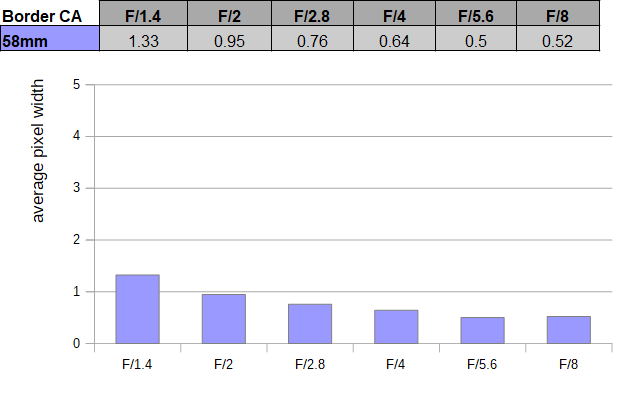
Lateral CAs aren’t too bad. They are somewhat noticeable at f/1.4 with an average pixel width of 1.3px at the image borders. The CAs decrease the more you stop down, and they are irrelevant from f/4-ish.
Bokeh
One aspect that is often criticized in modern lenses is the “lifeless” bokeh. This can’t be said about this Rokkor – which may be a good or bad thing dependent on your perspective on this.
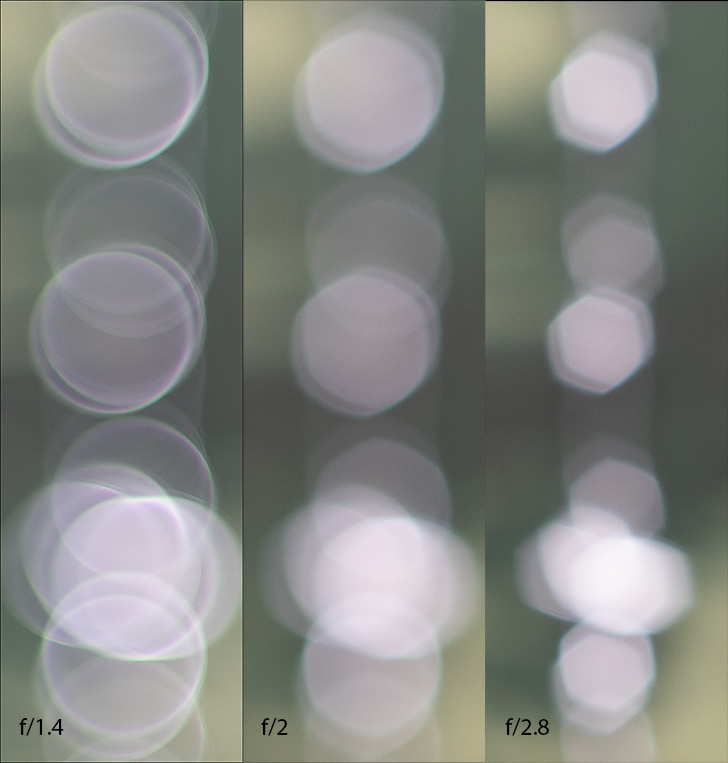
You can already see below that the highlight rendering at f/1.4 is “special” – to be precise, it’s very bubbly with a rather extreme outlining of the highlight discs. The outlining is gone at f/2, although the edgy aperture is creeping in here already. And it’s more so at f/2.8.
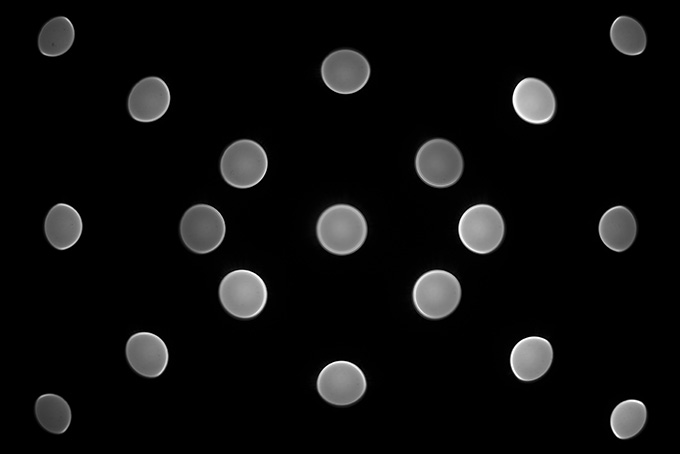
The bubble bokeh at f/1.4 is also very obvious beyond the image center as you can see below. The highlight discs deteriorate towards the corners without getting too edgy, though. As usual, stopping down restores some of the circular shape, but the bubbly magic is gone then.


The quality of the general blur in the focus transition zone is a bit of a mixed bag at maximum aperture. As you will immediately notice, the rendering is very washed out and hazy – especially in the foreground (the right crop below). The background blur (to the left) is very smooth, though.
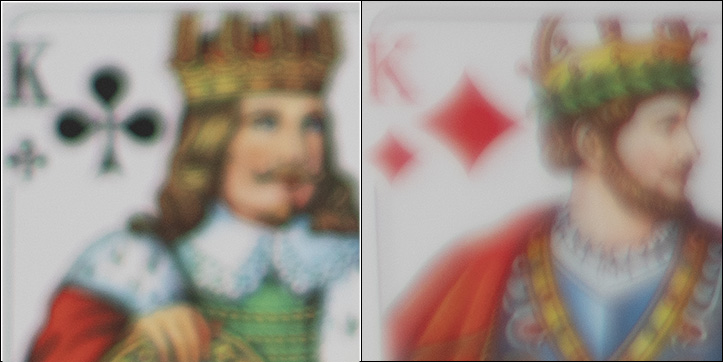
Bokeh Fringing / LoCA
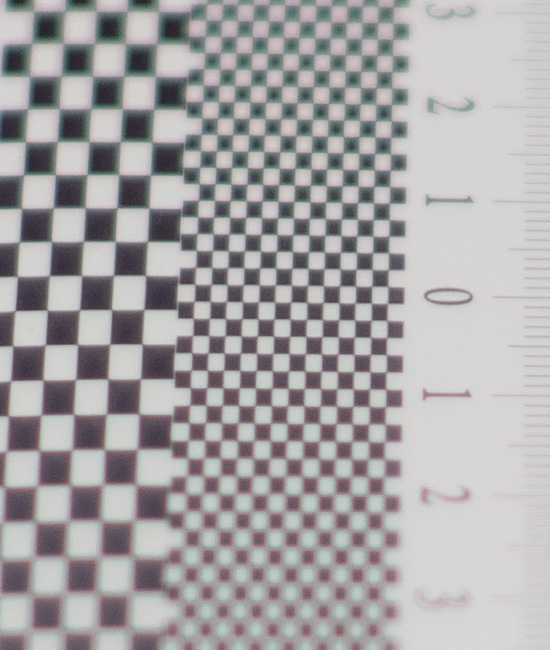
Boheh fringing/LoCA is an axial color fringing effect with purplish halos in front of the focus point and greenish beyond.
Given the simple designs of this era, it’s hardly surprising that there’s LOTS of color fringing happening at f/1.4. You may also notice the very low contrast. The contrast dramatically improves at f/2 and f/2.8 but the fringing is still very pronounced.
You may also notice that the focus shifts towards the rear (“Residual spherical abberations”) but it’s not too bad. We can still see this flaw in many modern fast 50s today.


Sample Gallery


Vintage lenses aren't a substitution for modern lenses, but they can spice up your photographic life. The Minolta MC Rokkor-PF 58mm f/1.4 could be one of them. If you are looking for tack-sharp images at f/1.4 or f/2, this is clearly not one of them. But if you are after dreamy/nostalgic images with a very bubbly bokeh, this could be one of the lenses to go for. When stopping down, the Rokkor improves dramatically, and it can reach the realms of modern 50s at medium aperture settings - but by then it has also lost its magic.
The build quality is exceptional, as you might expect from a lens of this era. It's an all-metal construction. The focus ring turns as smooth as silk. The aperture ring has this typical "metallic click" from the mechanical coupling. Weather-sealing is not provided in vintage lenses, which is a good thing because gaskets would likely have disintegrated after all these decades.
Generally, it's up to you whether you think such lenses are just wonderful, or only collector's items, or just not worth an attempt. However, one thing is for sure - the Rokkor MC 58mm f/1.4 is not an ordinary lens compared to what we have today.
-
Optical Performance
-
Mechanical Quality
-
Vintage "Character"