


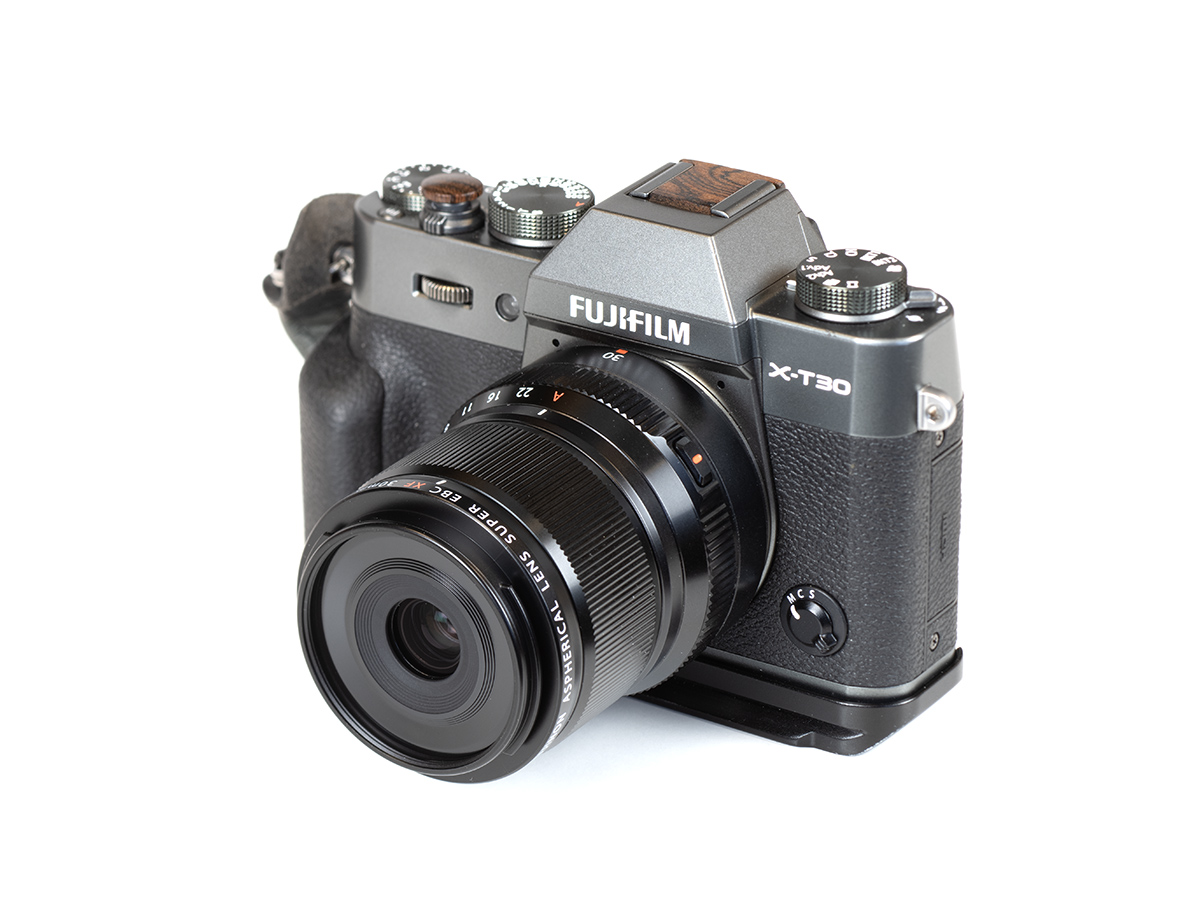
The Fujinon XF 30mm f/2.8 R LM WR macro is one of the three macro lenses in Fujifilm’s lens lineup for the X-mount system. However, you can also use it as a conventional standard prime lens, although it is a little slow for this purpose. It retails for around $700 USD which isn’t cheap, so let’s see how it performs.
The Fujinon is capable of focusing down to 0.1m or a maximum object magnification of 1:1. At 1:1, the object-to-front-lens-distance is merely ~1cm, so it’s only really aligned to shooting static “things”. As you may imagine, object lighting can also be a problem in this scenario.
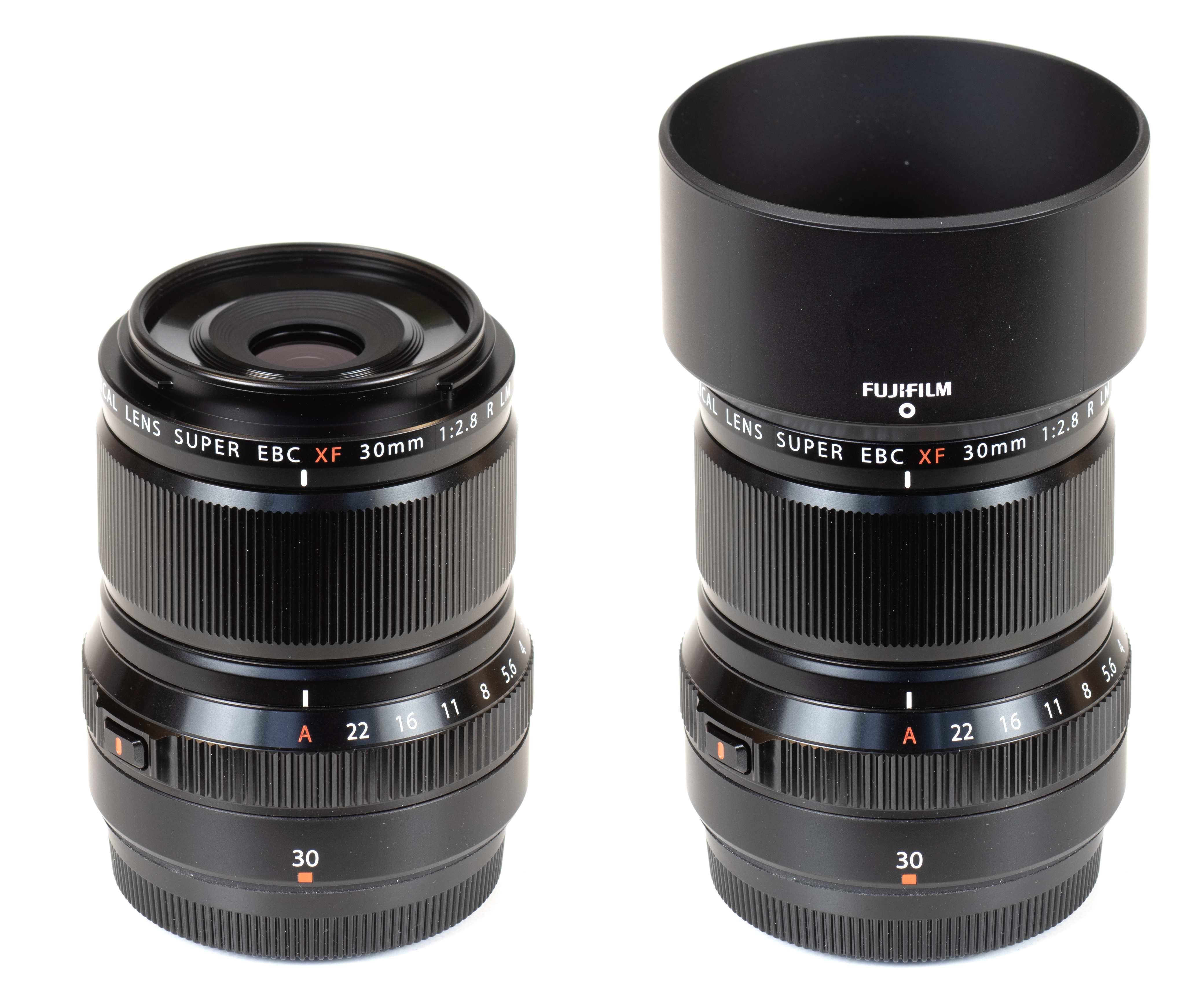
In terms of build quality, it’s impeccable. The lens barrel is made of anodized aluminum with a tactile aperture ring and smooth manual focus ring. It’s also fitted with extensive weather sealing and is specified to work down to -10C. While it is a bit long, it’s still very lightweight at just 185g. It uses an internal focusing system, so it doesn’t change its size during focusing operations. A plastic lens hood is provided.
It uses a linear motor (“LM”) for autofocusing which is fast (at normal focusing distances) and silent. Unfortunately, it does not feature a focus limiter which would have been helpful given its macro capabilities. Focus breathing can be noticeable which isn’t ideal for videos.
| Specifications | |
|---|---|
| Equiv. focal length | “45mm” (full format equivalent) |
| Equiv. aperture | “f/3” (full format equivalent, in terms of depth-of-field) |
| Optical construction | 11 elements in 9 groups (3x aspherical, 2x ED) |
| Number of aperture blades | 9 (circular) |
| min. focus distance | 0.1m (max. magnification ratio 1:1) |
| Dimensions | 60 × 69.5mm |
| Weight | 195g |
| Filter size | 43mm |
| Hood | petal-shaped (bayonet mount, supplied) |
| Other features | weathe- sealing aperture ring |
Distortion
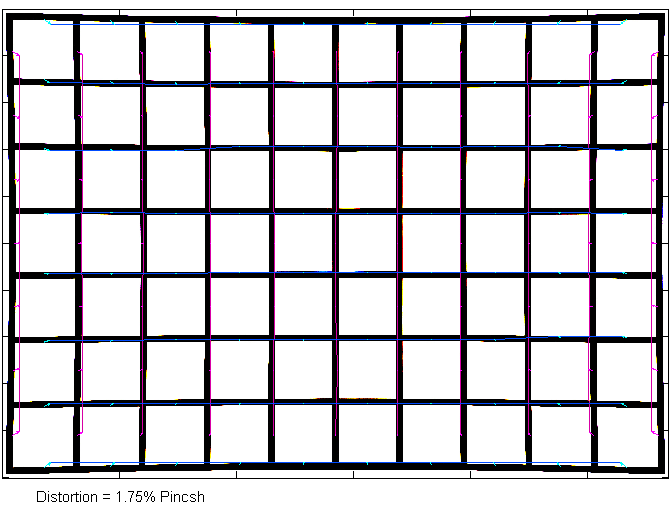
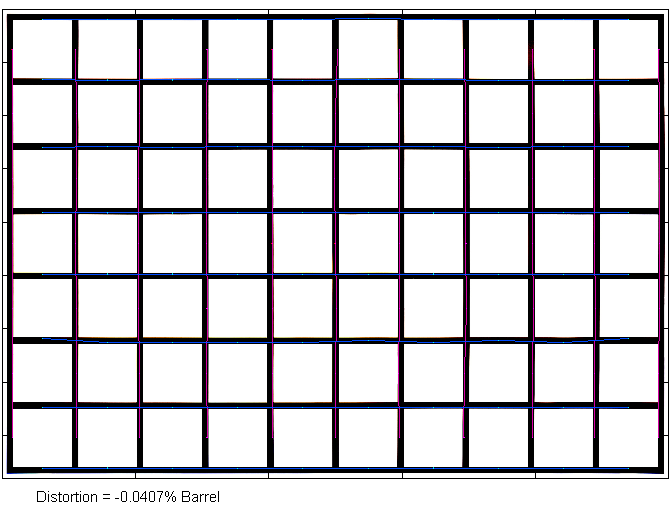
Macro lenses tend to excel when it comes to image distortions. However, the XF 30mm f/2.8 macro relies on digital correction here. RAW images show a medium pincushion distortion of ~1.7% which can be visible.
Vignetting
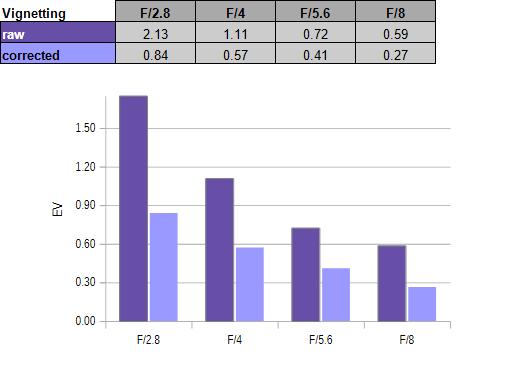
The vignetting in RAW mode is quite heavy at over 2 EV (f-stops) at f/2.8. This is beyond your usual scale for APS-C format lenses (although full-format lenses exceed this quite regularly). Stopping down to f/4 reduces this by 1 EV, and it settles around 0.6 EV from f/8 onward.
So, once again, autocorrection has to come to the rescue here. A light falloff of ~0.8 EV at f/2.8 is usually not a big deal anymore, and it’s negligible when stopped down a bit.
MTF (resolution)
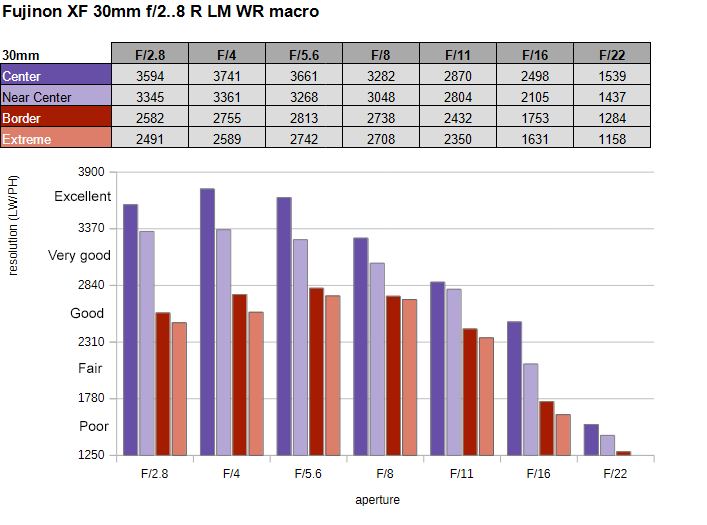
The Fujinon XF 30mm f/2.8 R LM WR macro produced decent resolution figures in the lab (at a standard focus distance, we can’t test the resolution at 1:1). The broader center quality is very high at f/2.8 already. However, the outer image field isn’t quite as impressive although it still reaches good quality. Stopping down to f/4 lifts the quality only marginally. The peak performance for the borders/corners is reached at f/5.6 without being truly tack sharp. Beyond f/5.6 diffraction has a higher impact, and it becomes noticeable at f/11. f/16 should be avoided and f/22 results in a pixel soup (not the fault of the lens, it’s just physics).
The centering quality of the tested sample was good. The field curvature is low.
Please note that the MTF results are not directly comparable across the different systems!
Below is a simplified summary of the formal findings. The chart shows line widths per picture height (LW/PH) which can be taken as a measure for sharpness. If you are keen to know more about the MTF50 figures, you may check out the corresponding Imatest Explanations
Chromatic Aberrations (CAs)
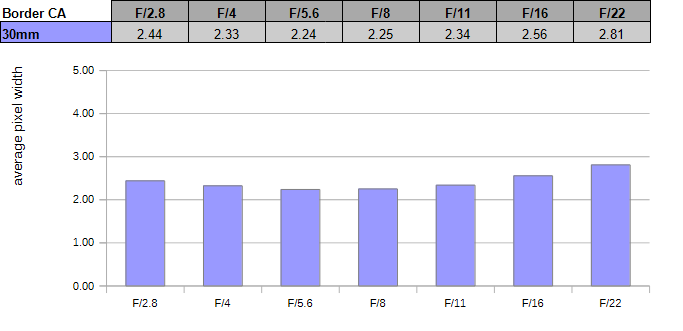
The lateral CAs (color shadows at hard contrast transitions) are unusually high in RAW images with a width exceeding 2px at the image borders. While autocorrection can handle this, it is too high for a modern lens, really.
Bokeh
When using the lens for its intended purpose, you will shoot with a very limited depth-of-field, so the bokeh is a major style element here.
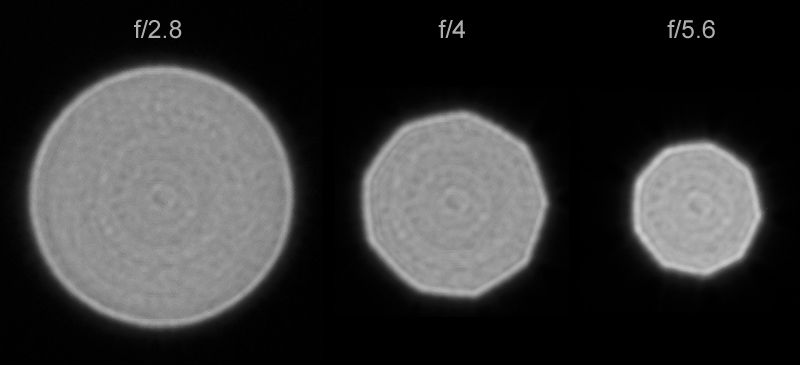
Out-of-focus highlights are a bit on the rough side as you can see below. The inner disc zone is quite “grainy” and exhibits a slight onion-like substructure. This probably relates to the 3 aspherical elements used in the design. There’s also a noticeable outlining effect at the disc edge. While Fujifilm claims to have used rounded aperture blades, the more edgy aperture shape is very obvious at f/4 already – this is rather disappointing.
The circular highlight shape is only maintained near the center when shooting at f/2.8. The shape deteriorates to “cat eyes” from the midfield into the corners. As usual, stopping down restores the discs although the edgy aperture shape doesn’t make the discs more pleasing. The corner discs are finally restored at f/5.6.
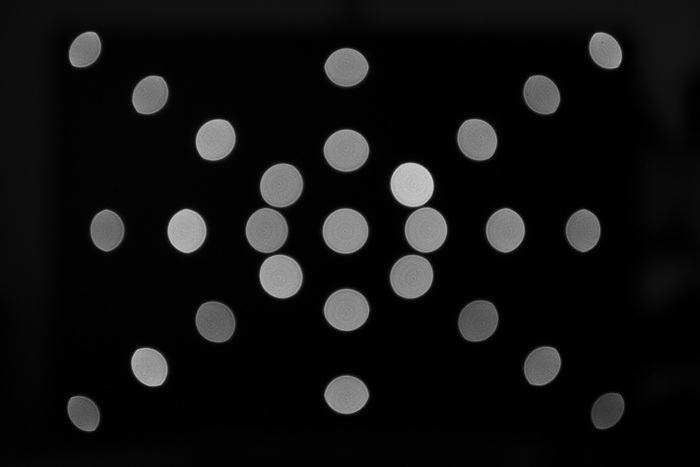
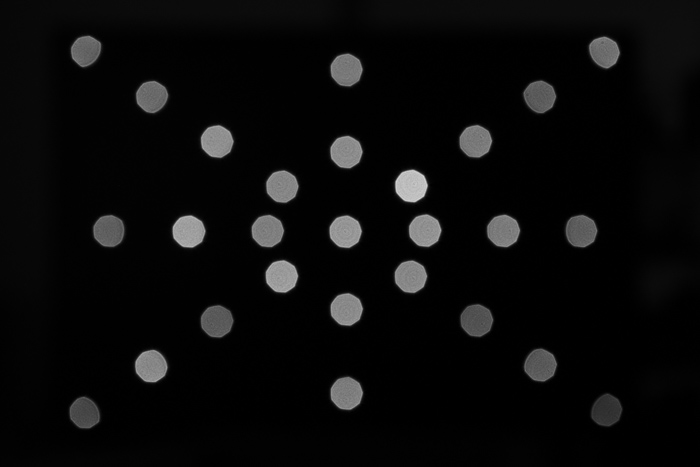
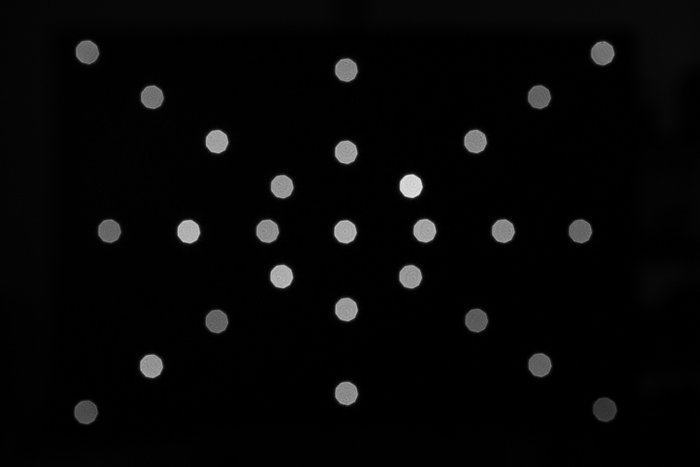
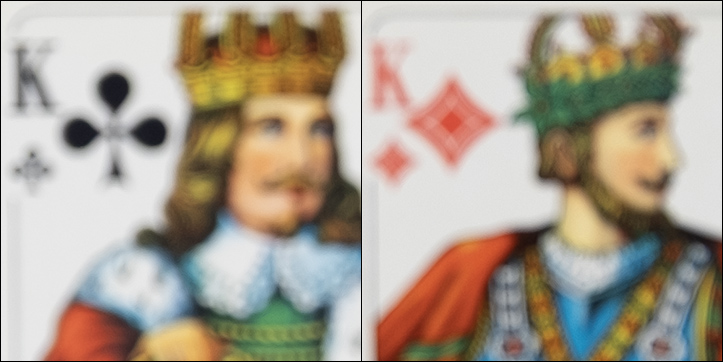
The general rendering in the focus transition zone is good (although not perfect) both on the image background (shown to the left below) as well as the foreground (to the right).
Bokeh Fringing / LoCA
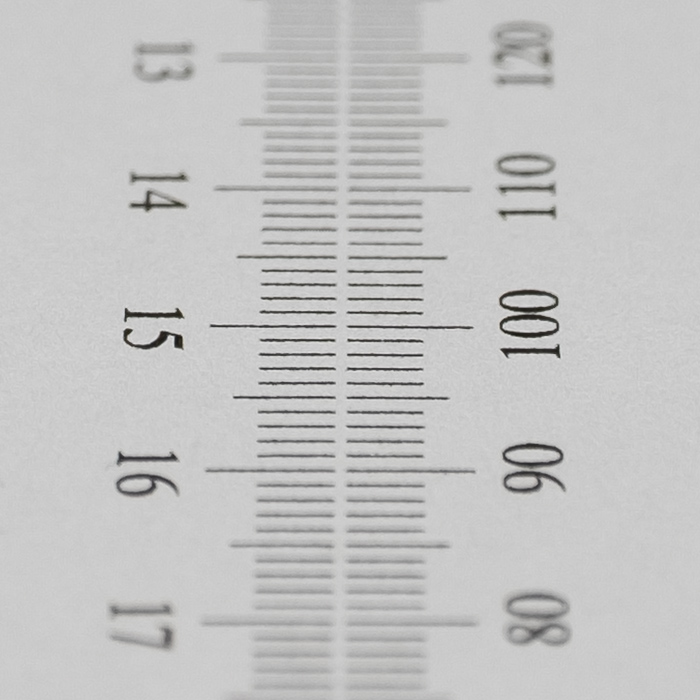
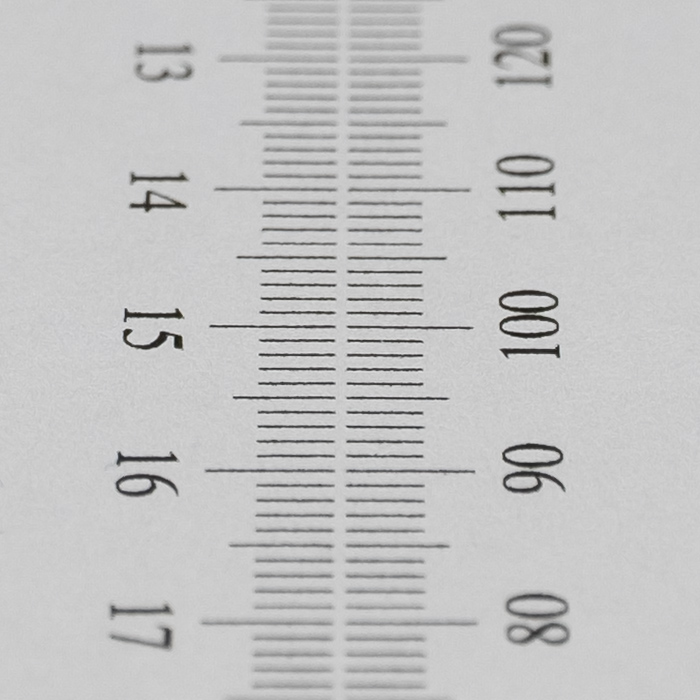
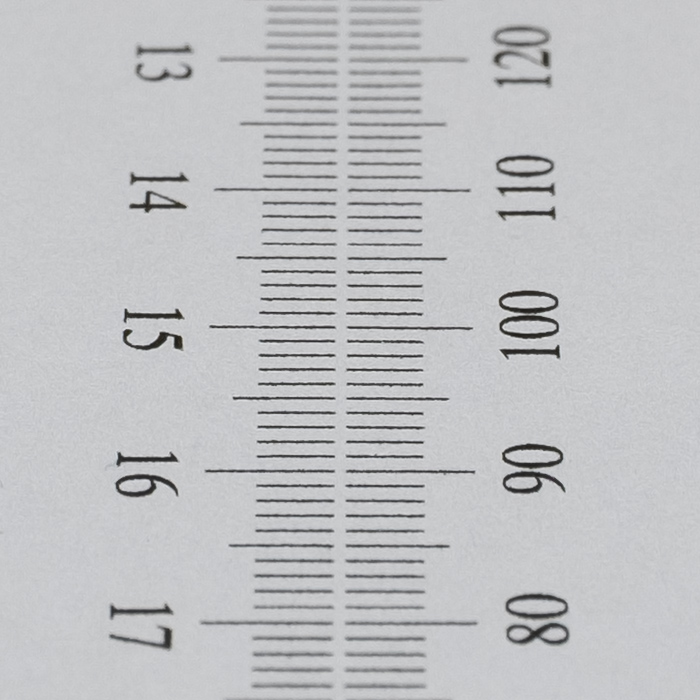
Bokeh fringing is an axial color fringing effect. It can show up as purple halos in front of the focus point and greenish halos in the background. The Fujinon XF 30mm f/2.8 R LM WR macro is comparatively slow, so it doesn’t suffer from any color fringing here.
Competition
There is only a limited number of 30-ish millimeter macro lenses available in Fujifilm X-mount. If you are on a very tight budget, there’s the TTArtisan 40mm f/2.8 macro. It’s a simple lens but at just over $110, it’s about as cheap as it gets. A more serious lens is the Voigtlander Macro APO-Ultron 35mm f/2. Just like the TTArtisan, it is a manual focus lens only but with electronic coupling. It focuses down to 1:2 only but it also translates to a more sensible working distance. We haven’t tested the Voigtlander lens yet but Voigtlander APO lenses have a stellar reputation.
Sample Shots


The Fujinon XF 30mm f/2.8 R LM WR macro leaves us with rather mixed emotions although this may relate to the difference between lab results and the real world. The lens is certainly plenty sharp in the image center - which is where most of the action plays, of course. The quality at the borders/corners is good although it falls short of the usually sky-high resolution that other macro lenses have achieved. It also relies heavily on autocorrection for lateral CAs, vignetting and image distortion.
The build quality is more impressive, as with many Fujifilm lenses. The metal body combined with weather-sealing, a broad focus ring and the clicky aperture ring are perfectly implemented. The linear AF motor is also very snappy.
We are a bit skeptical that a 30mm lens is the right approach to macro photography - the working distance is just too short. However, that's for you to decide, of course. If the Fujinon XF 30mm f/2.8 R LM WR macro was more affordable, we wouldn't complain, but it feels fairly overpriced for what it is.
If you'd like to support our work, please consider shopping for this or other lenses via one of the following partners:
* Amazon (US)
* B&H (US)
* Adorama (US)
* KEH (used gear, US)
The Good
- Great build quality
- 1:1 maximum object magnification
- Good image quality
The Bad
- Relies heavily on autocorrection
- Coarse highlight rendering
- A focus limiter would have been nice
- Impractical working distance at 1:1
-
Optical Quality6.5
-
Build Quality9
-
Price / Performance5