


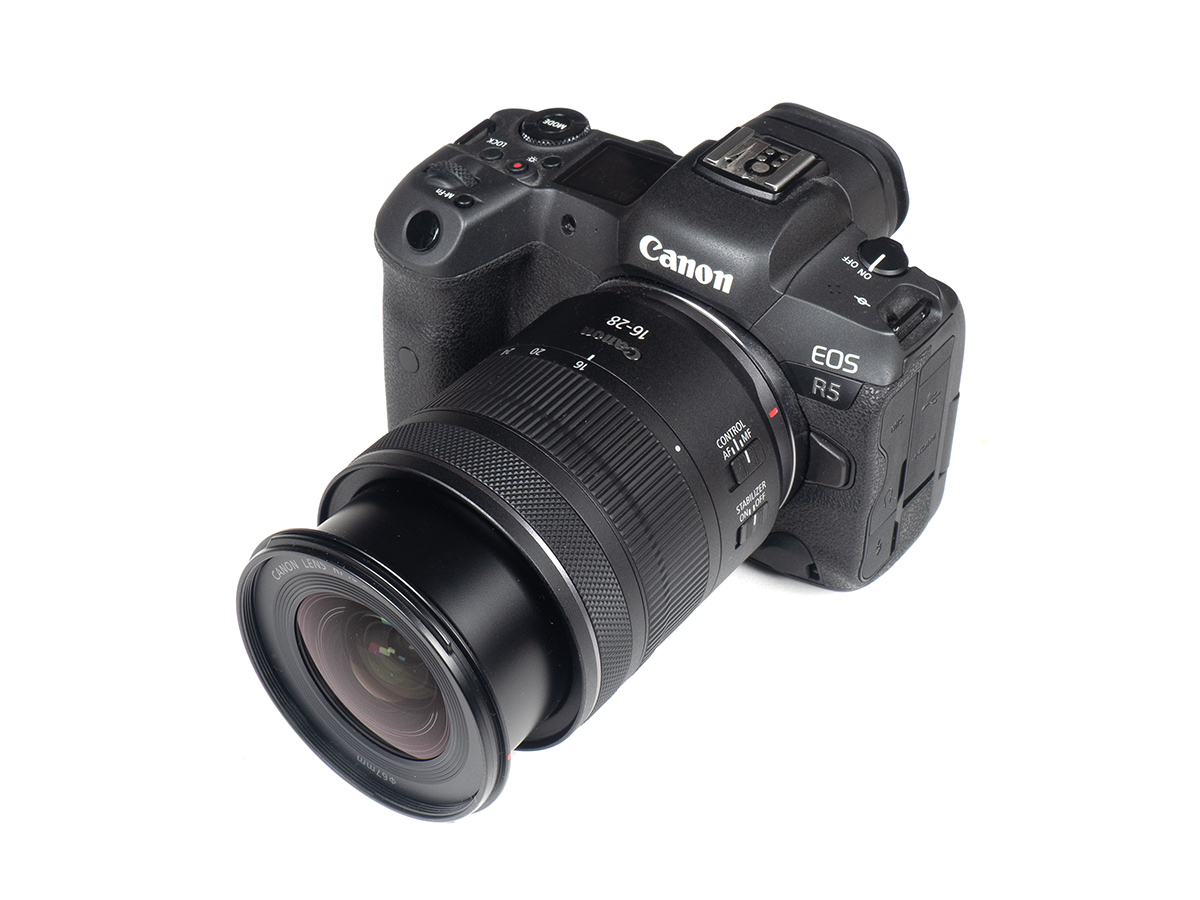
The Canon RF 16-28mm f/2.8 IS STM is what you could describe as a middle-ground lens in the Canon lens lineup. It’s not quite a professional L-class lens, but it’s not really a barebones consumer-grade lens either – just like the Canon RF 28-70mm f/2.8 IS STM. This is also obvious when looking at the price tag of around $1100 USD/EUR – give or take a little depending on sales events. It may feel steep, but if you look across the fence, the Sigma 16-28mm f/2.8 DG DN Contemporary (not available in Canon R-mount) costs about the same.
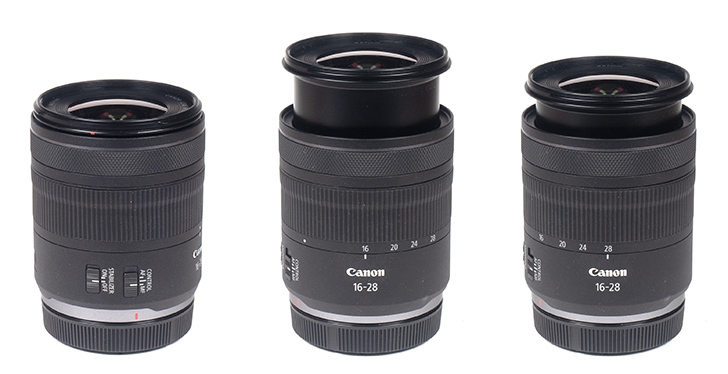
Another aspect that it shares with the RF 28-70mm f/2.8 IS STM is the mechanical design. The Canon RF 16-28mm f/2.8 IS STM is also using a retractable zoom mechanism. Thus, you have to turn it from its transport to working mode by moving the zoom ring to the 16mm mark. It’s not a major deal, but still a bit of an annoyance. As you can see below, there’s an inner tube that extends when doing so, and the maximum extension is reached at the 16mm setting. The main lens body is made of Canon’s usual engineering plastics based on a metal mount. The control rings operate smoothly. There’s also some sealing against the dust and moisture. Despite the high price tag, Canon still refuses to provide a lens hood, which would add another $50 to your bill if you want one.
As the name implies, the AF system is using an STM (stepping motor), which is both very fast and silent. As usual, manual focusing works “by-wire”. Canon also implemented an optical image stabilizer rated at 5.5 stops and 8 stops when combined with the camera’s IBIS (if available) – although, as always, you should be a bit conservative with your expectations here.
| Specifications | |
|---|---|
| Optical construction | 16 elements in 13 groups (4x UD, 2x aspherical) |
| Number of aperture blades | 9 (circular) |
| min. focus distance | 0.2m (max object magnification 0.26x) |
| Dimensions | φ 76.5 x 91mm |
| Weight | 445g |
| Filter size | φ 67mm |
| Hood | petal-shaped, bayonet mount, OPTIONAL |
| Other features | Image stabilizer (5.5 stops, 8 stops w/ IBIS), dust- and water-resistant customizable control ring |
Distortions
If you’ve read our previous Canon RF lens reviews, you may have already guessed what’s coming here. Canon’s design philosophy for their consumer lenses focuses on maximizing theoretical image resolution while almost ignoring image distortions – thus they are HEAVILY relying on digital autocorrection.
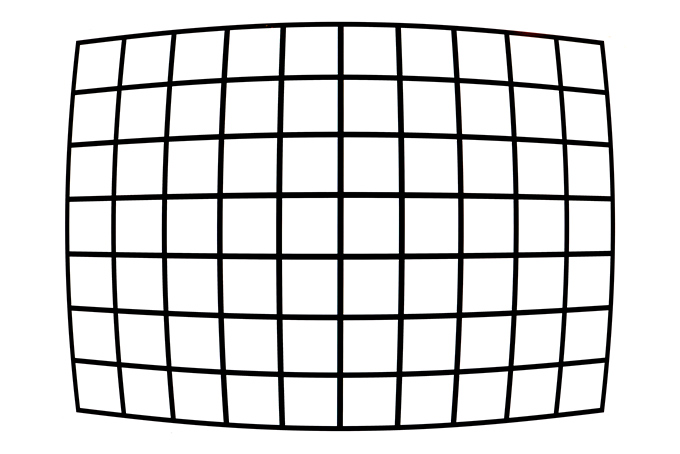
This also applies to the RF 16-28mm f/2.8 STM IS. The native barrel distortion at 16mm is a MASSIVE ~8.2%! This may not be fisheye level yet, but it goes in this direction. A distortion of ~5.3% at 21mm is also on the very heavy side, and ~3.4% at 28mm is still very visible.
This also explains why Canon disabled distortion control setting in the camera (you can still do so in RAW converters) – it’s always-on.
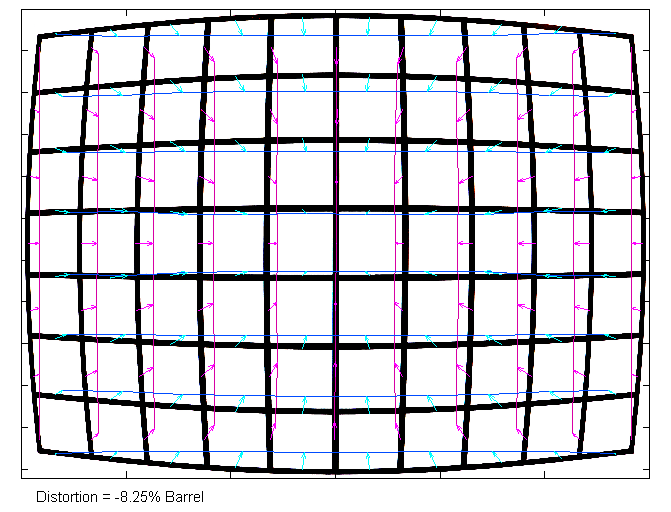
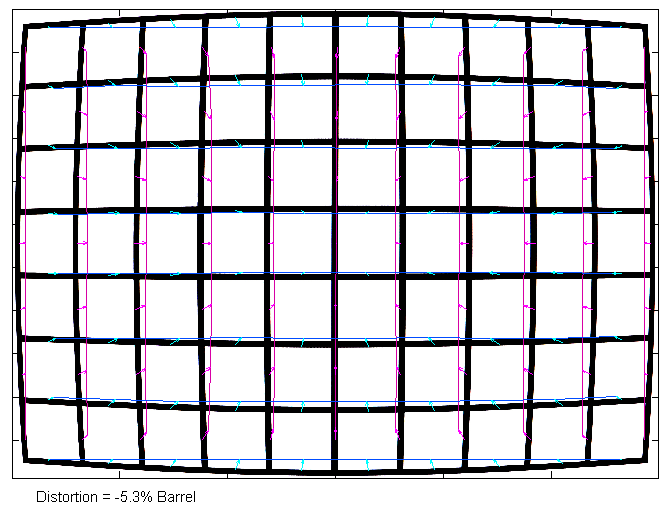
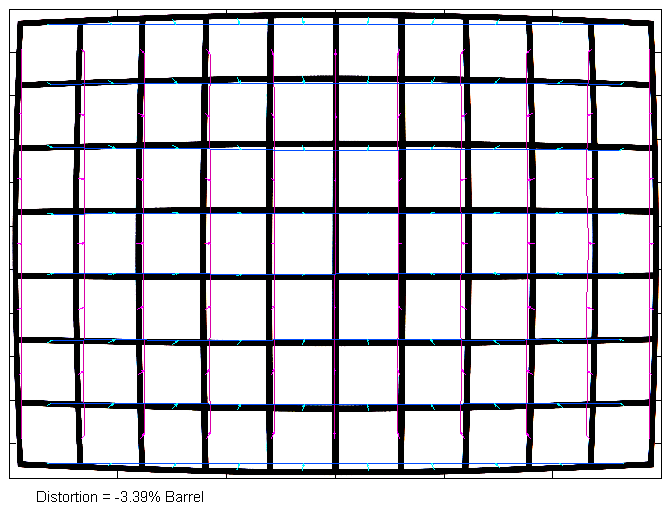
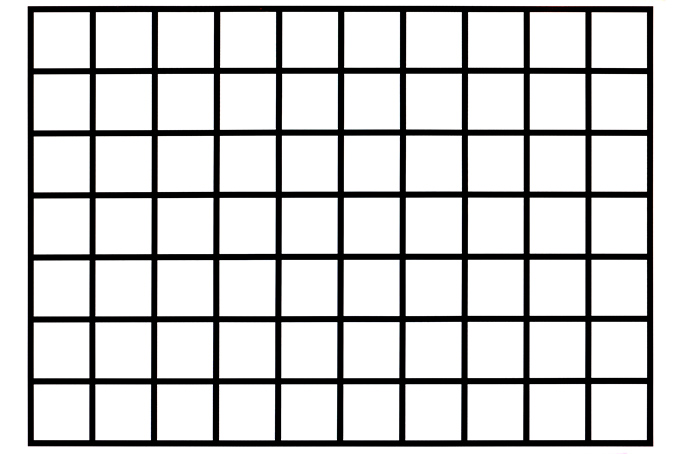
Having said that, with activated autocorrection, the distortions are perfectly eliminated:
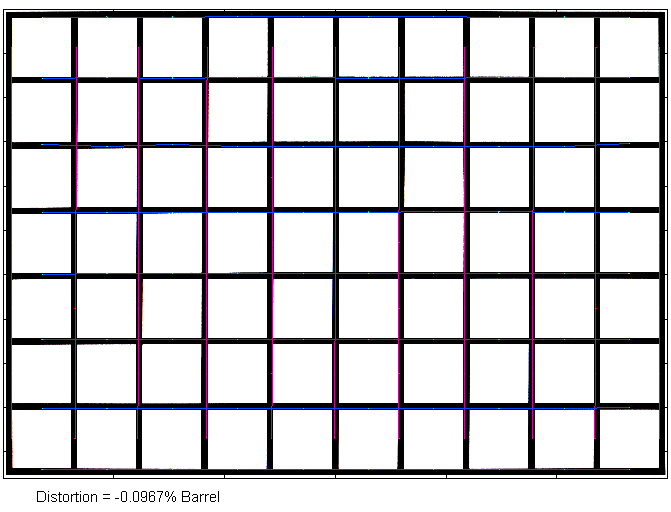
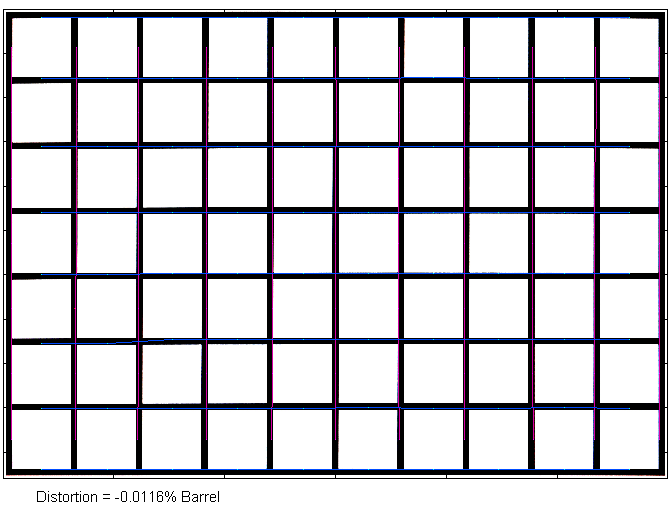
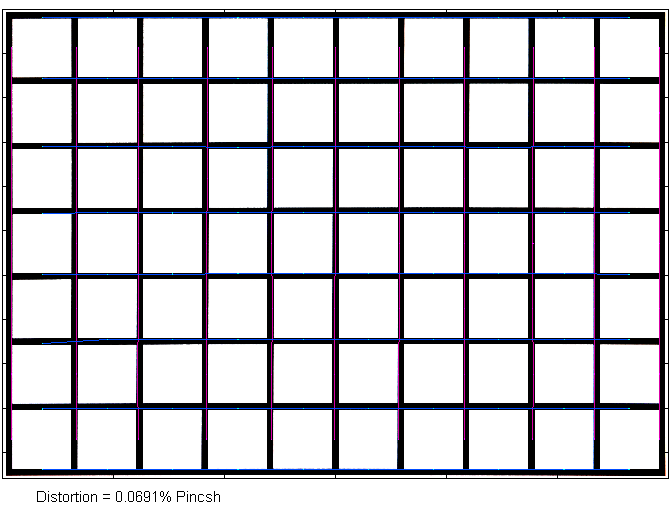
Just to illustrate the amount of image stretching applied by autocorrection, have a look below. The edges are stretched by approximately ~600(!) pixels horizontally and ~400(!) pixels vertically (at 45 megapixels) – per corner.
Vignetting
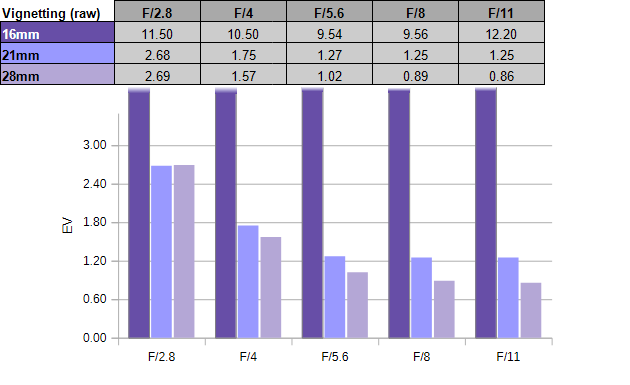
The RAW vignetting also relates to the image distortions. The lens just wasn’t designed to be used without autocorrection. At 16mm, the corners are just black, and stopping down doesn’t change this. At 21mm and 28mm, the vignetting is reasonable for an ultra-wide lens – thus, it’s clearly visible at f/2.8 but decreasing rapidly from here.
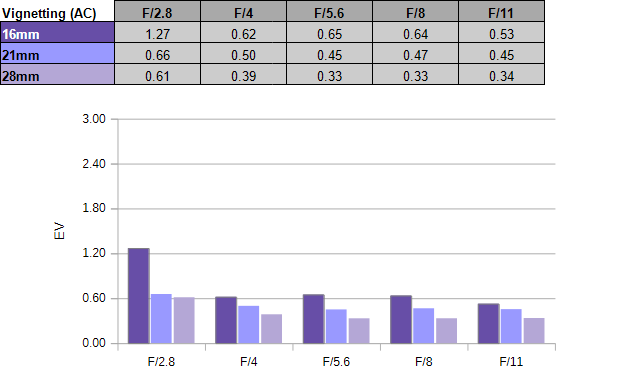
With both vignetting and distortion autocorrection active, the situation eases significantly. There’s still a visible vignetting at 16mm at f/2.8, but it’s not disturbingly high. At other settings, the vignetting isn’t really an issue anymore.
MTF (resolution) at 45 megapixels – Autocorrected
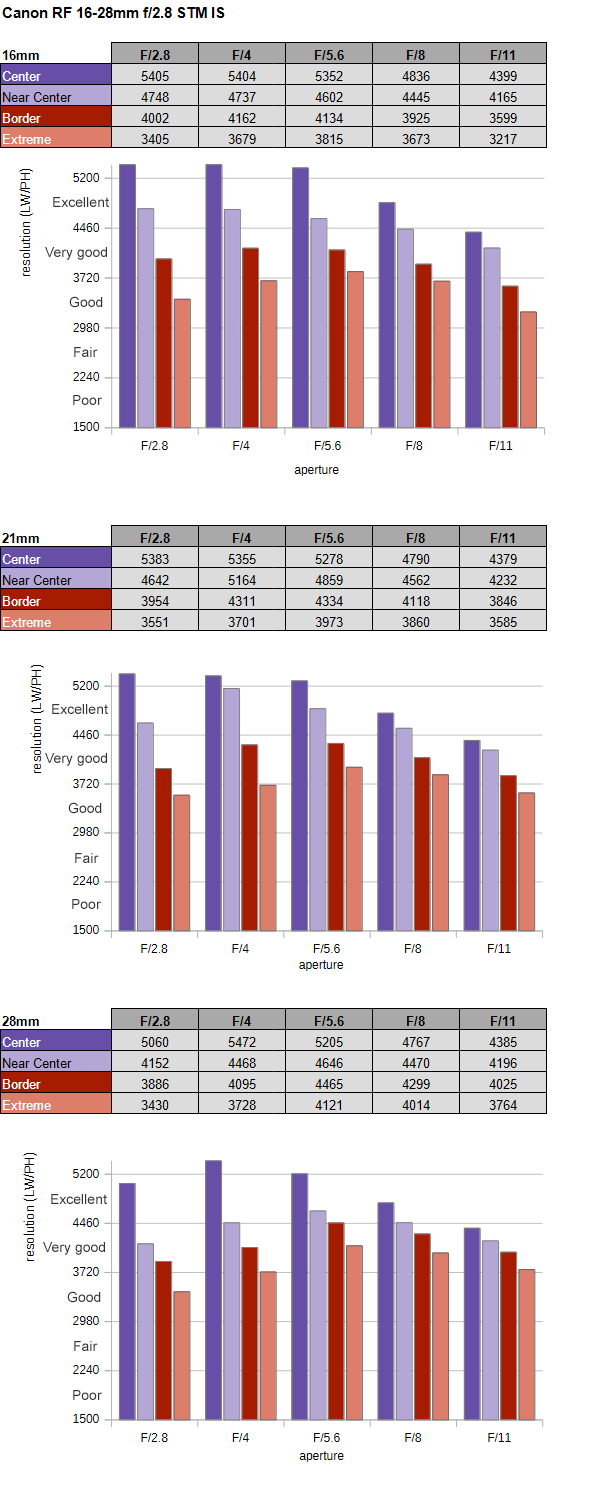
Due to the massive image distortion and vignetting in RAW images, we decided to analyze autocorrected images only this time. Despite all the image stretching, the results are actually pretty good. This is especially true for the image center, which is exceedingly sharp at all focal lengths. At 16mm, the near center is also excellent straight from f/2.8. The borders are very good, but the image stretching takes its toll in the image corners, which are merely good here. Stopping down lifts the corners a little, but there isn’t much in it. The quality remains intact at 21mm and 28mm – and the borders/corners are actually slightly better at medium aperture settings here.
Note: corners are TACK sharp in uncorrected RAWs at 16mm, but the quality decreases due to the image stretching from the distortion correction.
The centering quality of the tested sample was good. The field curvature is low in the low-to-middle zoom range but increases slightly towards the “long” end.
Please note that the MTF results are not directly comparable across the different systems!
Below is a simplified summary of the formal findings. The chart shows line widths per picture height (LW/PH), which can be taken as a measure of sharpness. If you would like to know more about the MTF50 figures, you may check out the corresponding Imatest Explanations.
Chromatic Aberrations (CAs)
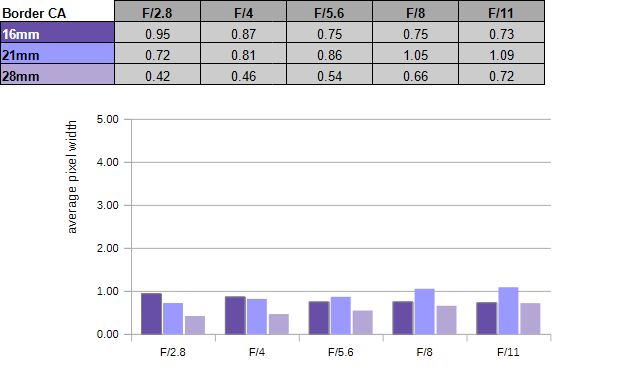
Lateral CAs are quite low overall. The CA pixel width stays mostly below 1px at the image borders. This is usually not disturbing.
Bokeh
Normally, we don’t test the bokeh quality of ultra-wide lenses because a reasonable amount of object separation is only possible at extremely close focus distances – and that’s hardly a mainstream application for such lenses.
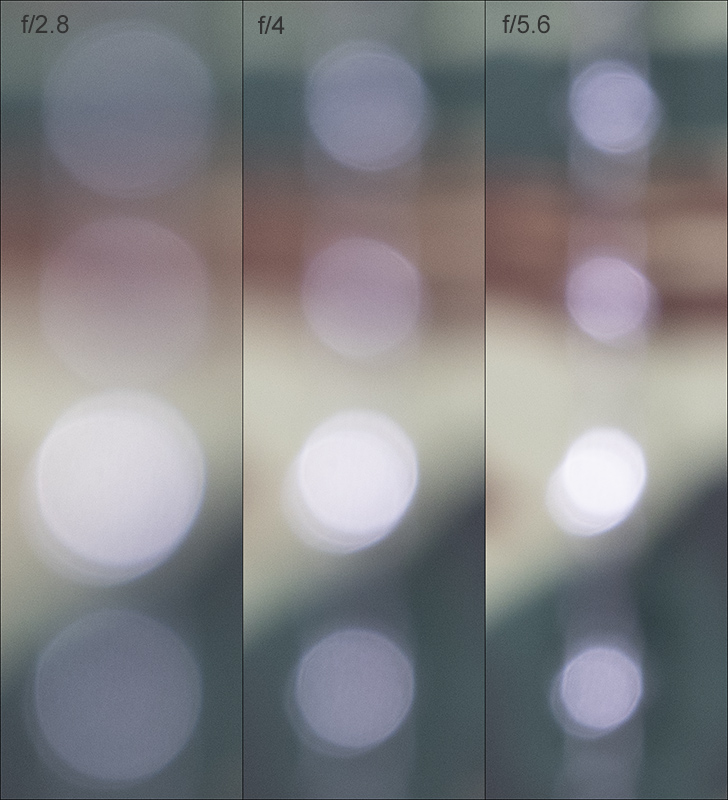
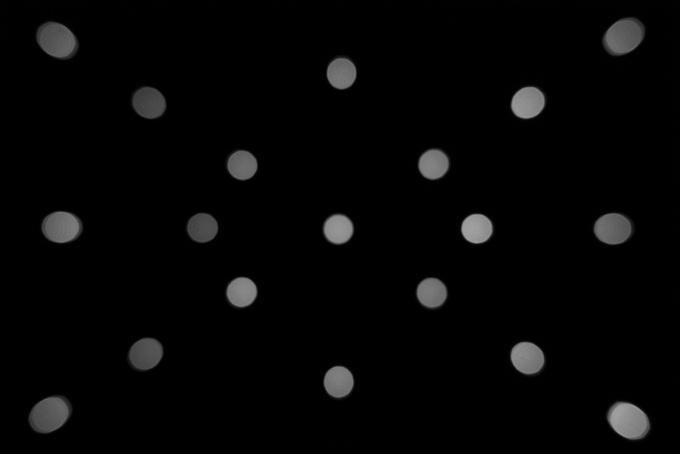
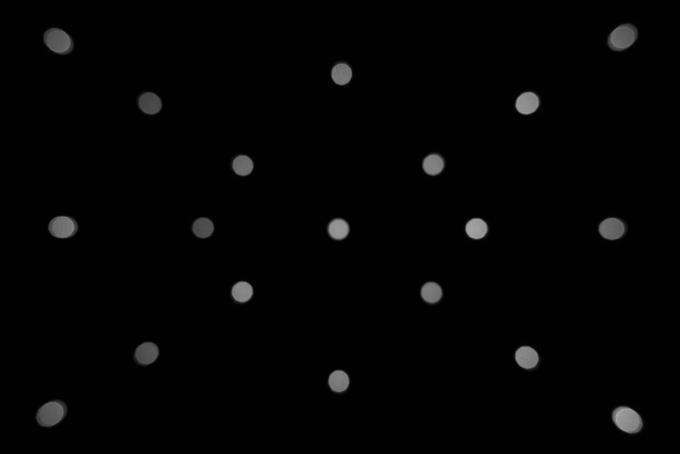
However, the RF 16-28mm f/2.8 can focus down to just 0.2m, so we were able to perform our out-of-focus highlights check at least. As you can see below, the results are actually quite pleasing – especially for a lens in this class. The inner zone of the discs is pretty clean, and there’s barely any outlining to speak of. The highlight discs (in the center) are circular at f/2.8 and f/4, and there’s just a hint of edginess from the aperture shape creeping in at f/5.6.
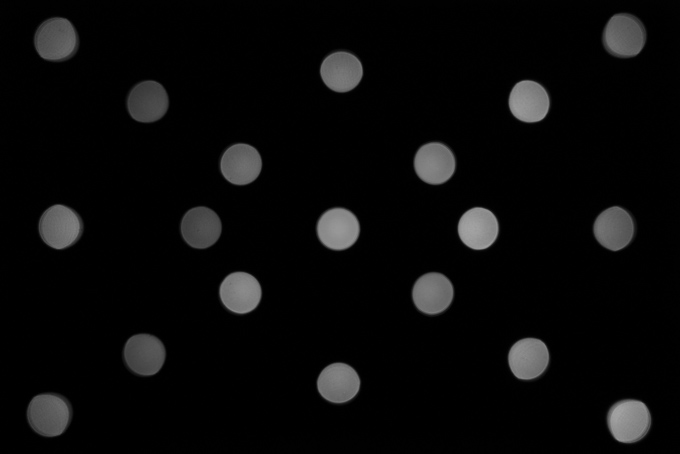
The discs remain circular across much of the image frame at f/2.8 (note: the corner lights show a side effect from the slightly protruding light sources (LEDs) when shot at very close focus distances with an ultra-wide lens). There’s only a slight deterioration to cat eyes in the corners. Stopping down to f/4 corrects most of this, and the cat eyes are gone from f/5.6.
Sun-Stars
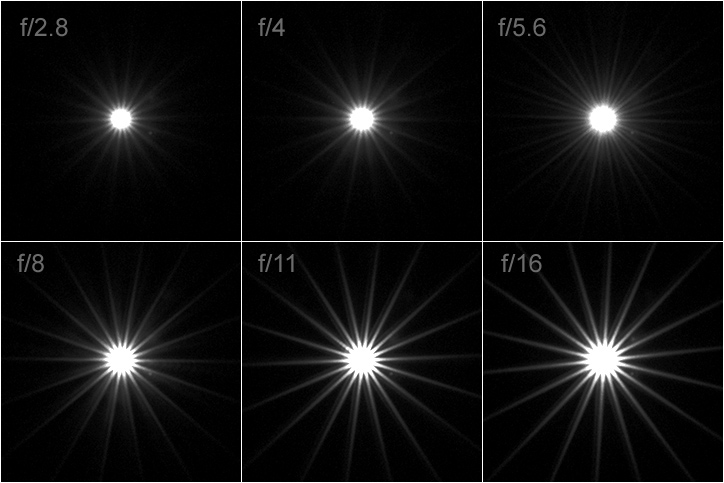
Sun stars (diffraction spikes) are an aperture effect that occurs at strong light sources – such as streetlamps in nighttime city scenes.
The Canon RF 16-28mm f/2.8 IS STM has an almost circular aperture between f/2.8 and f/5.6, so there isn’t much going on – resulting in light “blobs”. The rays are starting to form up at f/8, with the best results at f/11 and f/16. The 18 rays caused by the 9 aperture blades are nicely “pointy” as you can see below.
Competition
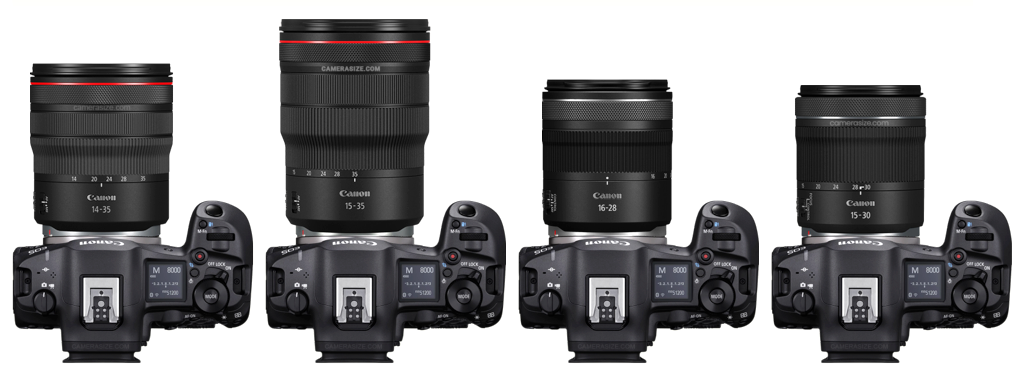
Full-format Canon users are confined to native Canon RF lenses. However, there are still no less than 4 zoom lenses to choose from. Besides the RF 16-28mm f/2.8 STM IS (2nd to the right below), there’s the RF 14-35mm f/4 USM L (far left), the RF 15-35mm f/2.8 L USM IS (2nd left), and the RF 15-30mm f/4.5-6.3 STM IS (far right). The latter is certainly the outlier in this group because it’s made to a budget and sold for just $500. We haven’t tested it, but it doesn’t seem overly impressive based on other reports. The two L-class lenses are slightly better, but, obviously, more expensive.
Sample Images


You can find arguments against Canon's design philosophy, which lets image distortion and vignetting "float", but ultimately it works fine with image autocorrection - and the Canon RF 16-28mm f/2.8 IS STM is a testament to this. It delivers a superb center performance and decent border & corner quality through the zoom range. Lateral CAs are pretty low for a lens in this class. Sunstars are rendered nicely from f/8, and at close focus distances, the bokeh is respectable as well. The build quality is fine, although we aren't huge fans of the retractable zoom mechanism (Nikon does the same, but Sony does not). Your mileage may vary here, of course. The lens body is made of Canon's standard engineering plastics on a metal mount. It feels a bit hollow, but technically there's nothing wrong with this. The STM AF is fast and silent, and the image stabilizer helps a lot in low-light situations. The biggest question mark is probably the price tag. It's not a cheap lens, and the price gap to the Canon RF 14-35mm f/4 L IS USM isn't really dramatic. It may come down to whether you'd like the extra stop in speed or the extra kick that the 14mm setting and L-class build quality can give you. If you'd like to support us, you can shop this or other lenses at: * Amazon * B&H * Adorama * KEH (used camera gear)
The Good
- Pretty good performance across the range (autocorrected)
- Compact and lightweight
The Bad
- Relies HEAVILY on image autocorrection
- Retractable zoom mechanism
- Not much cheaper than the RF 14-35mm f/4 L IS USM (in some markets)
-
Optical Quality7
-
Build Quality7
-
Price / Performance8