


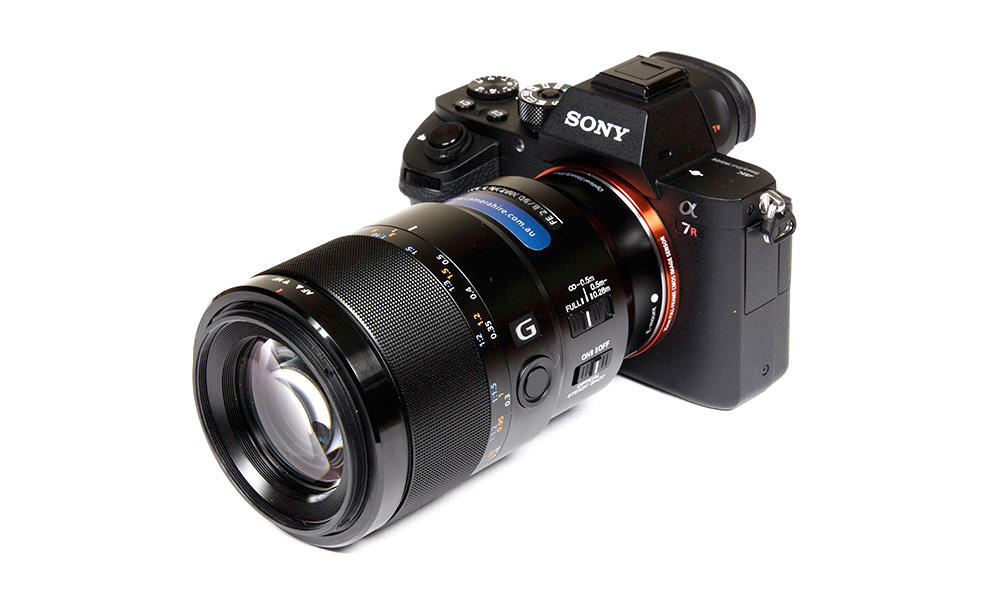
Sony’s ramp up of their full format E-mount lineup is in rapid progress. This time we’ll have a look at their first macro lens – the Sony FE 90mm f/2.8 G OSS macro. Like most modern macro lenses it is capable of focusing down to an object magnification of 1:1 although it also works perfectly fine as a general purpose tele lens, of course. It is a designated G-series lens. Back in the Minolta days, G stood for “Gold” but you don’t hear/read that anymore. However, Sony is continuing to use the G label for high performance lenses. Besides consumer lenses, they also introduced GM (G “Master”) lenses as a further class above the G series. So similar to Olympus, Sony has 3 natives quality grades now (plus Zeiss) – just to give you an idea of the different classifications.
The 1000 US$/EUR price tag of the FE 90mm f/2.8 G OSS macro may be a shock for some. However, while you can indeed find many comparable DSLR macro lenses for much lens, this is actually just a bit more expensive than the Canon EF 100mm f/2.8 USM L IS. That being said it confirms once more that you have to pay a little extra for the privilege of entering this system. The Sony FE 90mm f/2.8 G OSS macro is also a (further) counter argument for the frequently mentioned statement that mirrorless lenses are generally more light-weight/compact. The weight and size dimensions are pretty much identical to the mentioned Canon lens. Compared to DSLR systems, you can primarily shrink the camera, less so the lenses. Of course, there’s nothing wrong about this but it’s just worth to mention once more
The build quality of the Sony lens is very good indeed. We aren’t totally sure whether the lens barrel is made of (thin) metal or plastics but either way we don’t see a reason for complaining here. The weather sealing also shows that Sony has been putting some serious efforts into the construction to make to suitable for professional use. The physical length remains constant throughout the focus range. The lens features a focus clutch mechanism so you can switch between auto- and manual-focus by pushing/pulling the broad focus ring. A focus-stop button as well as a focus limiter (macro <-> 0.5m <-> infinity) is also implemented. Sony claims that the optical image stabilizer offers a gain equivalent to 4-4.5 stops. While we can confirm that the OSS action is indeed very efficient, this is probably stretching things a little in the real life (as always). Sony’s new Nano AR coating is meant to improve the flare resistance and we tend to agree here. A barrel-shaped, plastic lens hood is also part of the package.

Sony uses its Direct Drive Super Sonic Wave AF Motor (DDSSM) which is reasonably fast and essentially noiseless. Typical for E-mount lenses, focusing works “by-wire” although it tries to mimic mechanical focusing by offering a focus scale. Manual focus precision is Okay albeit to perfect. We are heavily relying manual focusing during the lab testing – just like many macro photographers – and it felt a bit coarse regarding the focus action.
| Specifications | |
|---|---|
| Optical construction | 15 elements in 11 groups inc. 1x Super-ED, 1x ED and 1x aspherical elements |
| Number of aperture blades | 9 (circular) |
| min. focus distance | 0.28m (1:1) |
| Dimensions | 79×130.5mm |
| Weight | 602g |
| Filter size | 62mm |
| Hood | supplied, barrel-style, bayonet mount |
| Other features | Focus Hold Button, Sliding Focus Ring, Weather Sealing, Nano AR Coating, Floating System, Focus Range Limiter |
Distortion
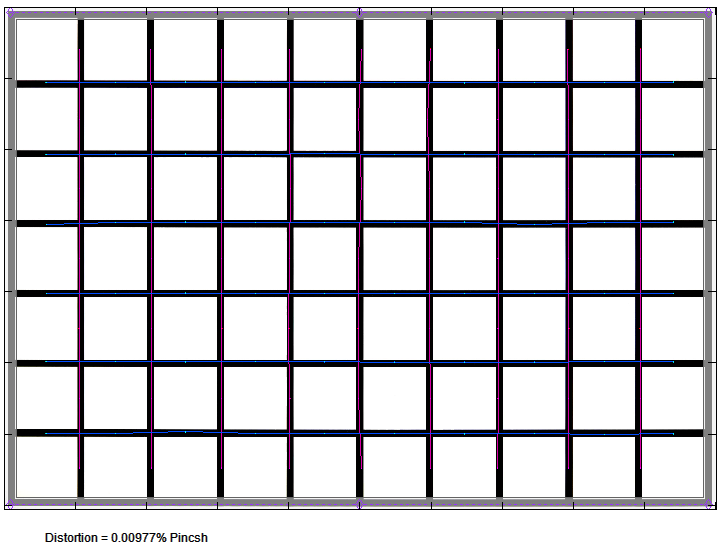
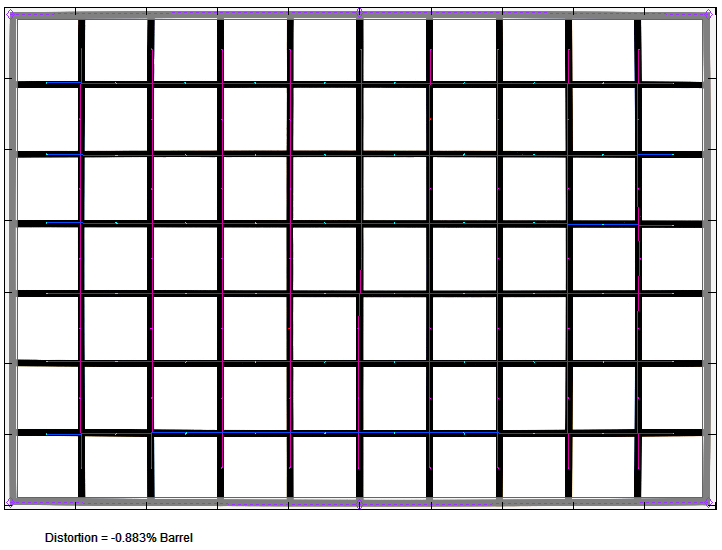
Macro lenses are usual free of image distortions and this also applies to the Sony lens … in JPEG mode with activated distortion correction that is. The distortion level is slightly higher at 0.9% (barrel-type) when looking at RAW images. This is, of course, still not an issue for the vast majority of applications.
Vignetting
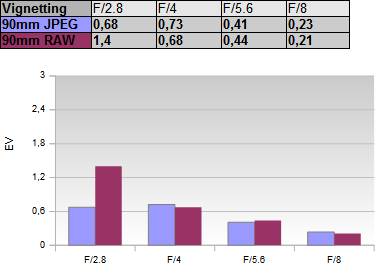
At fully open aperture and RAW mode, the light falloff reaches a medium level of 1.4EV (f-stops) – this is noticeable in certain scenes albeit far from being dramatic. Stopping down to/4 reduces the issue and it’s basically gone from f/4. When activating auto-correction the camera (or RAW-converter) compensates most of the vignetting at f/2.8 already (at cost of slightly increased corner noise).
MTF (resolution)
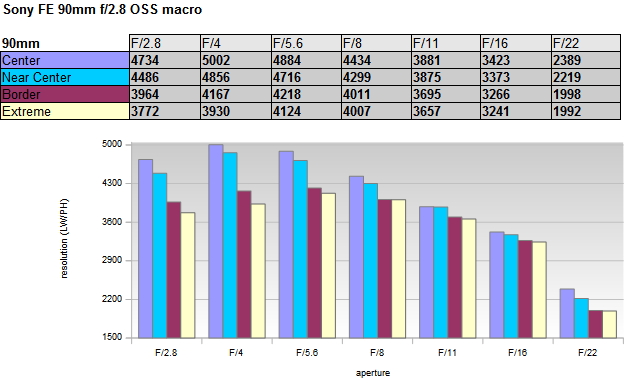
The Sony lens is capable of delivering highly impressive sharpness results straight from the max. aperture. The center performance is already excellent at f/2.8 and the quality of the outer image region is easily very good. The peak performance is reached between f/4-5.6 although the increase in quality from f/2.8 is rather marginal. Diffraction effects have a higher impact from about f/11. The quality is still good at f/16 whereas f/22 should be avoided for obvious reasons.
The centering quality of the tested sample was very good. Field curvature is not an issue.
Please note that the MTF results are not directly comparable across the different systems!
Below is a simplified summary of the formal findings. The chart shows line widths per picture height (LW/PH) which can be taken as a measure for sharpness. If you want to know more about the MTF50 figures you may check out the corresponding Imatest Explanations.
Chromatic Aberrations (CAs)
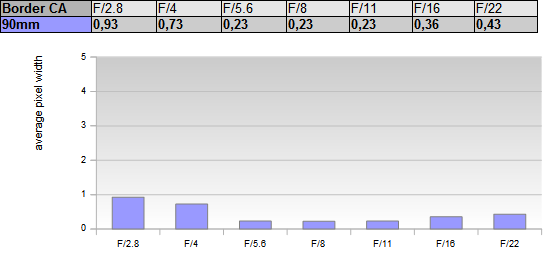
The Sony lens produces a very low amount of lateral CA (color shadows at harsh contrast transitions) starting with an average CA pixel width of 0.9px at f/2.8 and a fraction of that at medium aperture settings. Given the fact that the tests were performed on a 42mp sensor, this is very impressive indeed.
Bokeh
Sony emphasizes that their G (and more so their GM) lenses offer an outstanding bokeh … but then who’s still believing marketeers these days really …? Well, while there is a grain of truth in this statement, things aren’t absolutely perfect.
Out-of-focus highlights have a circular shape between f/2.8 and f/5.6. However, the inner zone of the highlight discs is nervous at least in bright discs. There’s a bit of an outlining effect which is getting obvious from f/5.6 onward.

The highlight discs deteriorate to towards the corners (see the sample crop taken at f/2.8 below) but this is a rather normal behavior in the full format scope. Interestingly the shape is a little different than usual here.
Stopping down helps to tame this aspect to some degree.

On the positive side, the rendition of the focus transition zone is very smooth and buttery in both the image background, slightly less so in the image foreground.

Bokeh Fringing / Longitudinal Chromatic Aberrations (LoCA)
So-called bokeh fringing is an effect that occurs around the focus point (on the Z-axis). It’s visible as halos of different colors in out-of-focus areas – magenta (red + blue) in front of the focus point and green beyond.
The Sony FE 90mm f/2.8 G OSS macro is moderately fast so it’s not overly affected by the issue. You can spot traces of this at f/2.8 but this is rather negligible.
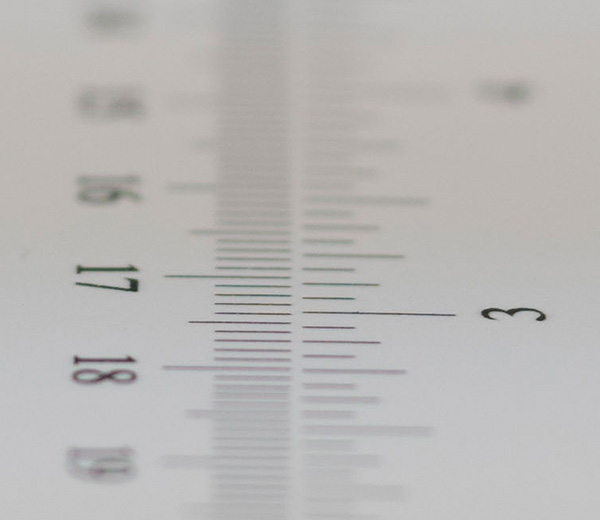
If you traverse through the aperture range below, you will also recognize that the focus remains static (thus no residual spherical aberrations).
Note: Sorry about the banding in these images. The samples were taken with electronic shutter and the banding is an effect from the artificial light in this case.
 |
Sample Images
Sony has come a long way since they entered the system market several years ago. During this journey We became a bit skeptical because of various quality issues. However, it seems as if they are finally getting their act together now. Unlike with their APS-C format lenses we have yet to experience significant centering issues with Sony's full format E-mount lenses for instance (and we are keeping our fingers crossed that this statement will stand the test of time). The Sony FE 90mm f/2.8 G OSS macro is a good example how things improved. In terms of optical quality it is easily playing on the same levels as its DSLR counterparts. In terms of sharpness the Sony lens has probably surpassed them. The center quality is excellent at f/2.8 and extreme at f/4 and f/5.6. Furthermore the borders/corners are also impressive especially considering the high density sensor used for the tests. Lateral CAs are generally a non-issue. The vignetting figures are about typical for a lens in this class. The RAW image distortions is just slightly worse although this is rather irrelevant for everything but repro work and in this case you can rely on image auto-correction anyway. On the downside we are not so much convinced of the way the lens is rendering out-of-focus highlights. The general quality of out-of-focus blur is very good if not excellent though. The amount of bokeh fringing is negligible. On the mechanical side, it doesn't feel quite as rock solid as say the Zeiss FE 55mm f/1.8 OSS or the Sony FE 70-200mm f/4 G OSS. However, we admit that this is mostly subjective. The lens barrel feels a bit hollow but formally there's nothing wrong with the construction. We certainly appreciate the weather sealing. The precision of manual focusing could be a bit better especially considering the fact that the lens is relying on the focus-by-wire approach. The AF is quite fast although not on the level of comparable Canon/Nikkor DSLR lenses. We aren't completely convinced whether the generally high pricing of Sony lenses is always justified but at least in this case, it remains relatively sane in relation to the delivered quality. While the Sony FE 90mm f/2.8 G OSS macro isn't perfect, it is still easily good enough for our "highly recommended" mark!
-
Optical Quality8
-
Build Quality8
-
Price / Performance8