


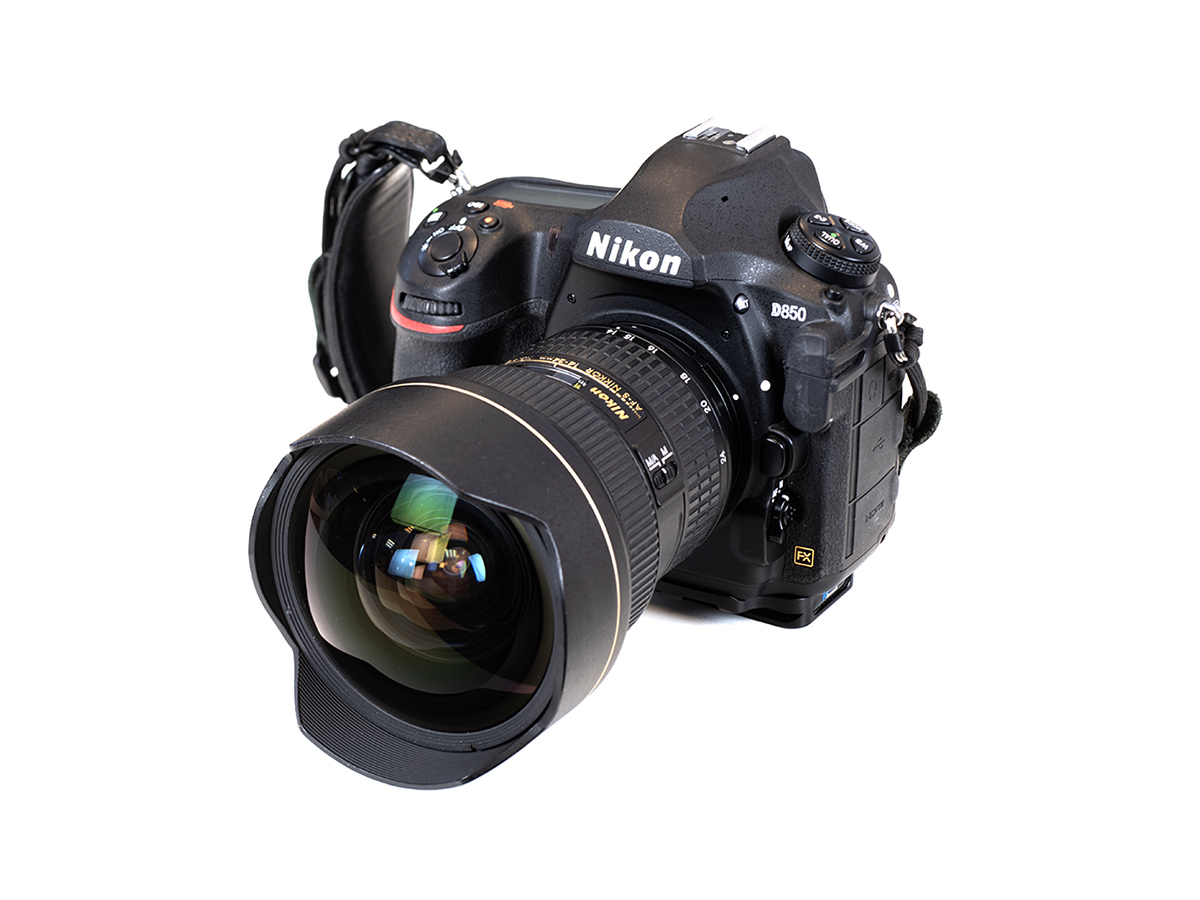
We reviewed the Nikkor Z 14-24mm f/2.8 S just before this article and it may be interesting to have a look where this lens evolved from – the Nikkor AF-S 14-24mm f/2.8 G ED in Nikon F-mount. Just like the current “S” this DSLR lens has primarily targeted the professional market and thus the build quality is accordingly high. The outer lens barrel is made of a metal alloy and there are seals for dust and moisture protection. The broad rubberized focus ring operates exceptionally smoothly, whereas the zoom ring has more friction – a side effect of the immense weight of the zoom group. Apropos weight – at around 1kg it is among the heaviest zoom lenses in its class.
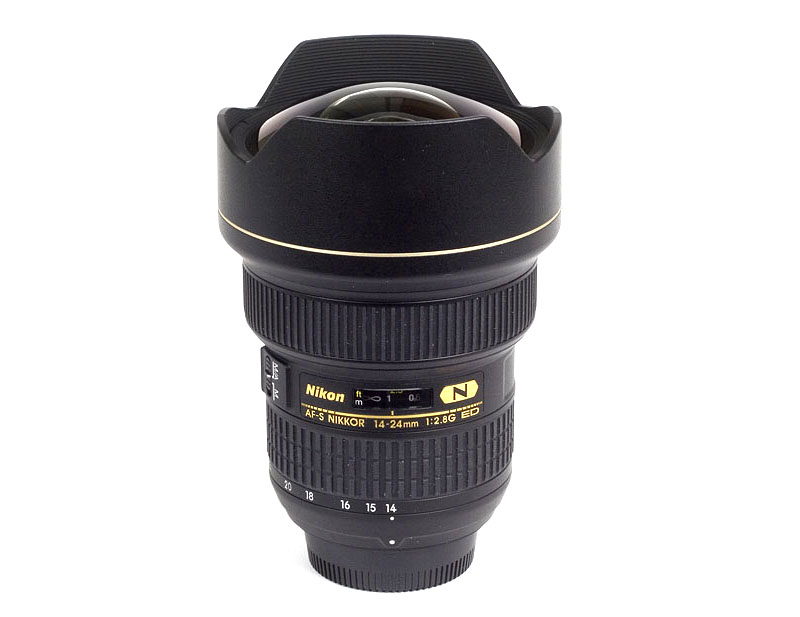
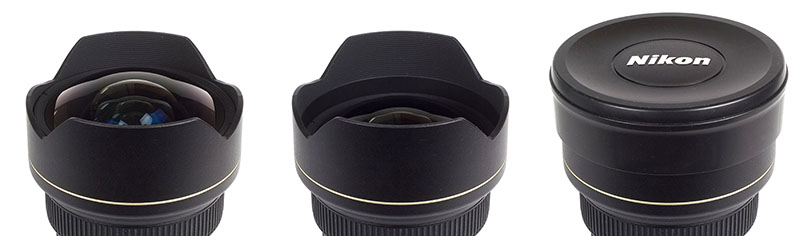
Just like many other extreme ultra-wide lenses, the optical front element has an immense front element, almost bulb-style, which protrudes significantly. Consequently there’s no filter thread and it’s also not possible to attach a filter to the lens hood. This is a bit of a worrisome thought because the naked front element is quite vulnerable. During zooming, the physical length of the lens remains constant but the inner lens tube moves a little according to the focal length (see below). Thanks to an internal focusing system (IF) the inner tube remains static during focus operations though. For those who nonetheless want to use filters on this lens, 3rd party alternatives are available. They do, however, add even more bulk and weight to the lens and require large square filters at quite some cost, too. The Nikkor AF-S 14-24mm f/2.8 is a G-type lens so it does not offer an aperture ring. Thanks to an AF-S drive (Silent Wave Motor) AF operations are fast and basically silent.
| Specifications | |
|---|---|
| Optical construction | 14 elements in 11 groups (2x ED, 3x aspherical) Nano Crystal Coat |
| Number of aperture blades | 9 (rounded) |
| min. focus distance | 0.28m (max. magnification ratio 1:6.7) |
| Dimensions | 98 x 132mm |
| Weight | 1000g |
| Filter size | n/a |
| Hood | petal-shaped, built-in |
| Other features | Dust- and moisture-resistant |
| Mounts | Nikon F |
Distortion
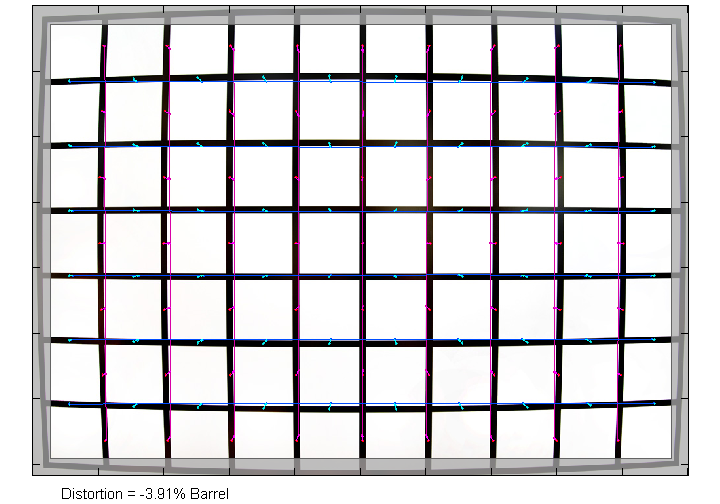
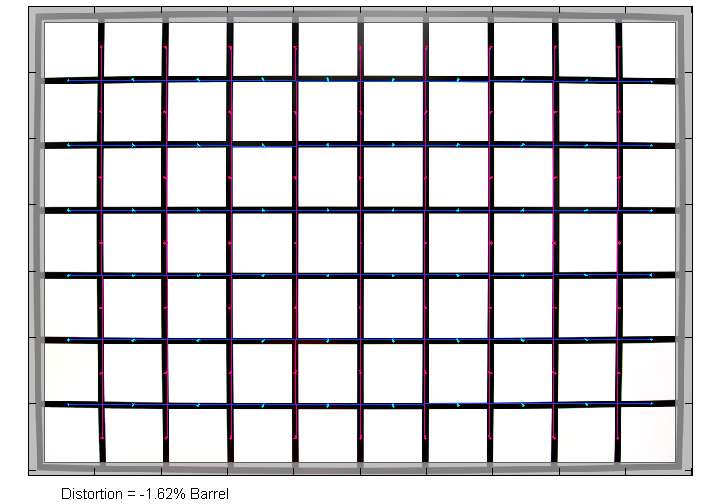
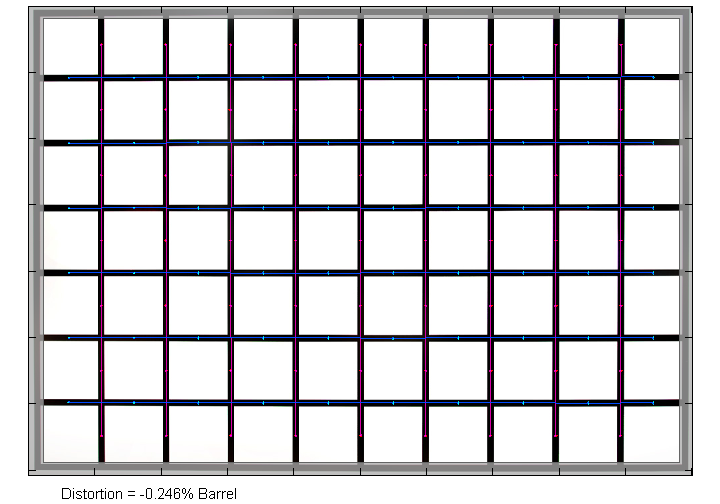
Ultra-wide-angle lenses usually show a considerable amount of barrel distortion and the Nikkor AF-S 14-24mm is no exception to this rule. At 14 mm the lens shows barrel distortion of almost 4 %, a visible amount of barrel distortion (1.6%) is still left at 18 mm while at 24 mm the lens can be considered distortion-free (0.25% barrel distortion). At the short end, that’s a fairly large amount although still moderate by today’s “mirrorless” standards. However, the good news is that it is uniform distortion that is not too complicated to correct by software in post processing (at the expense of resolution and a little field of view, of course).
Vignetting
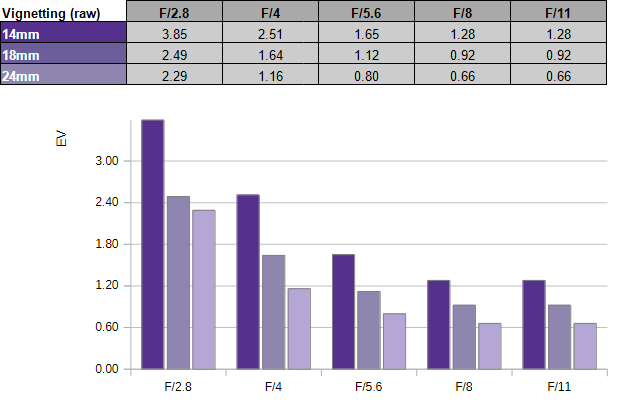
Being both fast and ultra wide, some vignetting has to be expected. Wide open, the amount of vignetting is very visible, especially at the 14mm setting where it exceeds our usual scale by quite a margin to a whopping 3.85 EV (f-stops). Stopping down helps to reduce vignetting considerably, but more than 1 EV remains even here. This may be visible in many scenes. The issue is, of course, less pronounced at “longer” focal lengths although it’s still on the heavy side at f/2.8.
MTF (resolution at 45 megapixels)
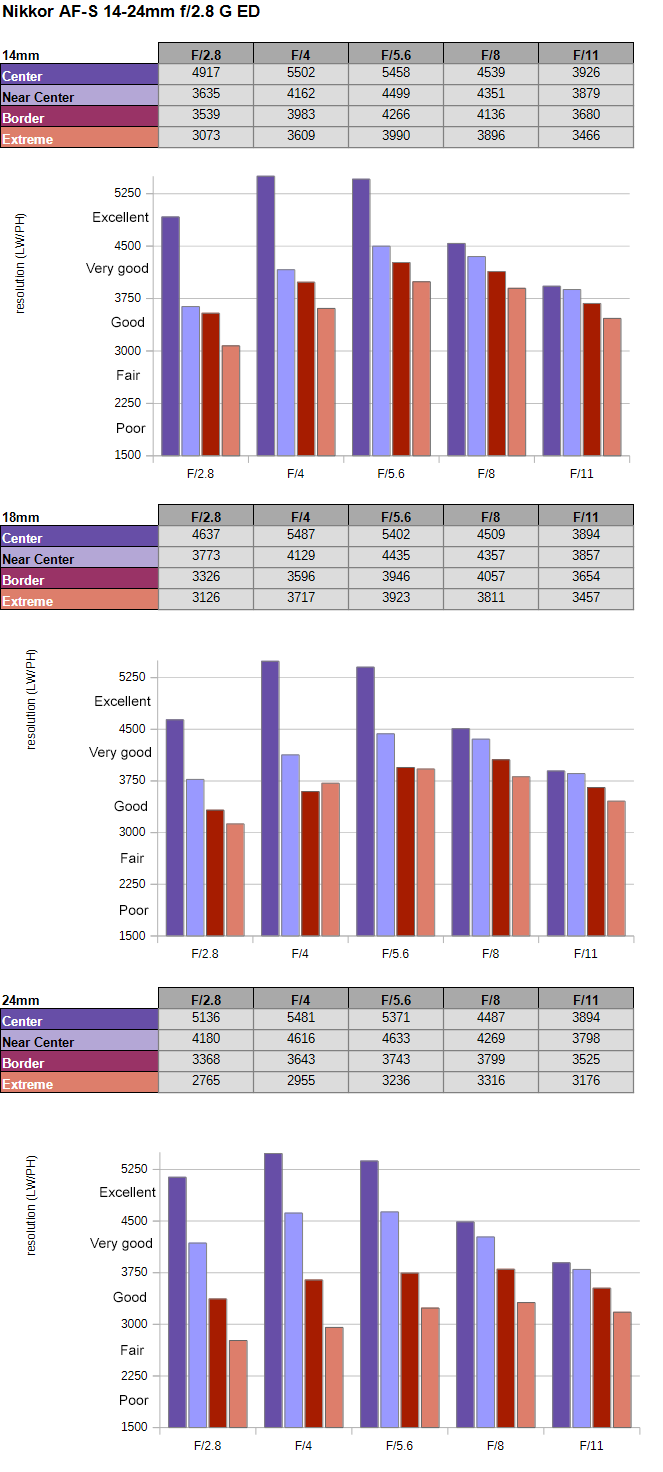
The AF-S 14-24mm f/2.8 G ED performed nicely on a 24-megapixel sensor but a 45mp sensor is a different beast and it shows. At 14mm, the center quality is still great and exceeds the sensor limits at f/4 and f/5.6. There is a fairly “sharp” drop from here and the near-center quality is “only” good at maximum aperture and the corners are slightly soft. The peak performance is reached at f/5.6 where the outer image field reaches very good results. There’s still some deterioration beyond the spot where we obtain the corner data, though. The resolution takes a slight hit from f/8 due to diffraction. f/11 is still pretty good overall, though. The performance is broadly similar at 18mm. We can, however, observe a quality penalty at the 24mm setting. The center and near-center results are still perfectly fine and the borders remain decent, but the corners soften quite a bit, especially at f/2.8. They recover by stopping down and reach good quality at medium aperture settings.
The centering quality of the tested sample was good. The field curvature is a bit “wobbly” at the wide end.
Please note that the MTF results are not directly comparable across the different systems!
Below is a simplified summary of the formal findings. The chart shows line widths per picture height (LW/PH), which can be taken as a measure of sharpness. If you would like to know more about the MTF50 figures, you may check out the corresponding Imatest Explanations.
Chromatic Aberrations (CAs)
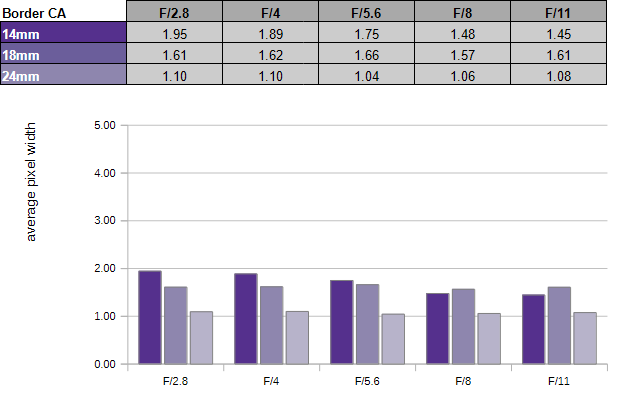
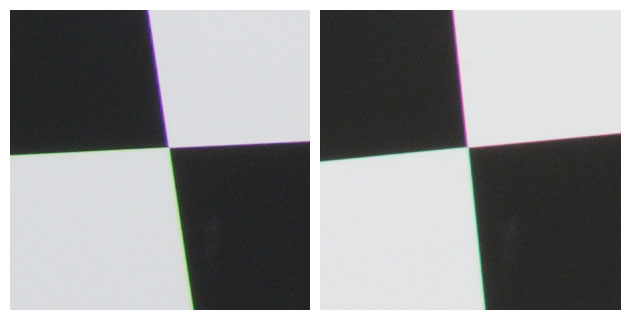
The border chromatic aberrations (color shadows at harsh contrast transitions) are in the range of roughly 1 to 2 pixels throughout the whole focal and aperture range. However, that’s only part of the story because the CAs increase dramatically in the image corners.
Below are 100% crops of the corner CAs at 14mm (left) and 24mm (right) taken at f/11:
Flare
The lens’ huge front element seems to collect sunlight from almost anywhere and as result the Nikkor 14-24 is very prone to flare – see the samples below, which were shot with an FX camera. These are web-sized full images, not crops. You can see lens flare in one of the samples on the next page, too (the portrait mode landscape shot with a large amount of sky).
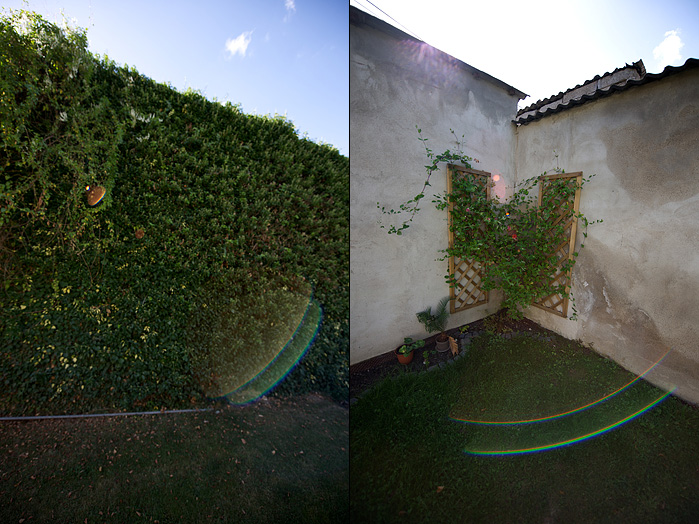
They were taken straight into the sun or with the sun just outside the frame. The vast majority of lenses would produce flare here and it just shows that the Nikkor is no different. However, the amount of flare, especially towards the border opposite to the source of light, is rather high.
The 2nd set of images is different, though. You may notice that in these shots the sun is actually coming from slightly behind the camera, still there are pronounced flare spots.
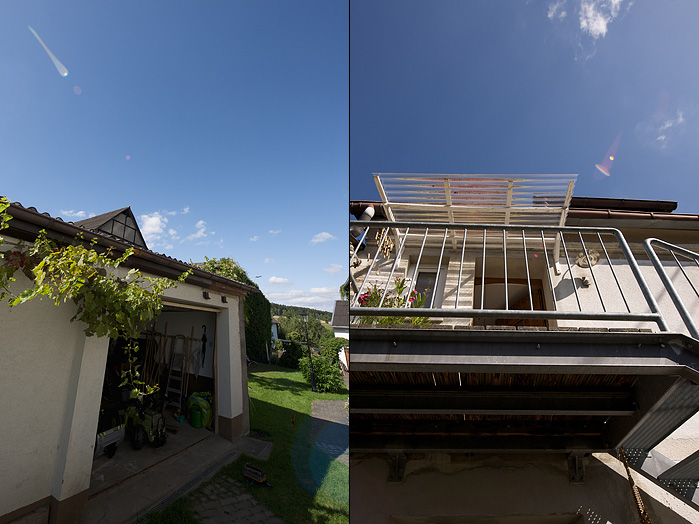
As mentioned the Nikkor has a very protruding front element and at the wide end, the fixed lens hood cannot provide full protection, even if the source of the light is slightly behind the camera. In the shot below you can clearly see that parts of the front lens are visible at such angles, too. This way, the lens manages to “bend” sunlight and thus flare into the image when you really wouldn’t expect it.
Sample Images


When we first reviewed the Nikkor AF-S 14-24mm f/2.8 G ED years back at 24 megapixels, it felt like the best thing ever since sliced bread in terms of sharpness. However, 24 megapixels are an easy game for most lenses. The D850 used for this test has 45 megapixels and that's a different caliber where optical flaws show up more easily. The lens is still pretty good in this context but by today's standards it doesn't stand out anymore. As so often with ultra-wide zoom lenses, it performs best in the lower part of the zoom range. Even so it makes sense to stop down to f/5.6 for the best results - which are pretty decent even today. The 24mm setting is less impressive (just like on the Z 14-24mm f/2.8 S actually). The corners are a bit "meh" at f/2.8 and f/4 and only moderately good from f/5.6. While image distortions are mostly fine, vignetting is quite high at f/2.8 (which is rather normal). A weak aspect is flare resistance mostly due to the immense bulb-like front element.
The Nikkor is built solid enough to withstand the hard treatment of a working professional although this, combined with the huge amount of glass, makes it one of the heaviest ultra-wide lenses around and also among the most expensive in Nikon F-mount. Some will dislike that there's no filter thread to mount a polarizer or a filter holder.
Overall, the lens had its day. It's obvious that it has been surpassed by its successors but that's hardly surprising. While tele (zoom-) lenses have barely seen progress in recent years, optimizing ultra-wide lenses is still a battlefield even today.
If you'd like to support our work, please consider shopping for this or other lenses via one of the following partners:
* Amazon (US)
* Amazon (EU)
* B&H (US)
* Adorama (US)
* KEH (used gear, US)
The Good
- Sharp when stopped down
- Optically well corrected
- Great build quality
The Bad
- Very prone to flare
- Corners not ideal at f/2.8
- High corner CAs
- Wobbly field curvature
-
Optical Quality6
-
Build Quality9
-
Price / Performance5