


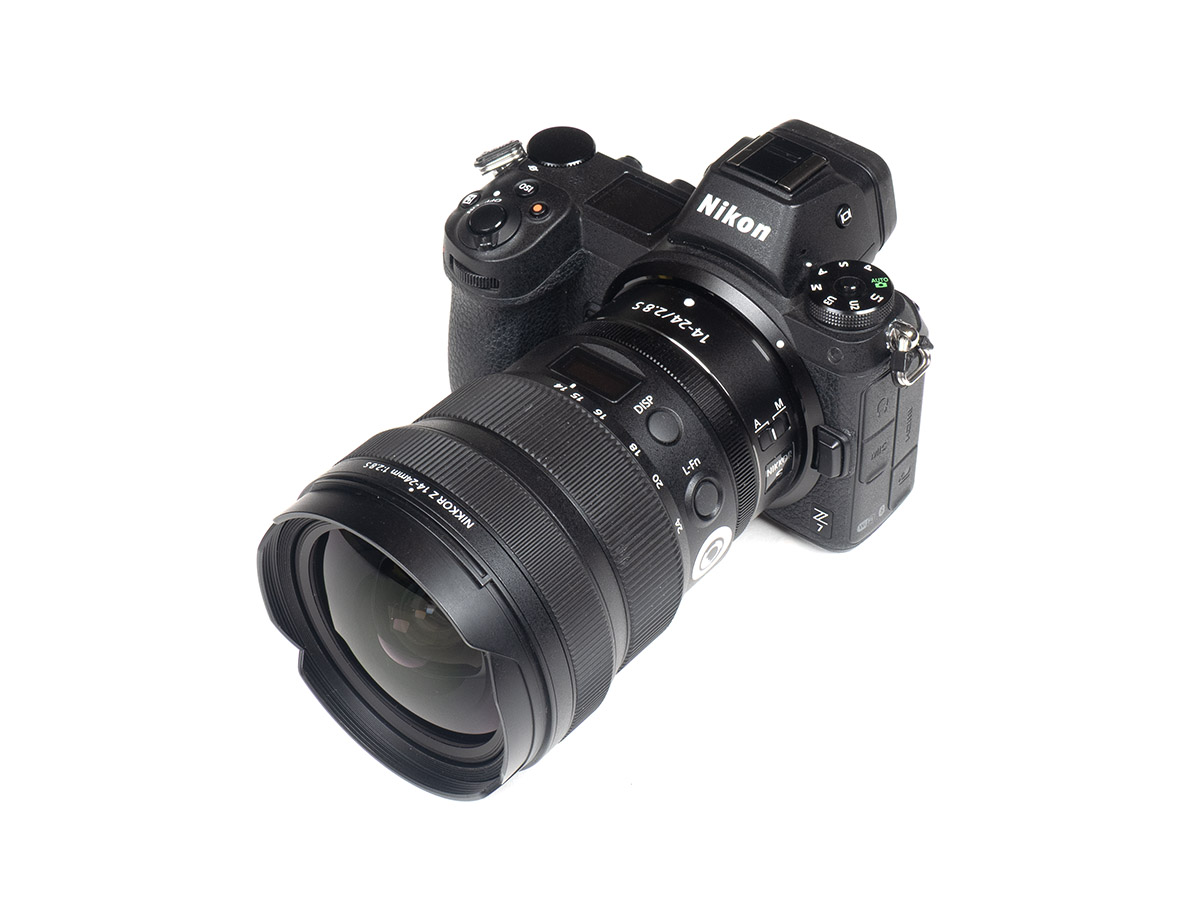
The Nikkor Z 14-24mm f/2.8 S is the high-end ultra-wide zoom lens in Nikon’s Z-mount lens lineup. It was released in late 2020 so it’s probably nearing the end of its production cycle. It retails around $2400 USD so it’s clearly targeting the professional and enthusiast market segments.
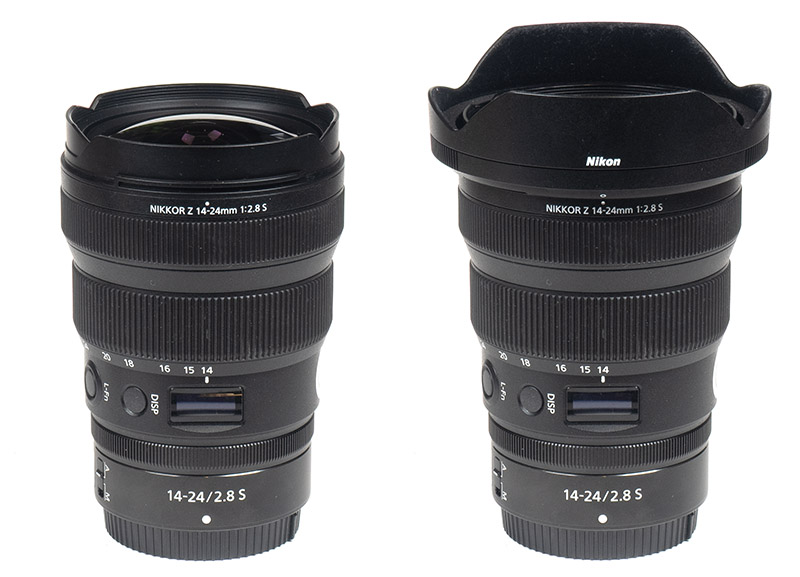
Compared to its heavy DSLR predecessor, Nikon worked hard to shed some weight. At just 650g, they clearly succeeded here and they did so without compromising the build quality. The Z 14-24mm f/2.8 uses a high-grade polycarbonate lens body based on a metal mount, backed by extensive weather sealing with rubber gaskets around moving parts and the mount. While the physical length remains constant, an inner lens tube moves when zooming. It is most extended at the 14mm setting. Unfortunately, there’s no filter thread on the lens itself due to the slightly bulbous front element. Instead, it accepts very expensive 112mm filters via the included HB-97 lens hood (the product image below only shows the also supplied HB-96). The rear features a filter slot for gel sheets. There’s also the Nikon-typical customizable control ring, an L-Fn (Lens Function) button, and an OLED info display panel for showing focus distance, depth-of-field, or aperture. Normally, the front lens cap isn’t worth mentioning, but in this case it’s an annoyance because it only attaches in a specific orientation.
The Z 14-24mm f/2.8 S uses Nikon’s multi-focus stepping motor (STM) for autofocusing. It’s fast, near-silent and very precise. Focus breathing is comparatively well controlled and the stepless aperture mechanism is nicely aligned to video work.
| Specifications | |
|---|---|
| Optical construction | 16 elements in 11 groups (4x ED, 3x aspherical) Nano Crystal Coat or ARNEO Coat Fluorine-coated front lens element |
| Number of aperture blades | 9 (rounded) |
| min. focus distance | 0.28m (max. magnification ratio: 0.13x) |
| Dimensions | 88.5 x 124.5mm |
| Weight | 650g |
| Filter size | 112mm (w/HB-97 lens hood) Rear-filter slot |
| Hood | petal-shaped (bayonet mount, HB-97 and HB-96 supplied) |
| Other features | LCD information panel L-Fn button Dust- and drip-resistant |
| Mounts | Nikon Z |
Distortion
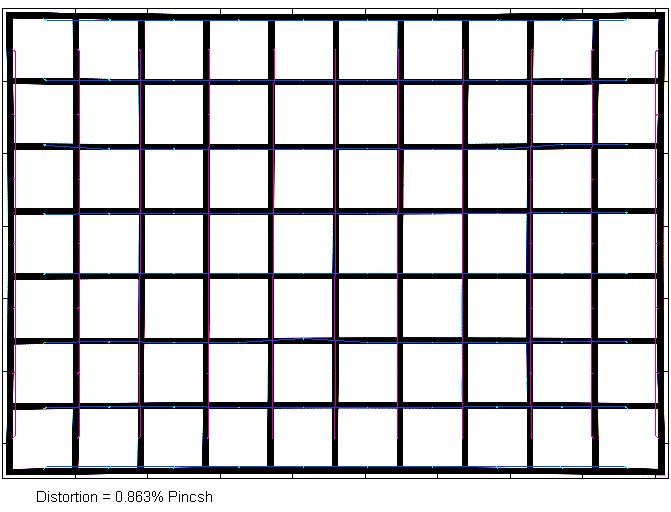
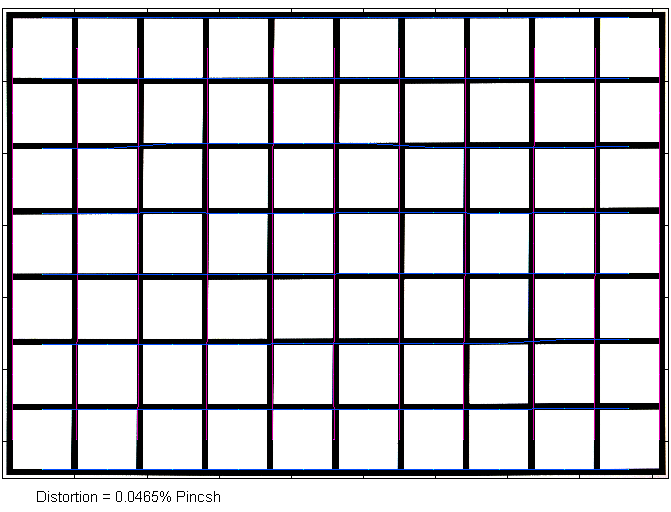
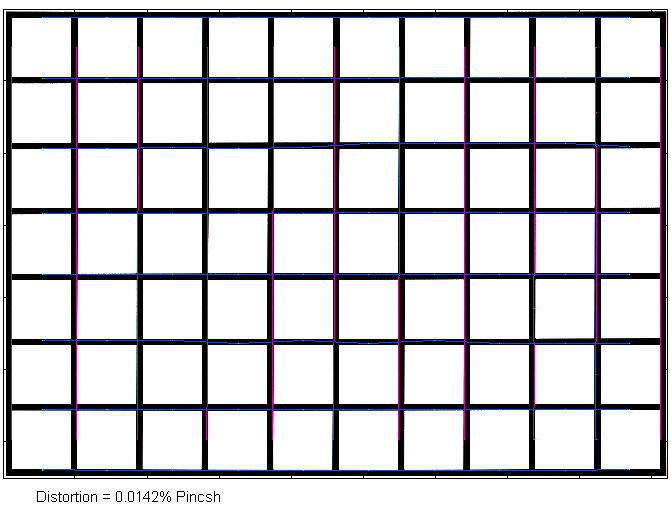
These days, the manufacturers often “ignore” image distortions and place a priority on sharpness alone and leave distortion correction to the post-processing. However, Nikon shows that this isn’t inevitable. RAW images show a rather moderate barrel distortion of just ~3.2% at 14mm. That’s visible in certain scenes but usually still acceptable, especially for landscape photography. The distortion eases towards the middle of the zoom range before increasing again to rather mild pincushion distortion at the “long” end.
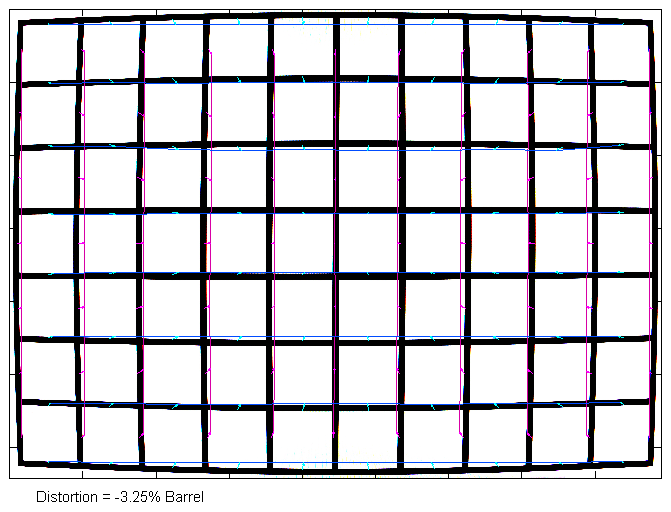
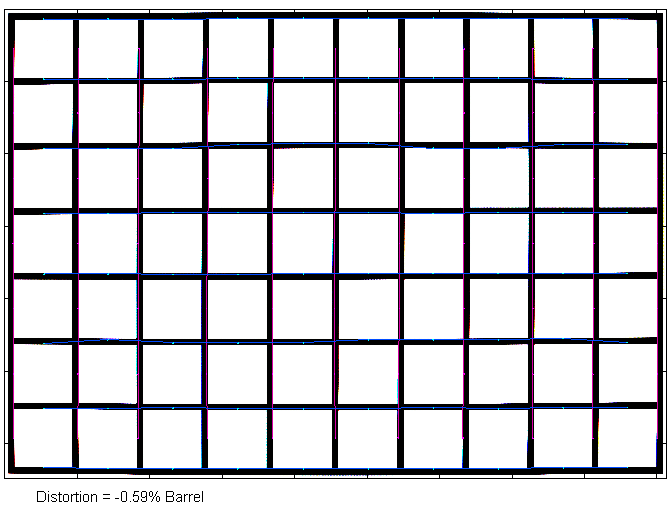
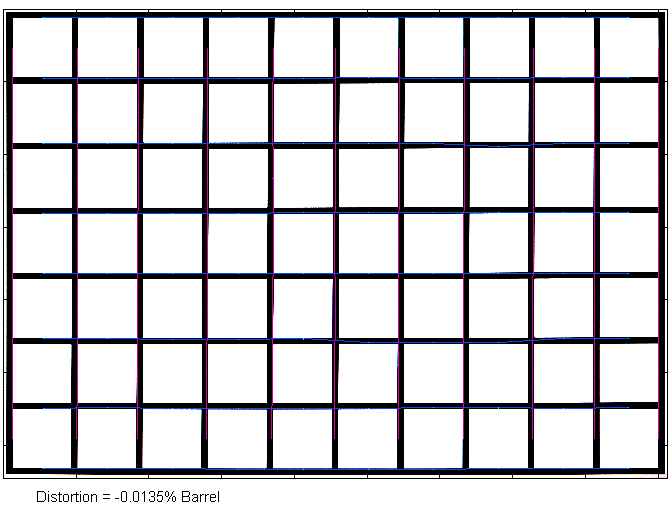
If you prefer distortion-free images, autocorrection reduces this to a negligible degree as you can see below.
Vignetting
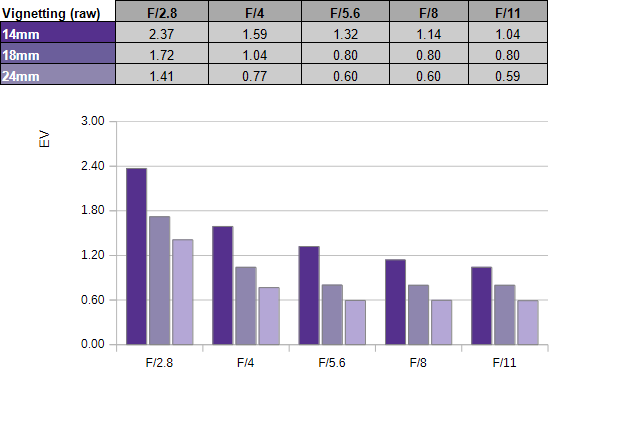
The RAW vignetting is also better than average probably courtesy of the large front element. It’s, of course, still heavy at 2.4 EV (f-stops) at 14mm f/2.8 – also due to the increased “natural” vignetting. Stopping down reduces this quite a bit although the light falloff never decreases below 1 EV here. The vignetting is lower at longer focal lengths. While still visible wide-open, the light falloff is quite acceptable from f/5.6 at 18mm and 24mm.
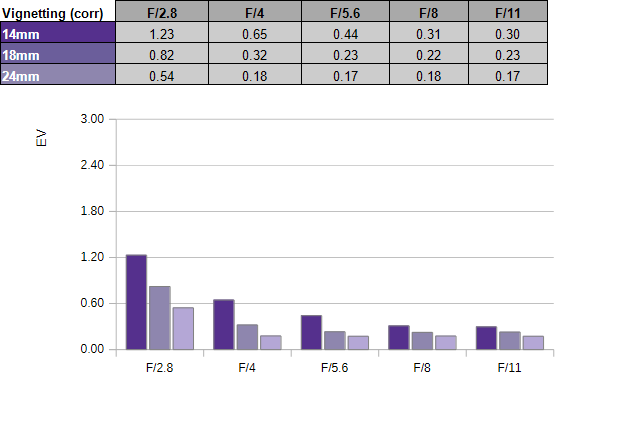
Autocorrection (in high mode) resolves most of the issue. There’s still a moderately visible vignetting at 14mm f/2.8 but otherwise, it’s very well controlled.
MTF (resolution at 45 mp)
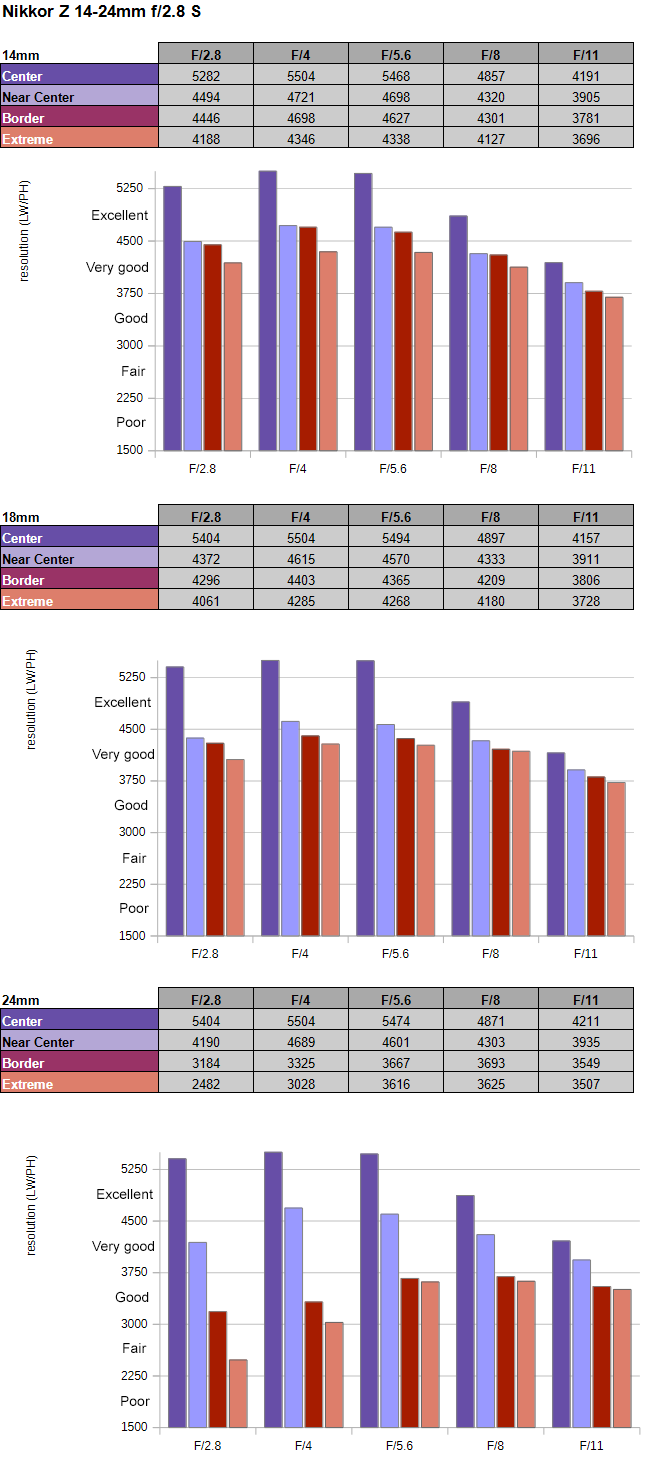
The resolution characteristic is a bit of a mixed bag. The lens is comparable to prime lenses at 14mm and 18mm which is quite an achievement at such extreme focal lengths. The dead center quality is nothing short of outstanding. The quality drops a little from here but the near-center and the outer image field are still easily very good. Stopping down to f/4 or f/5.6 still lifts the borders/corners a little. The situation changes at 24mm. The center quality is still great. But there’s a “sharp” decrease in quality towards the corners at f/2.8. The corners are downright soft here. Stopping down to f/5.6 boosts the border/corner quality to good levels. Diffraction effects become relevant from f/8, but the results are still fine at f/11.
The centering quality of the tested sample was good. The field curvature is a bit “wobbly” at the wide end.
Please note that the MTF results are not directly comparable across the different systems!
Below is a simplified summary of the formal findings. The chart shows line widths per picture height (LW/PH), which can be taken as a measure of sharpness. If you would like to know more about the MTF50 figures, you may check out the corresponding Imatest Explanations.
Chromatic Aberrations (CAs)
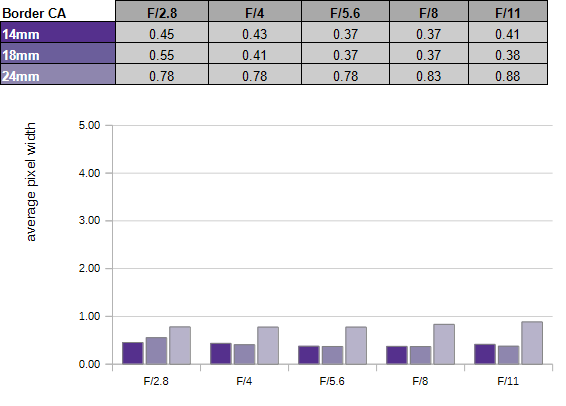
Lateral CAs are generally very well controlled especially in the wide- to mid-zoom range where they stay at or below a width of 0.5 px at the image borders. They increase slightly at 24mm but stay well below 1 px. Autocorrection handles profiled CAs nicely anyway.
Sunstars
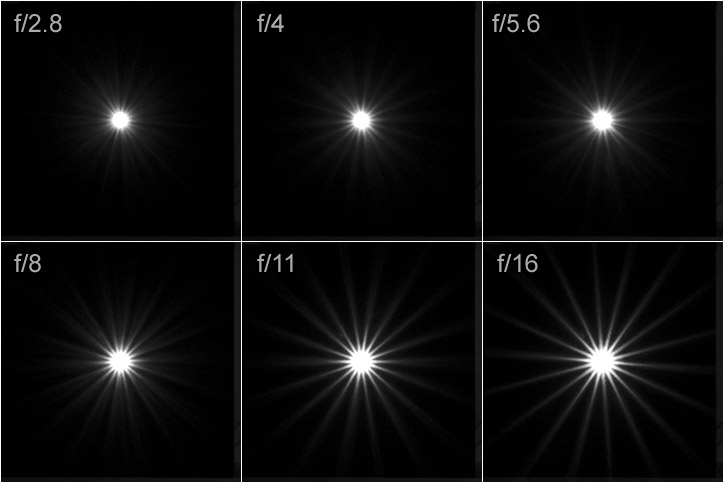
Sunstars (diffraction spikes) are an aperture effect that occurs at strong light sources – such as streetlamps in nighttime city scenes. The effect increases the more edgy the aperture becomes when stopping down. At maximum aperture, a pointy light source is just a “blob” and there isn’t much going on until f/8. As so often, the best ray rendering is achieved at f/11 and f/16. The Nikkor has 9 aperture blades resulting in 18 rays. The rays are pointy in this case which is what you want here (as opposed to fan-like rays).
Competition
Nikon isn’t Sony but the lens ecosystem is growing fast, so there are a couple of alternatives that you could consider. There is, of course, the home grown Nikkor Z 14-30mm f/4 S. It’s an (older) S-class lens, yes, but not quite as impressive at the wider settings of the zoom range. The Z 17-28mm f/2.8 Di III RXD, a relabeled Tamron, isn’t the best lens around. Tamron itself has a couple of options as well, although we haven’t tested them yet. There’s the new 12-20mm f/2.8 which impresses with the on-paper specs. But if we can believe other reviewers, its optical quality falls apart at 20mm, though. If you can live with something a little longer, there’s also the Tamron 16-30mm f/2.8 Di III VXD G2.
Sample Images


x
If you'd like to support our work, please consider shopping for this or other lenses via one of the following partners:
* Amazon (US)
* Amazon (EU)
* B&H (US)
* Adorama (US)
* KEH (used gear, US)
The Good
- Great at 14mm and 18mm
- Fairly lightweight
- Comparatively well-corrected
The Bad
- Not so great at 24mm
- Insane lens cap
- Only takes (expensive) front-filters via the lens hood
-
Optical Quality7
-
Build Quality9
-
Price / Performance8