


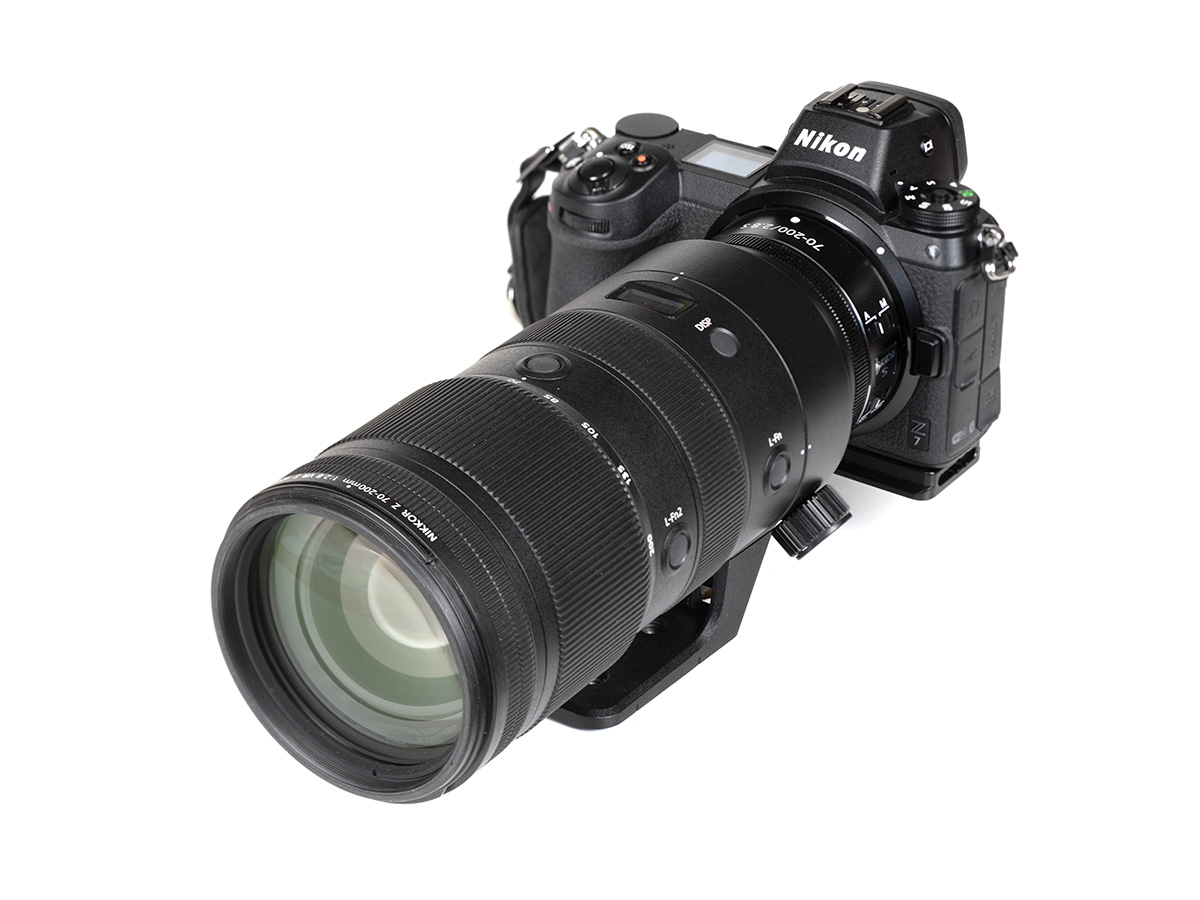
Yes, we are very late with this review. The Nikkor Z 70-200mm f/2.8 S was released back in 2020, and Nikon has released its successor meanwhile. However, better late than never so let’s go for it — also because the lens is readily available in the used market and some shops may still have some in stock as of the time of this writing.
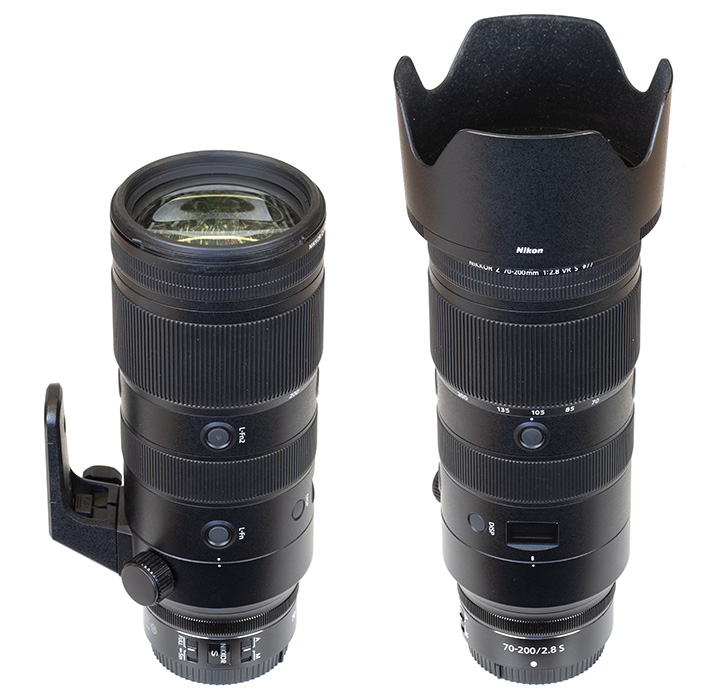
The lens body is based on high-quality engineering plastics over a magnesium alloy chassis. Just like all other S-class lenses, the internals are extensively sealed against the elements. Nikon didn’t go for the smallest physical dimensions and opted for an internal zoom mechanism instead. A good idea in a pro-grade lens — it just adds an extra layer of protection. The various control rings feel very well made. There’s also two programmable L-Fn (Lens Function) buttons and an OLED screen that can display some basic shooting parameters. A petal-shaped lens hood is part of the package.
The AF is based on a “Multi-Focus System”. Two noiseless stepping motors (STM) drive two focus groups. It’s no longer the cutting edge in terms of speed but it gets the job done most of the time. Needless to say there’s a built-in image stabilizer which Nikon rated with a potential gain of up to 5.5 f-stops.
You may ask about the differences to the new Mk II version. The latter is now more lightweight and uses a more modern and thus faster VCM (Voice-Coil-Motor) for autofocusing. The tripod mount is now also fully detachable and Arca-Swiss compatible. Other changes include a more efficient image stabilizer (6 f-stops vs 5.5) and handling improvements. And, of course, that’s all for a much higher price tag.
| Specifications | |
|---|---|
| Optical construction | 21 elements in 18 groups (6x ED, 2x aspherical, 1x fluorite, 1x SR lens) Nano Crystal and ARNEO coats fluorine-coated front lens element |
| Number of aperture blades | 9 (rounded) |
| min. focus distance | 0.5-1m (max. magnification: 0.2x) |
| Dimensions | 89 x 200mm |
| Weight | 1360g (1440g w/ tripod foot) |
| Filter size | 77mm |
| Hood | petal-shaped, bayonet mount, supplied |
| Other features | control ring dust- and drip-resistant detachable tripod foot 2x Fn buttons OLED Display image stabilizer w/ 5.5 f-stops gain Compatible w/ 1.4x and 2x converters |
Distortion
Tele zoom lens don’t tend to produce a lot of image distortions and this also applies to the Nikkor. In RAW files, images are basically free of distortions at 70mm. At longer focal lengths this changes to medium pincushion distortions.
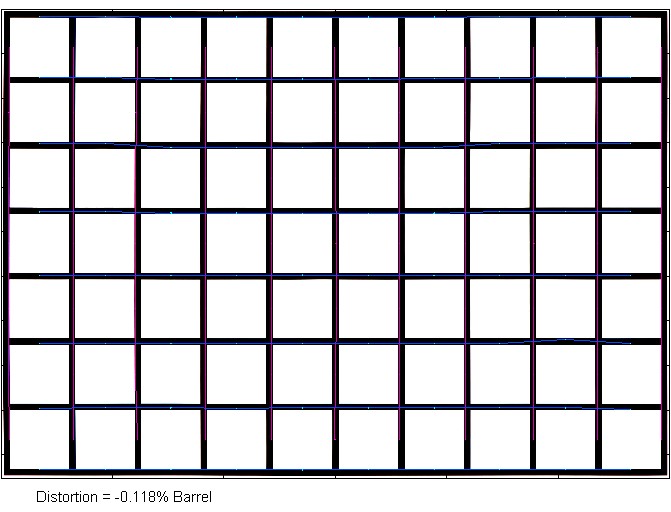
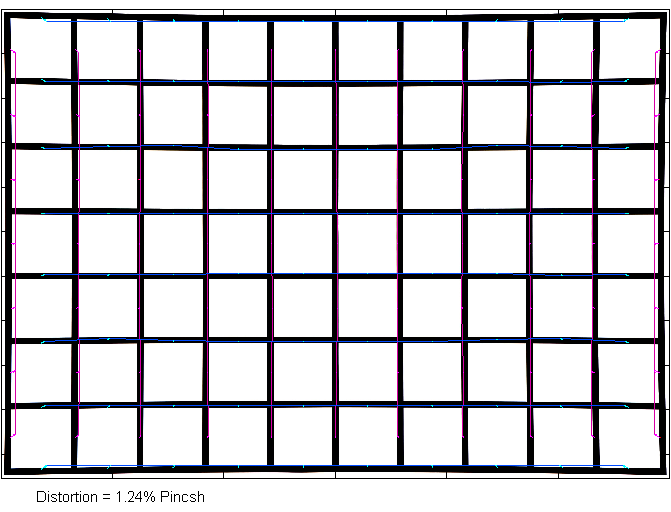
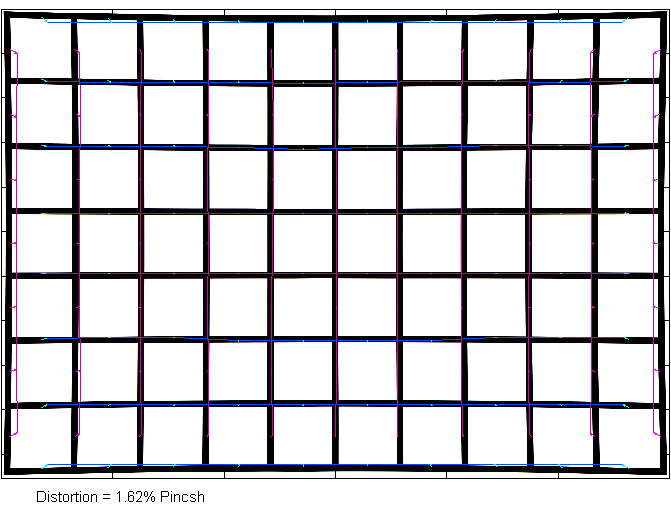
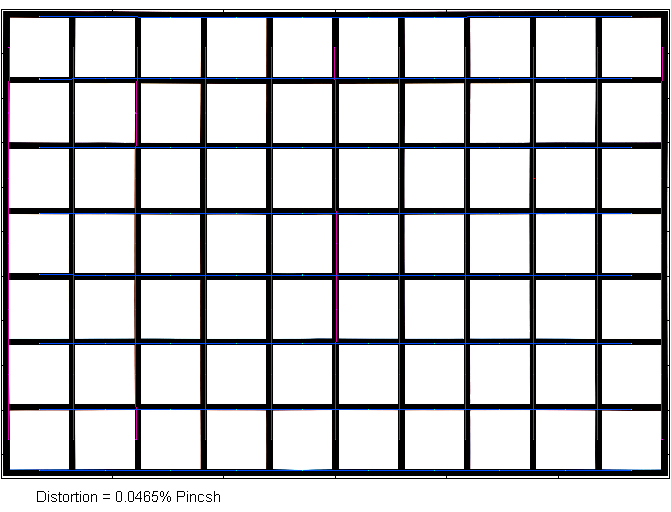
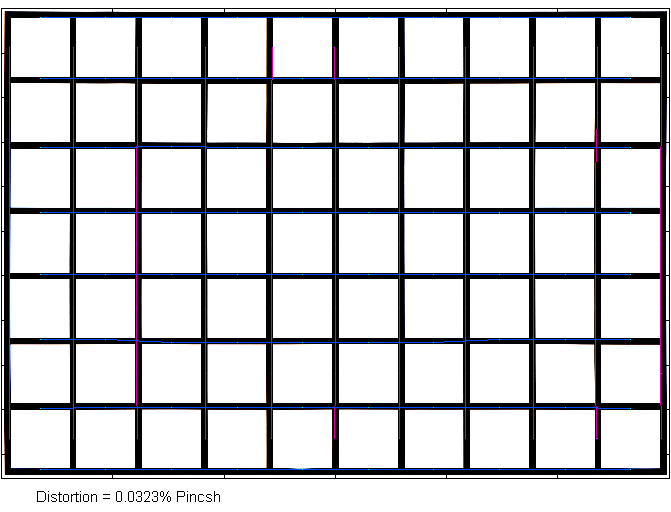
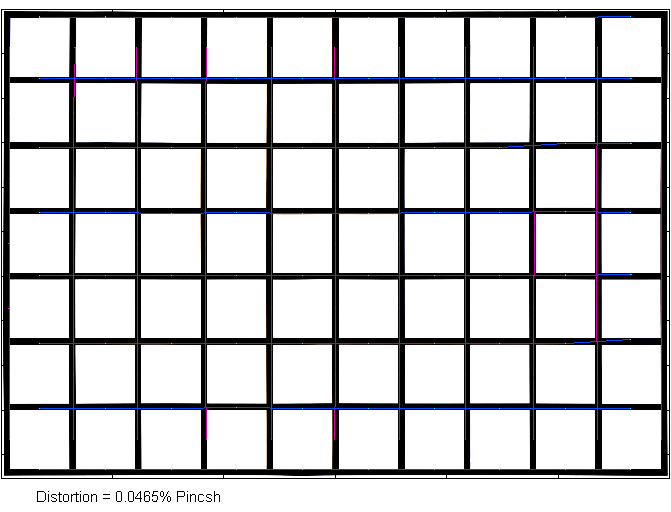
Image auto-correction has an easy job here as you can see below:
Vignetting
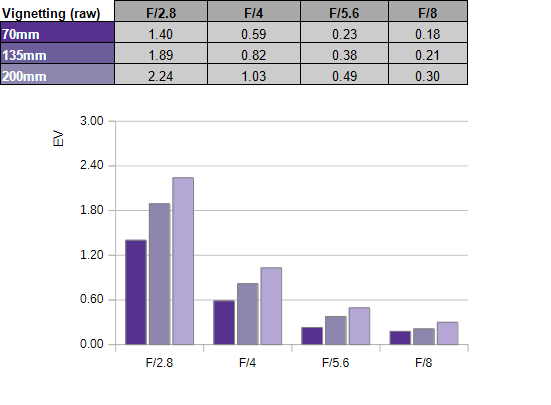
The light falloff in RAW images is relatively pronounced with a peak beyond the 2 EV (f-stop) mark at 200mm. This eases substantially when stopping down to f/4, and the vignetting is mostly negligible from f/5.6.
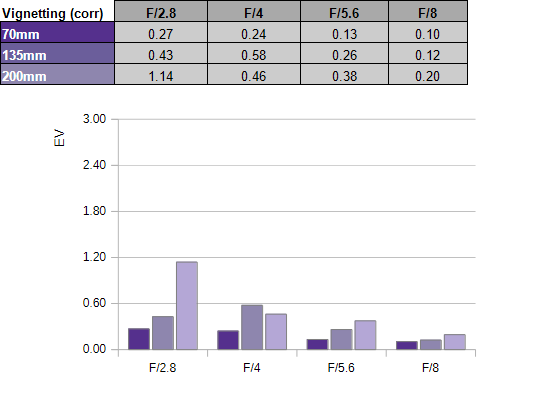
Autocorrection shaves off more than 1 EV (f-stop) at maximum aperture. You may still notice a bit of vignetting at 200mm f/2.8, though. The light falloff can be ignored at other settings.
MTF (resolution at 45 mp)
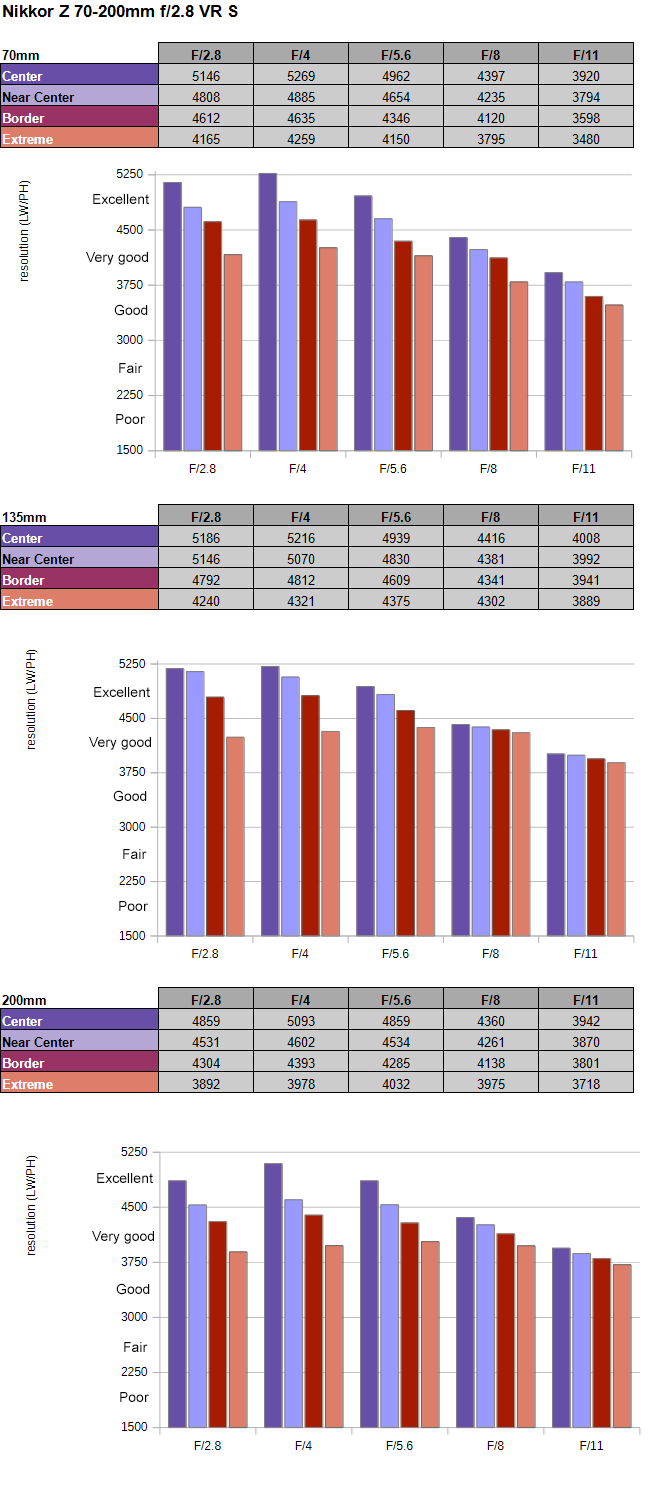
The Nikkor Z 70-200mm f/2.8 VR S produced consistently high resolution results in the lab. The center quality is excellent straight from f/2.8. The borders are also excellent in the 70-135mm ranage and only the corners drop to a “very good” rating. There’s a slight downturn at 200mm at f/2.8 with the borders dropping to very good quality, but that’s difficult to notice in real-world images. The 200mm setting is also the only one where stopping down to f/4 improves the results a little. As usual, diffraction has an impact from f/8 onward.
Please note that the MTF results are not directly comparable across the different systems!
Below is a simplified summary of the formal findings. The chart shows line widths per picture height (LW/PH), which can be taken as a measure of sharpness. If you would like to know more about the MTF50 figures, you may check out the corresponding Imatest Explanations.
Chromatic Aberrations (CAs)
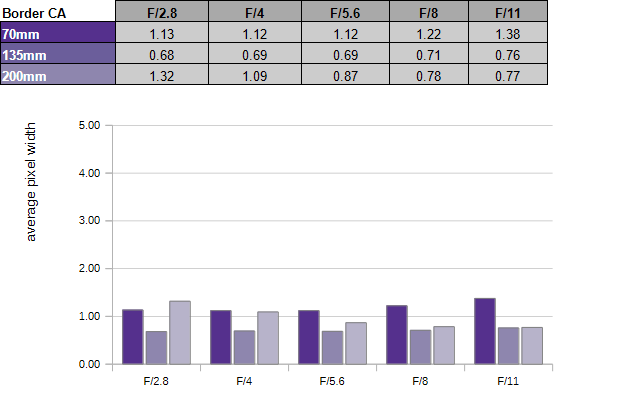
Lateral CAs are low with an average pixel width of around 1px across the zoom- and relevant aperture-range. Autocorrection can handle this easily without a drop in quality.
Bokeh
70-200mm f/2.8 are very flexible lenses, and unlike their wider cousins they can easily produce a pronounced shallow depth-of-field when needed, so let’s check it out.
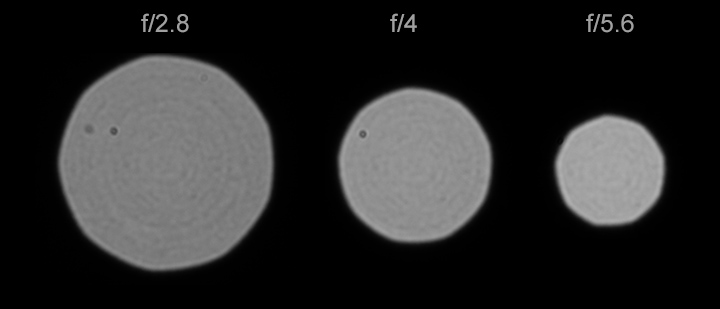
Out-of-focus highlights show a slightly nervous inner substructure (and some dust). It’s relatively subtle, though. The discs are almost circular near the center. There is no relevant outlining at the edges of the discs. As so often the more edgy aperture shape gets more obvious from f/5.6 onward.
When looking at the whole image (@ 110mm), the circular highlight shape is maintained in the broader center but there is a usual deterioration to “cat eyes” towards the corners. The “perfect” zone is broadening the more you stop down and the corner discs are restored from f/5.6.
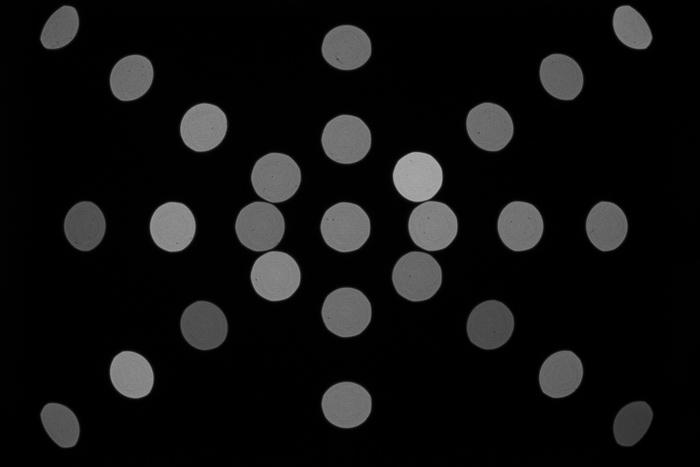
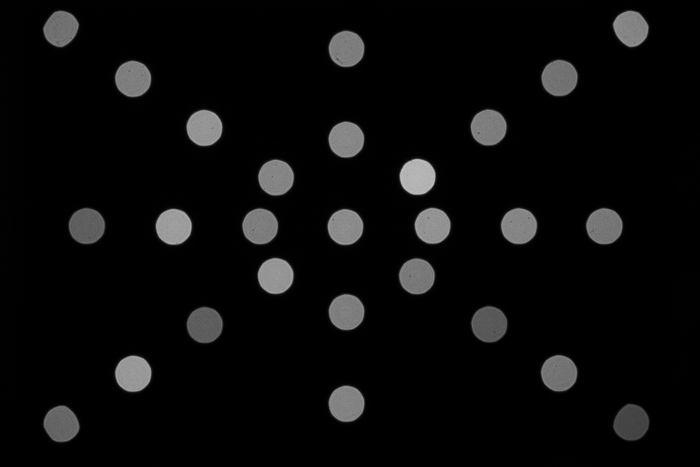
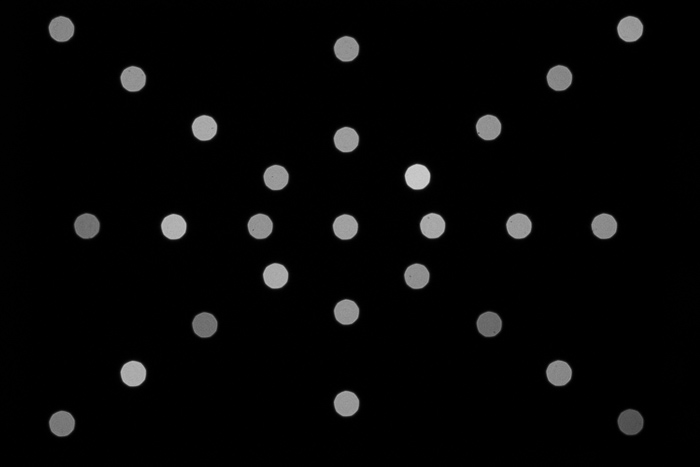
The general blur in the focus transition zone is smooth both in the image background (shown to the left below) and foreground blur (to the right).

Bokeh Fringing (LoCA)
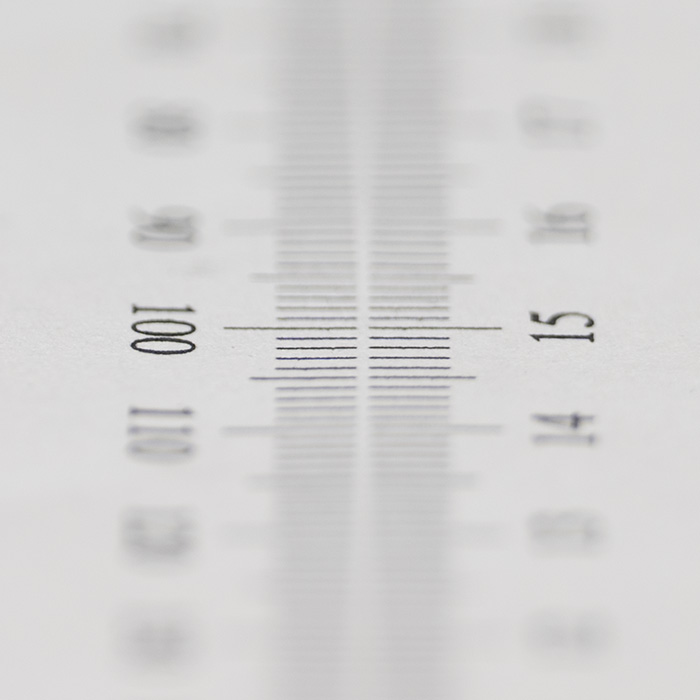
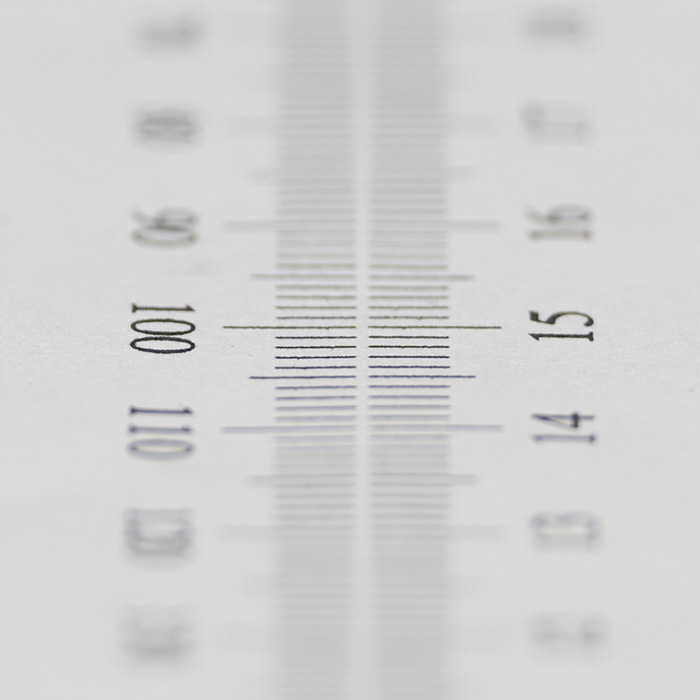
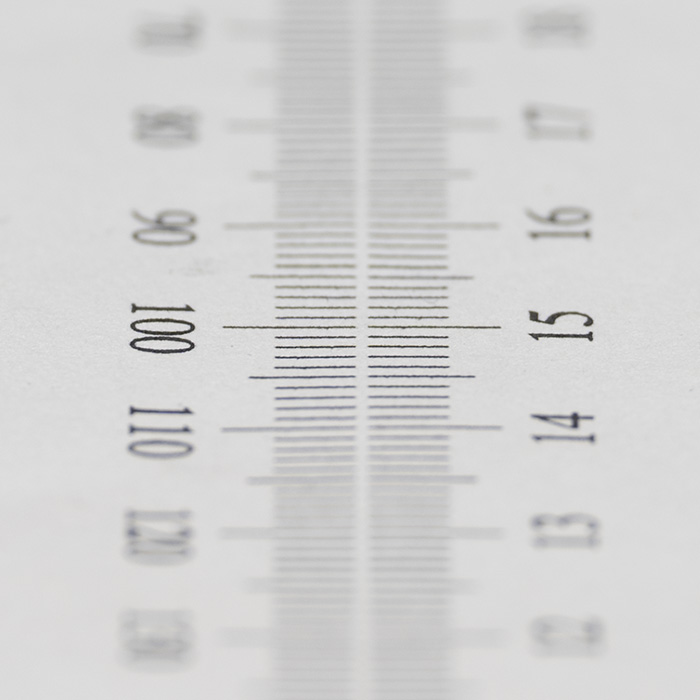
LoCAs are a color-fringing effect on the Z-axis. They show up as purplish/yellowish halos in front of the in-focus zone and greenish/bluish beyond. The Nikkor is surprisingly clean in this respect with almost no fringing to speak of even at f/2.8!
Competition
Nikon has opened up their system to third-party vendors so you’ve got a couple of choices. However, the most obvious competitor is the new Nikkor Z 70-200mm f/2.8 VR S II. As already mentioned, it has been improved in a number of ways … at a price. If you need the latest and greatest, it’s certainly the one to go for. Nikon is also offering a cheaper, more compact and MUCH more lightweight Nikkor Z 70-180mm f/2.8. This is a relabeled 1st generation Tamron 70-180mm f/2.8 Di III. It’s pretty good although the Z 70-200mm f/2.8 VR S is still better. However, the Tamron 70-180mm f/2.8 Di III VC VXD G2 has been improved significantly. Namely, it also features an optical image stabilizer. Please note, however, that the Tamron(-derived) lenses are incompatible with tele converters.
Sample Images
Countryside Germany here rather than the usual sights of Australia.
Please note that some images were taken with an attached teleconverter so they aren’t as tack sharp.


The Nikkor Z 70-200mm f/2.8 VR S may not be the latest interpretation of the medium-tele lens topic, but it's still a great performer. It's capable of producing consistently high-quality results across the focal length range, even at f/2.8. Axial CAs are basically absent which is surprising, really. Auto-correction handles most of the slight imperfections like lateral CAs, distortions and vignetting. The bokeh is very smooth although out-of-focus highlights could be a bit "cleaner". The Nikkor has a tank-like build quality but it's also not the most lightweight lens to carry around. The AF is fast. However, the AF has been improved significantly in the new Mk II version thus if you are into action photography you should probably consider the new one. While the Nikkor Z 70-200mm f/2.8 VR S may be an older lens by now, it's still not obsolete in terms of performance. On the contrary. Thus, unless you really require the improvements that Nikon applied in the Mk II, it's still a "highly recommended" lens in our book. Support us by shopping at: * Amazon Europe * B&H * Adorama * KEH (used gear)
The Good
- Consistently sharp
- Great build quality
- Barely any LoCAs!
The Bad
- Comparatively heavy
- Not the fastest AF speed around
-
Optical Quality8.5
-
Build Quality9
-
Price / Performance9