


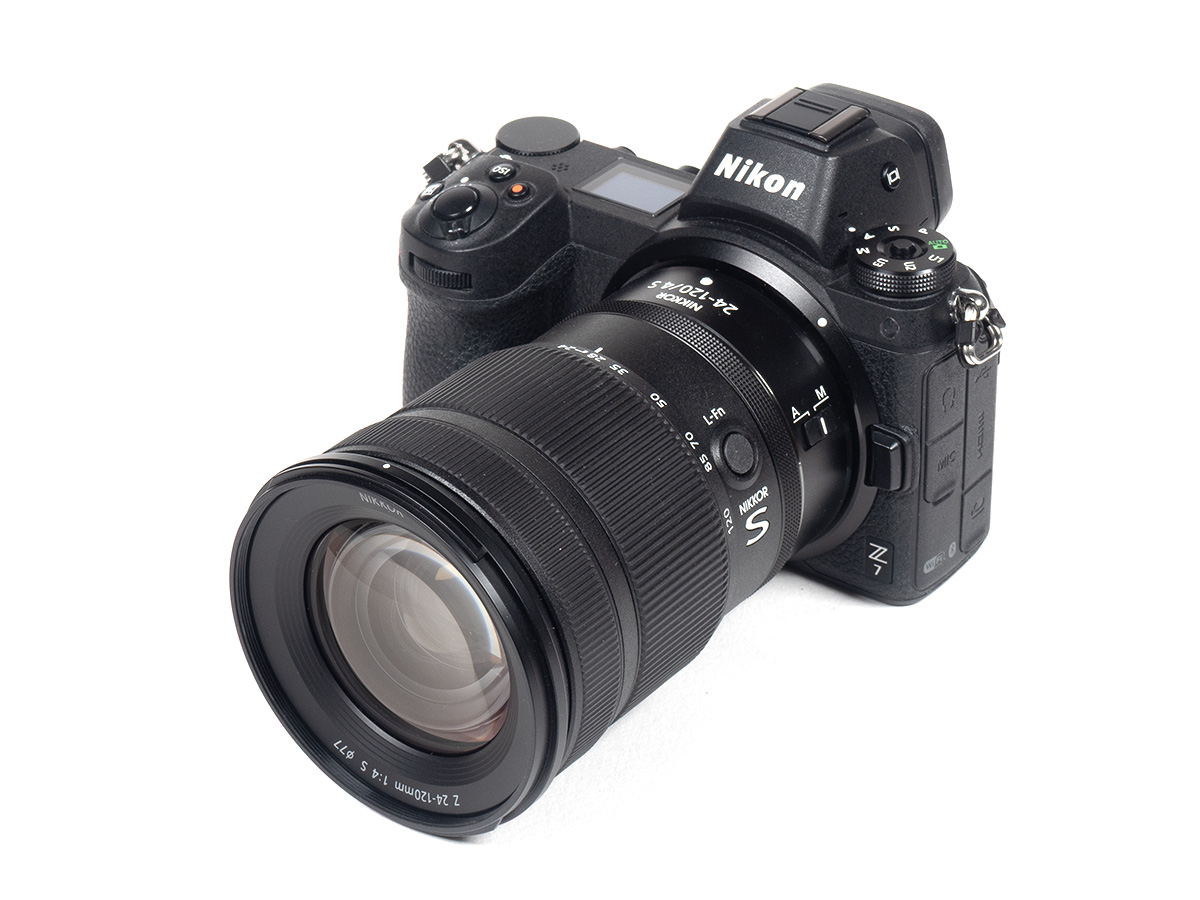
The Nikkor Z 24-120mm f/4 S is a popular standard zoom range for a reason. It combines a high zoom ratio of 5 with a reasonably fast max aperture (for a zoom lens). Unlike the native f/2.8 alternatives, it doesn’t cost an arm and a leg at around $1000, making it an obvious choice for enthusiasts – on paper, at least. It’s also a member of Nikon’s “S” series of lenses, which promises professional-grade qualities.
Historically, this is actually Nikon’s 2nd 24-120mm f/4 lens. They are still offering the AF-S 24-120mm f/4 G ED VR for DSLR cameras – released back in 2010. However, optically, this one isn’t an overly impressive lens, so it’ll be interesting to see whether the Z-mount version with its different optical and mechanical design is superior.
While not intimidatingly large upon first contact, it’s not a small lens. However, it uses a duo-cam zoom design, so it extends quite a bit when zooming toward the long end of the range, and with an attached hood, it essentially doubles in length. We are not a huge fan of the duo-cam design for long-term durability – a single extending tube should be enough, really. However, the tested sample showed no wobbling whatsoever, even at the 120mm setting. In terms of materials, Nikon used engineering plastics based on a metal mount. They also implemented some sealing against the elements. The zoom action is pretty smooth, and turning the focus ring feels silky. A somewhat cheap-feeling petal-shaped lens hood is part of the package.
The Z 24-120mm f/4 S uses an STM (stepping motor) for autofocusing. This is a slightly dated approach in theory, but the AF is both snappy and silent, so there’s nothing wrong with this here.
You may have already concluded from the lens name that, unlike the old DSLR lens, there is no optical image stabilizer. Some may raise an eyebrow because of this, but we actually like this design choice – the mechanical construction is already complex enough as is.
It’s worth noting that the lens has surprisingly high close-focus capabilities with a max. magnification of 0.39x. This is essentially macro territory already.
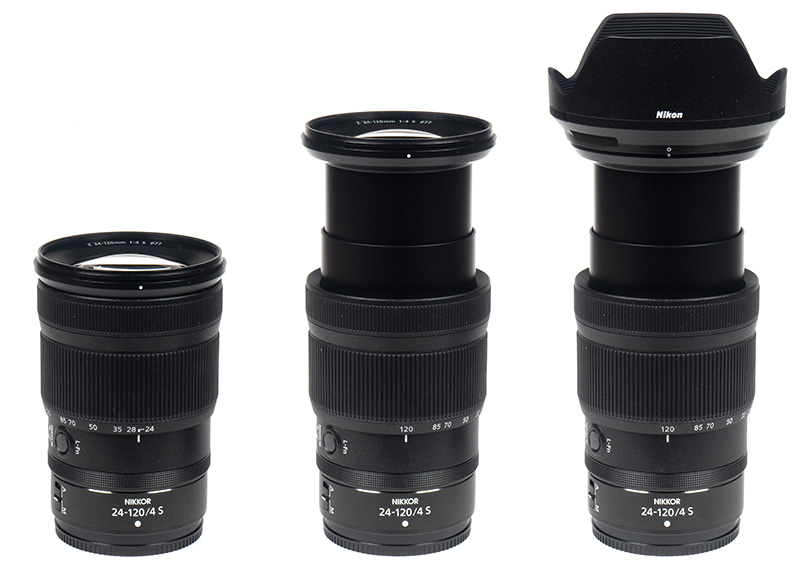
| Specifications | |
|---|---|
| Optical construction | 16 elements in 13 groups (3x ED, 1x aspherical ED, 3x aspherical) Nano Crystal Coat, ARNEO Coat, fluorine-coated front lens |
| Number of aperture blades | 9 (rounded) |
| min. focus distance | 0.35m (max. magnification: 0.39x) |
| Dimensions | 84 x 118mm |
| Weight | 630g |
| Filter size | 77mm |
| Hood | petal-shaped, bayonet mount, supplied |
| Other features | Fn button dust- and drip-resistant |
Distortion
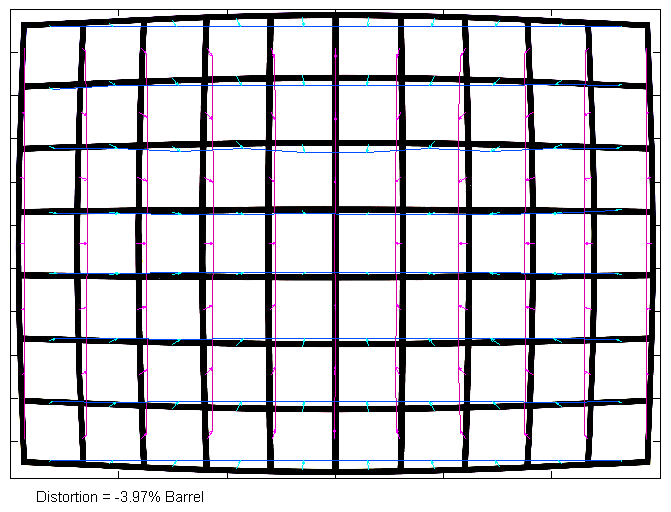
Let’s check out the native image distortion characteristic first. The lens produces a heavy barrel distortion (4%) at 24mm. This eases in the lower zoom range and switches to pincushion style from ~35mm onward. The pincushion distortions are quite heavy again from the midrange, with a peak of 3% at 120mm. This isn’t glorious, but not truly excessive either.
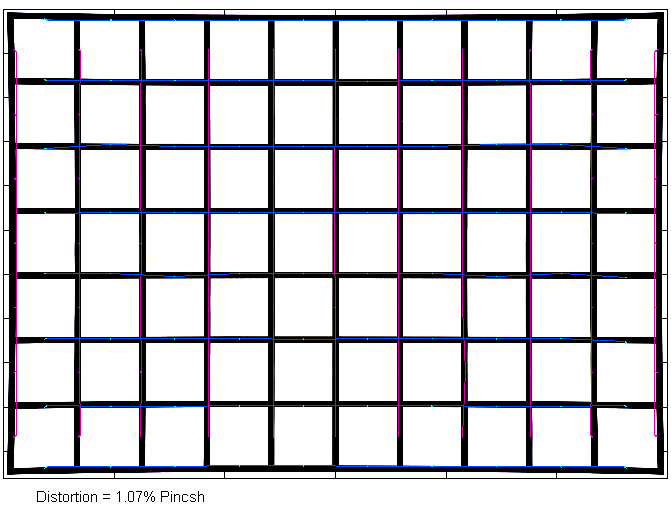
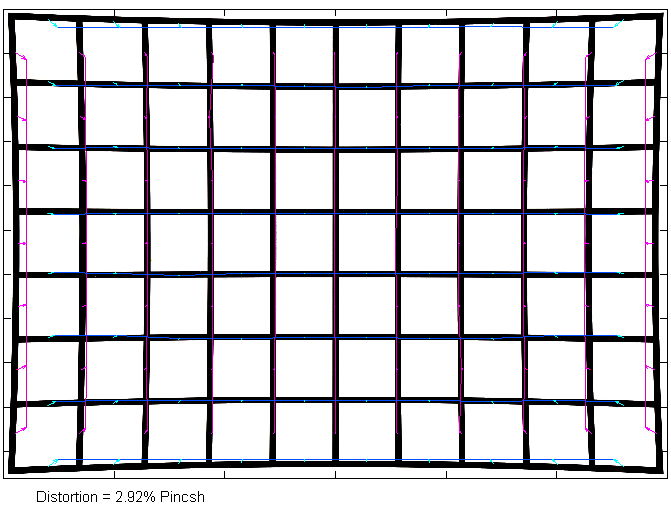
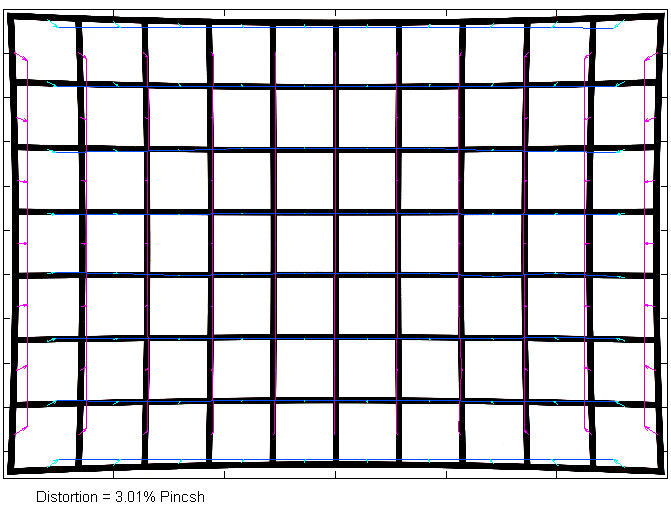
From a user perspective, the above isn’t all that relevant, and digital autocorrection handles image distortions almost perfectly, as you can see below.
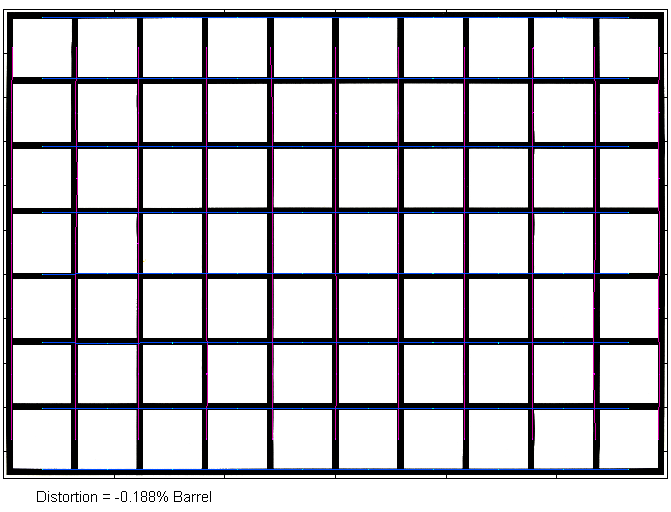
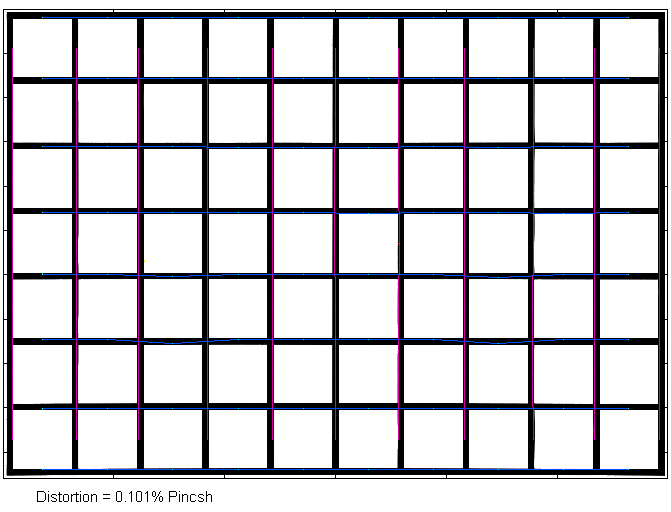
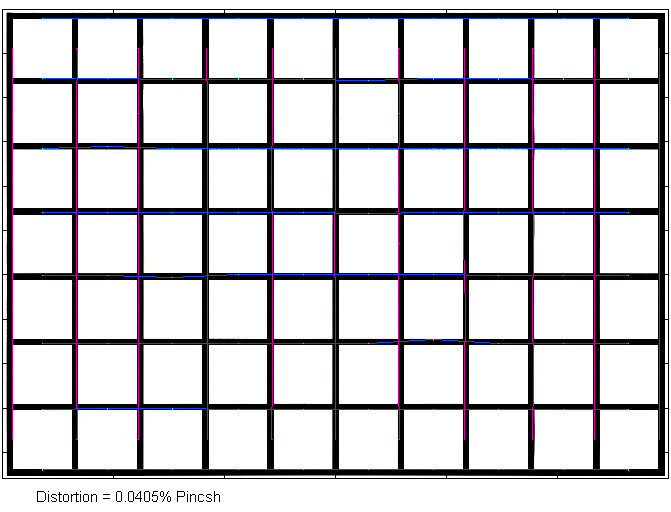
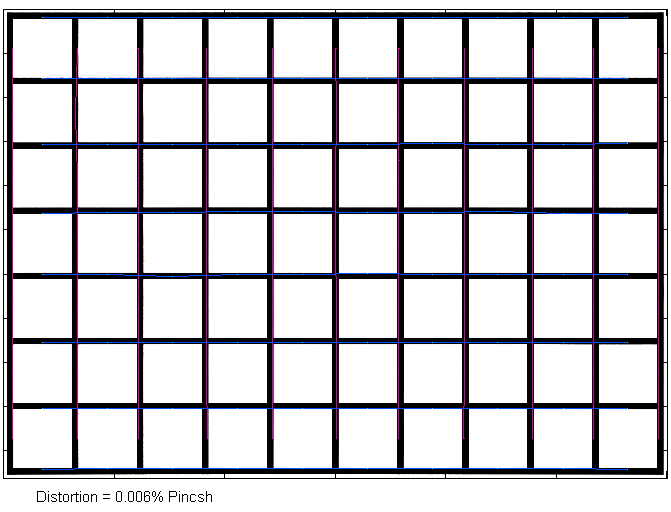
Vignetting
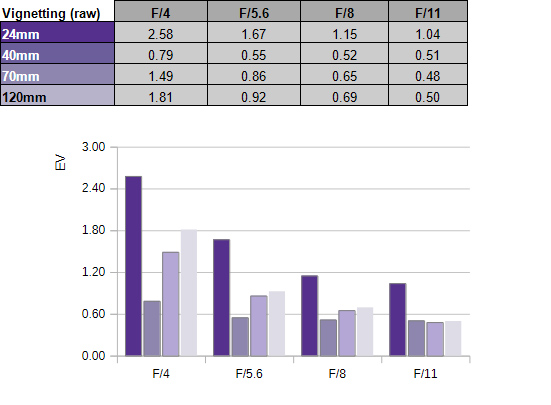
The RAW vignetting of the Nikkor is good for such a zoom lens. Unsurprisingly, the light falloff is most pronounced with ~2.6 EV (f-stops) at 24mm f/4. Stopping down helps, as usual, and the vignetting is quite well controlled from f/8. The other weak spot is at 120mm f/4, where the vignetting approaches 2 EV (f-stops).
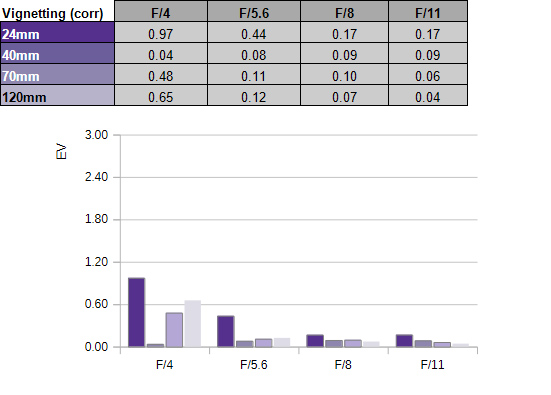
Autocorrection (in high mode) doesn’t remove all the vignetting, but other than at 24mm f/4, it’s negligible.
MTF (resolution at 45 mp)
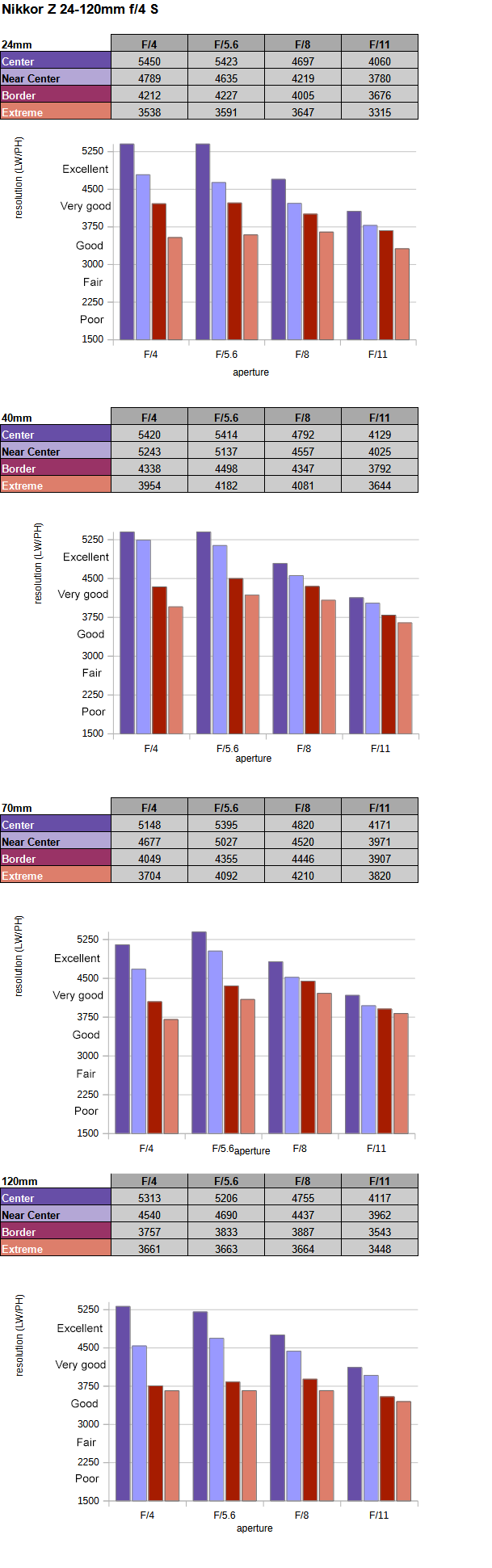
The resolution figures of the Nikkor Z 24-120mm f/4 S are pretty good for such a high zoom ratio lens. This is especially true for the image center, which is downright outstanding throughout the zoom range and that’s straight from f/4. The near-center quality remains very high, and the border quality is pretty snappy as well. The corners are good at 24mm. However, the corners suffer from rather strong field curvature at this setting.
As is to be expected, the sweet spot is in the middle of the zoom range, where the corners reach very good quality. The corner quality drops again at the very long end, but it remains good to very good. Diffraction effects are becoming more dominant beyond f/8 – this is a physical limitation.
The centering quality of the tested sample was good.
Please note that the MTF results are not directly comparable across the different systems!
Below is a simplified summary of the formal findings. The chart shows line widths per picture height (LW/PH), which can be taken as a measure of sharpness. If you would like to know more about the MTF50 figures, you may check out the corresponding Imatest Explanations.
Chromatic Aberrations (CAs)
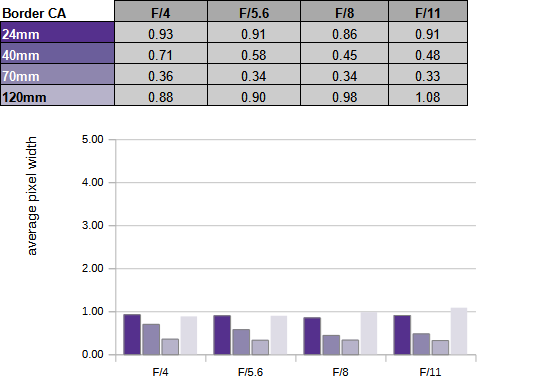
Lateral CAs are generally very well controlled, with an average CA pixel width around 1px at the image borders at 24mm and 120mm and lower CAs in the middle range.
Bokeh
An f/4 standard zoom lens can’t be a bokeh monster, but a reasonably shallow depth-of-field is possible in many scenes.
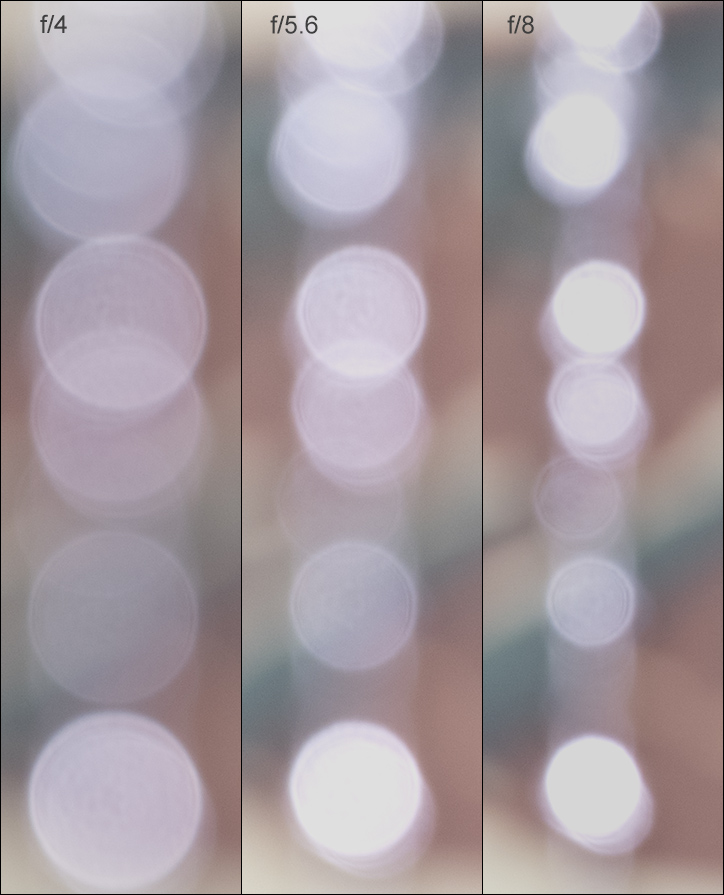
Out-of-focus highlights are reasonably well rendered for a zoom lens. The inner zone of the highlight discs is slightly “grainy” – probably due to the use of aspherical elements in the design. The disc edges show some outlining, which doesn’t disappear when stopping down. The circular shape of the discs (near the image center) remains intact at f/5.6, with only a hint of edginess creeping in at f/8.
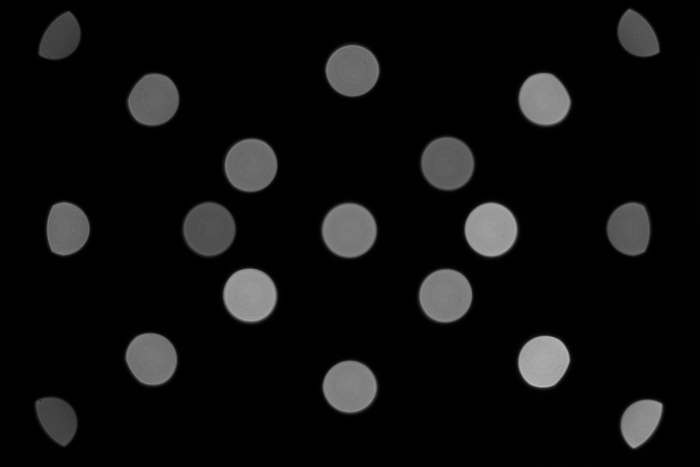
When looking at the whole image at f/4, the circular highlight shape is maintained up to the mid-field of the image. Beyond, the discs are “cut off” due to mechanical vignetting. As usual, stopping down slowly restores the discs, although the corner discs are still not circular again at f/8.


The general blur in the focus transition zone is reasonably smooth in the image background (shown to the left below). The foreground blur is rather “shadowy” (Ni-sen bokeh, Japanese for “two-line”).

Sunstars
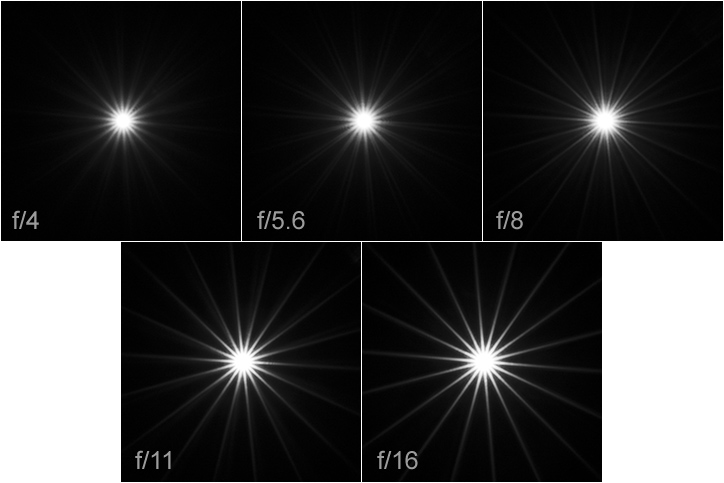
Sunstars (diffraction spikes) are an aperture effect that occurs at strong light sources – such as streetlamps in nighttime city scenes.
The Nikkor produces some minor rays at f/4 already (samples taken at 24mm) which is fairly unusual because the aperture “should” be perfectly circular here. The effect increases the more you stop down, and a pleasing rendering is available from f/11, with the best results at f/16.
Competition
The Nikkor Z 24-120mm f/4 S resides in a market spot that isn’t really shared with other lenses. It has a high 5x zoom factor and a reasonably fast max. aperture. The Nikkor Z 24-70mm f/4 S may come to mind, but it lacks the long reach. The new Tamron 35-100mm f/2.8 Di III VXD could be an alternative for some users, but most will miss the wide-end settings. The extra speed may come in handy, though. If you need more reach and don’t require a straight f/4 lens, the Nikkor Z 24-200mm f/4-6.3 VR may be worth a thought.
Sample Images


It's not surprising that the Nikkor Z 24-120mm f/4 S is so popular among Nikon shooters. Who doesn't like the idea of a 5x zoom ratio on a straight f/4 lens, after all? The optical performance is mostly impressive with just a few caveats. The center sharpness is brutally high, and the border quality remains impressive. The only fall from grace is some field curvature in the corners at the wide end. For best results at 24-28mm and "infinity scenes" (e.g., landscapes), you should pull the focus towards you. Just like most modern zoom lenses, the native distortions are high but perfectly auto-corrected. Vignetting is quite typical for such a lens, as is the bokeh. Sunstars are quite nicely rendered. The build quality of the Nikkor is very decent, although the duo-cam zoom design is a bit of a concern. Regardless, the lens feels sturdy, and the weather sealing should provide some protection when the going gets tough outdoors. The AF is both snappy and silent. Given that Nikon's full-format cameras all feature in-body IS, the lack of an optical image stabilizer is a reasonable design choice. Overall, an attractive offering at a reasonable price point.
The Good
- Ultra-sharp center, generally fine borders/corners
- Reasonably priced
- Feels sturdy
- Long range for an f/4 standard zoom lens
- Quite nice sunstars
- Very close focusing capability
The Bad
- Field curvature in the corners at 24mm
- Very long when extended (for a such a lens)
- Lens hood somewhat flimpsy
- Duo cam design
- Relies heavily on distortion auto-correction
-
Optical Quality7.5
-
Build Quality8
-
Price/Performance8