


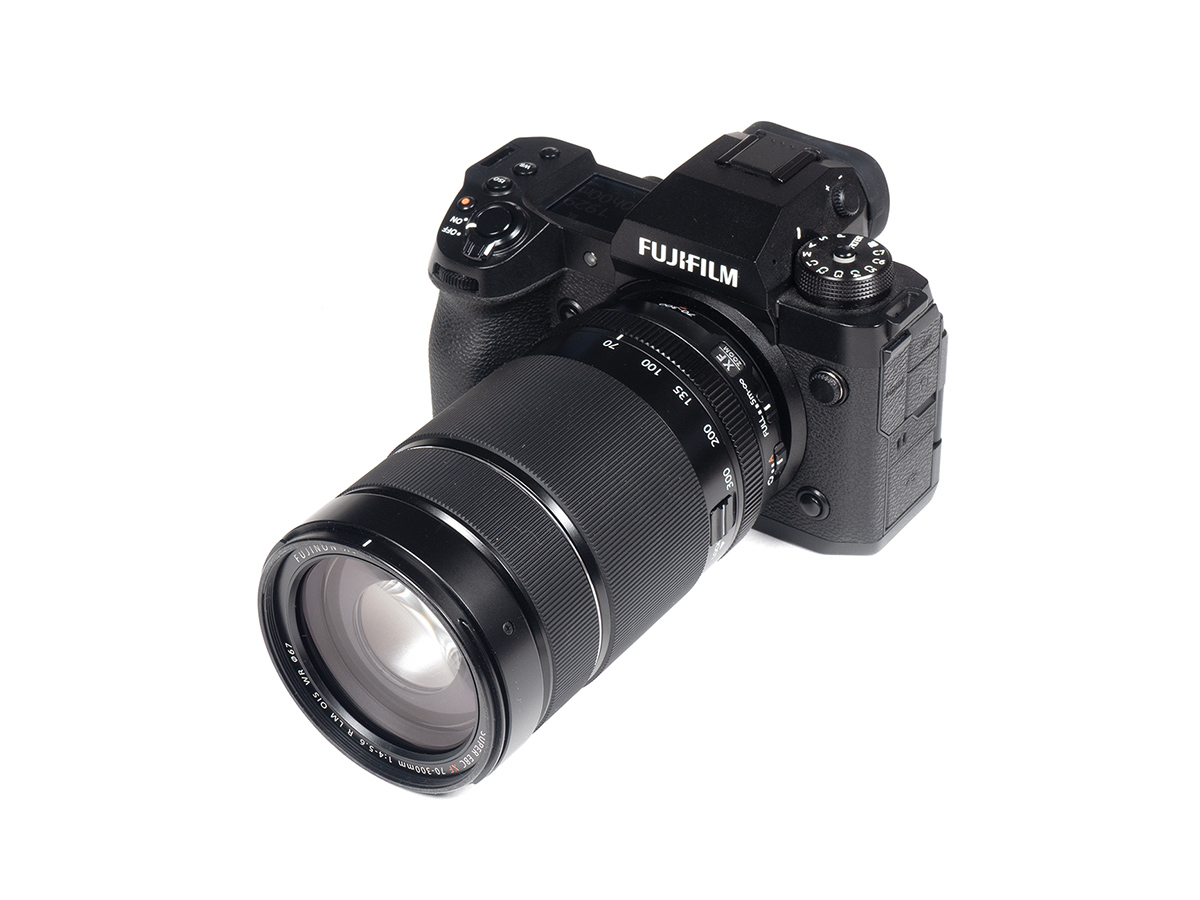
The 600mm zoom lenses are all the rage among tele lens enthusiasts – for a good reason. However, these lenses are heavy, expensive, and, for many users, simply an overkill, which is why it makes sense for manufacturers to offer 300mm as an alternative. This is especially true for APS-C format users who can benefit from the natural crop factor. In Fujifilm land, the Fujinon XF 70-300mm f/4-5.6 R LM OIS WR fills this niche. In full-format terms, this is equivalent to a “107-457mm” which is good enough for a wide array of use cases. And at around $950/800EUR, it’s still attainable for normal mortals.
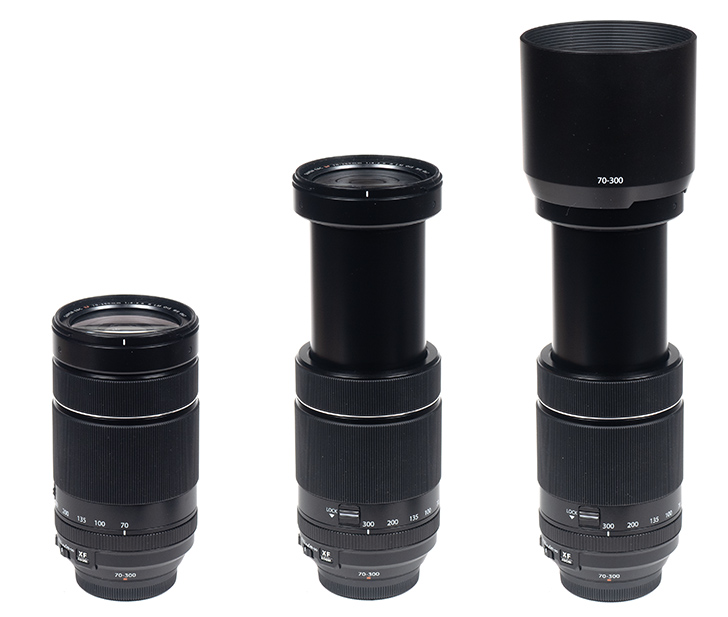
The build quality of the XF 70-300mm f/4-5.6 R LM OIS WR is in line with what you can expect from a consumer-grade zoom lens. The weather-sealed lens body is made of engineering plastics based on a metal mount. The rubberized focus and zoom rings are very grippy. The zoom ring has decent friction to allow for precise zooming, whereas the focus ring turns very loosely. A transport lock is provided to hold the lens in its 70mm position. We didn’t observe any zoom creeping, though. Typical for such lenses, it extends quite a bit when zooming out to 300mm. It is, however, a very compact lens at its 70mm setting. You can choose to operate the aperture in A-mode on the camera or via the (unmarked) aperture ring on the lens. The focus limiter switch allows you to limit the focus range to 5m to infinity, which can be helpful when tracking fast-moving objects. Otherwise, the lens can focus down to just 0.83m or a max object magnification of 1:3 at 300mm – that’s almost macro territory. A deep, barrel-shaped lens hood is provided.
As mentioned in the (long) lens name, the AF uses an LM (=”Linear Motor”). It is both fast and near silent. Manual focusing via the rubberized focus ring works, as usual, “by wire”. However, it is barely usable due to the light action of the focus ring and the poor focus response.
Fujifilm also implemented an optical image stabilizer (“OIS”) with an efficiency of “up to 5.5 f-stops.” We didn’t find a figure for sync IS (with the camera’s IBIS system), but regardless, the IS works nicely.
A curious aspect is the compatibility with Fujifilm’s teleconverters. However, keep in mind that while you can boost the focal length, the effective aperture is reduced accordingly to f/8 w/XF 1.4x TC WR and f/11 w/XF 2x TC WR. f/5.6 at 300mm isn’t exactly fast to start with – and there’s an impact on image quality, which is traditionally weakest at 300mm.
| Specifications | |
|---|---|
| Optical construction | 17 elements in 12 groups (1x aspherical, 2x ED) |
| Number of aperture blades | 9 (rounded) |
| min. focus distance | 0.83m (max magnification 0.33x) |
| Dimensions | Ø 75mm x 132.5mmm |
| Weight | 580g |
| Filter size | Ø 67mm |
| Hood | barrel-shaped (bayonet mount, supplied) |
| Other features | weather-sealing & freeze-proof aperture ring aperture mode switch zoom lock focus limiter image stabilizer compatible with XF teleconverters |
Distortions
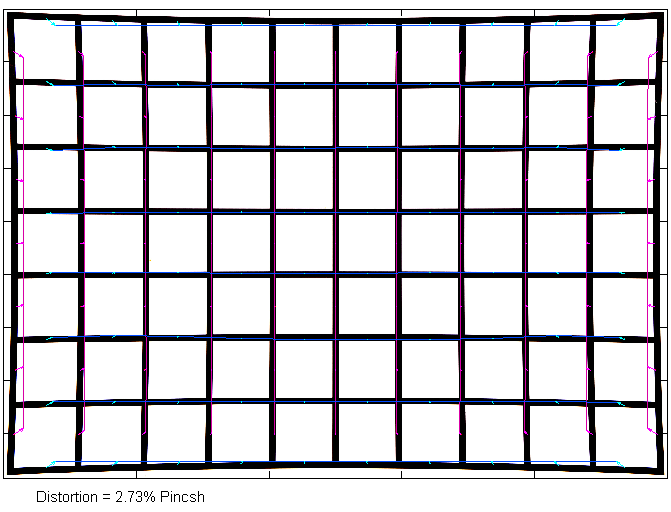
The Fujinon isn’t corrected regarding image distortion. In RAW images, we can observe a medium pincushion distortion across the zoom range, with a peak of 2.7% at 70mm.
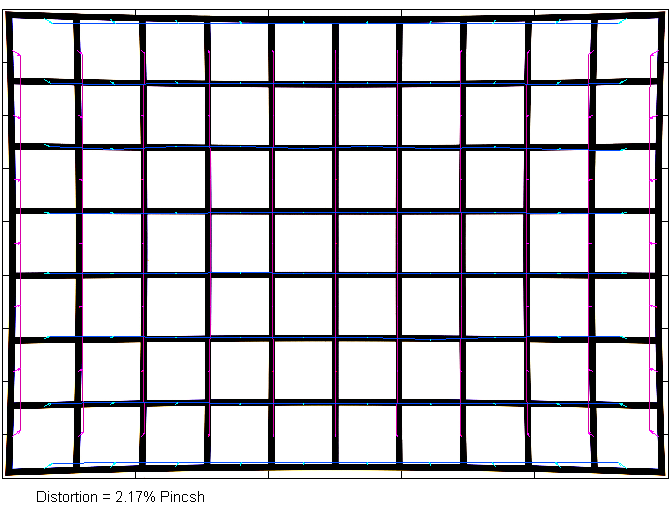
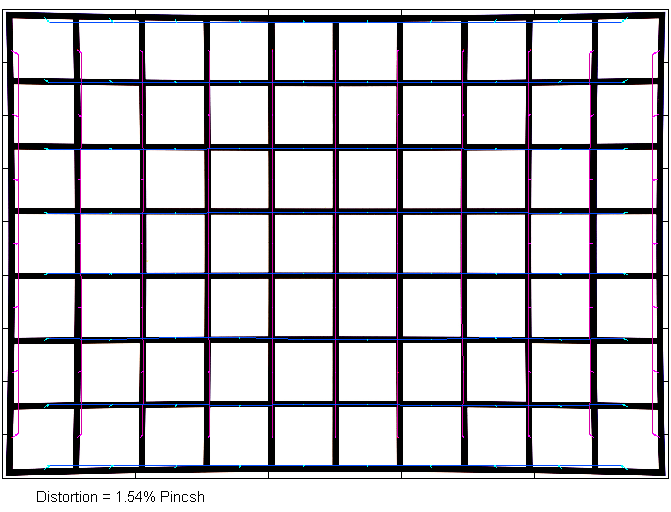
Activated auto-correction works perfectly, leaving only trace distortions:
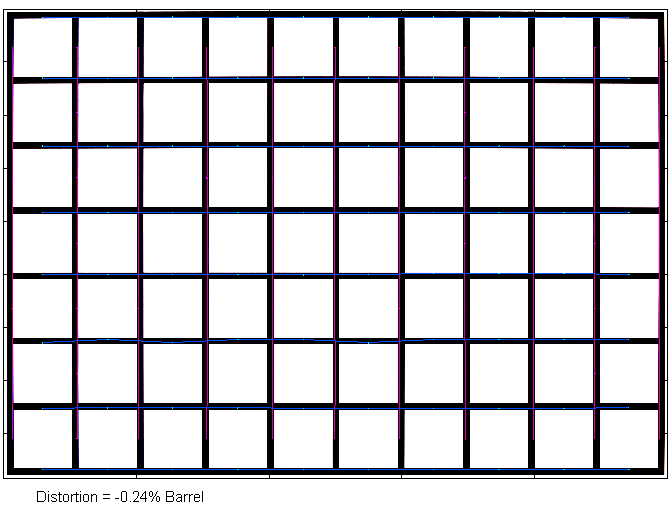
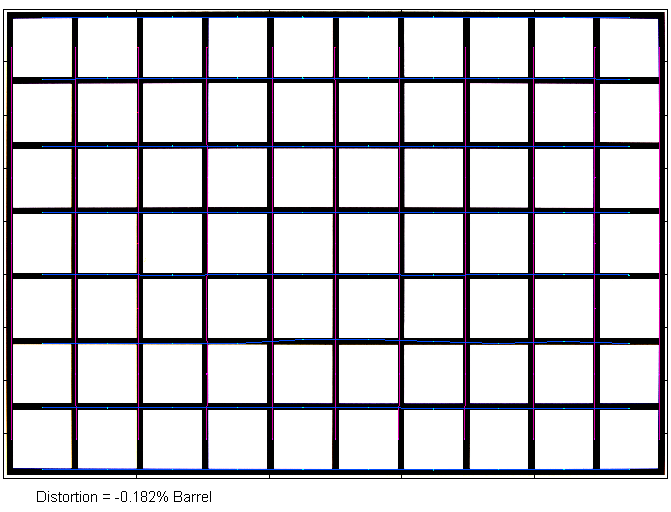
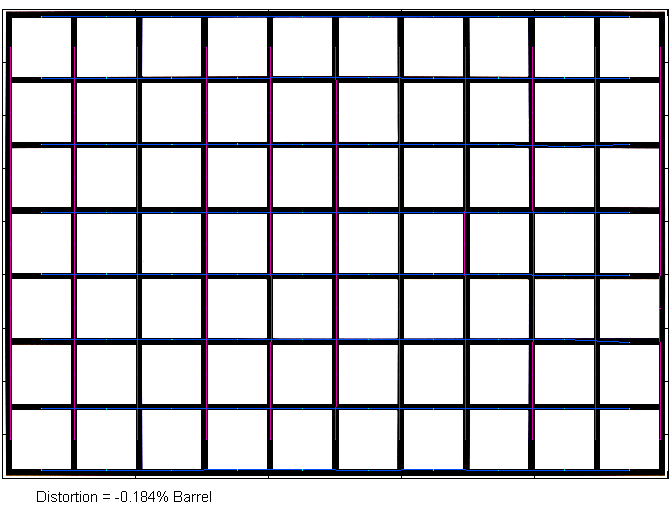
Vignetting
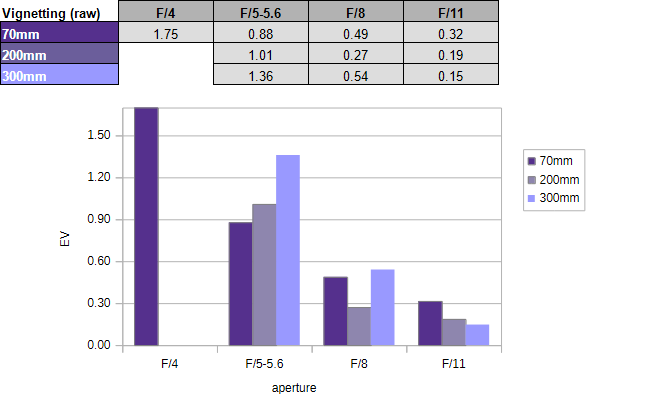
We can see a similar pattern with respect to vignetting. Uncorrected images show a fairly heavy light falloff at 70mm f/4 – at least within the APS-C scope (on full-format cameras, such figures are “normal”). It’s not quite as pronounced in the middle zoom range, but it increases again at the very long end. Stopping down mitigates the issue, as usual.
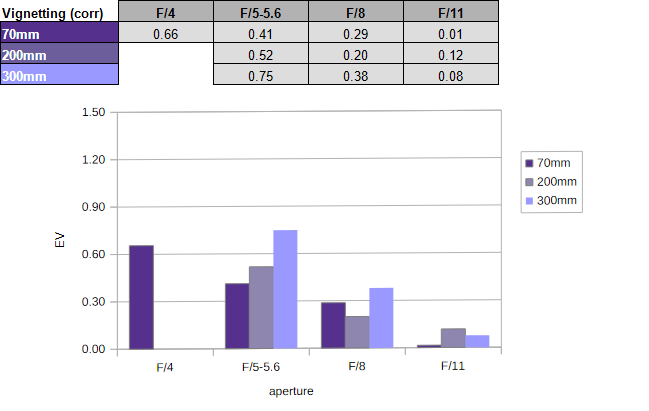
Once again, activated auto-correction comes to the rescue. There’s still a moderate vignetting at wide-open aperture, but it’s usually not disturbing anymore.
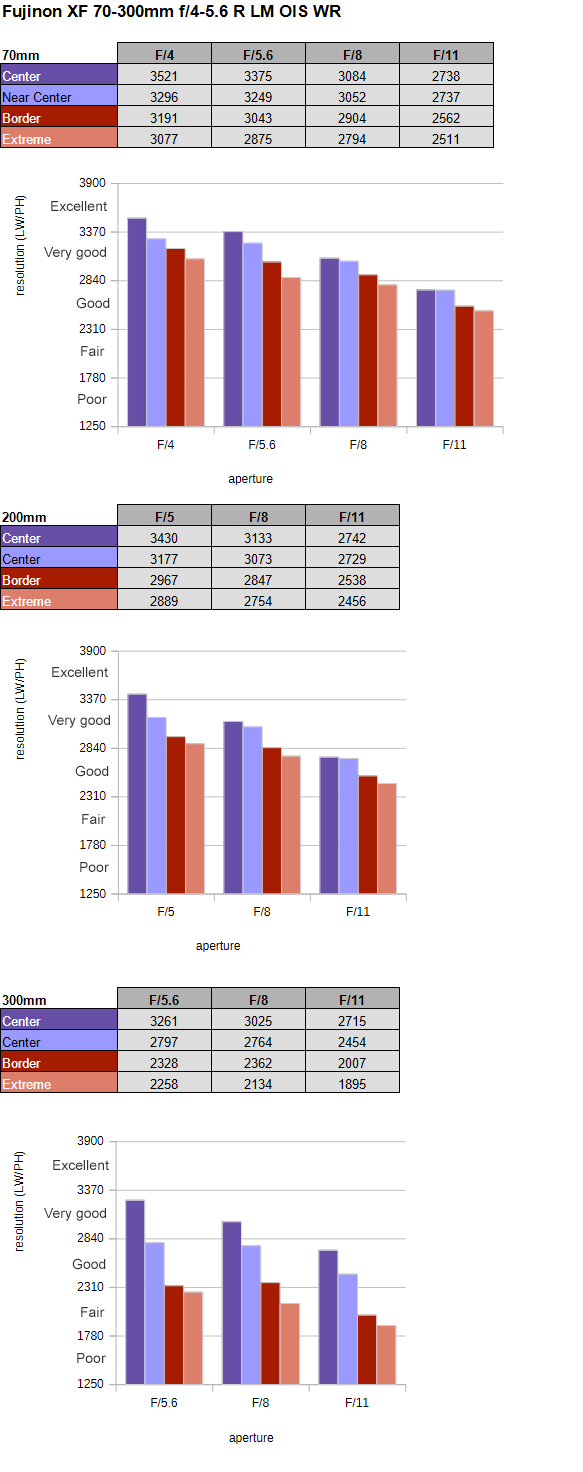
MTF (resolution) at 26 megapixels
The Fujinon XF 70-300mm f/4-5.6 R LM OIS WR is a comparatively slow lens, which is a bit of a limiting factor. Typically, the APS-C performance peaks at f/2.8 before diffraction effects start to kick in – at least under lab conditions. Even so, the resolution is pretty good at 70mm with excellent center quality at f/5.6 and a very good outer image field. Stopping down doesn’t improve the quality anymore (due to diffraction). The quality is mostly maintained at 200mm. However, there’s a drop in quality at 300mm. The dead center is still very good, but the borders/corners are rather mediocre at f/5.6, and they don’t recover from here.
The centering quality of the tested sample was Ok. Field curvature is low.
Please note that the MTF results are not directly comparable across the different systems!
Below is a simplified summary of the formal findings. The chart shows line widths per picture height (LW/PH) which can be taken as a measure of sharpness. If you would like to know more about the MTF50 figures, you may check out the corresponding Imatest Explanations.
Chromatic Aberrations (CAs)
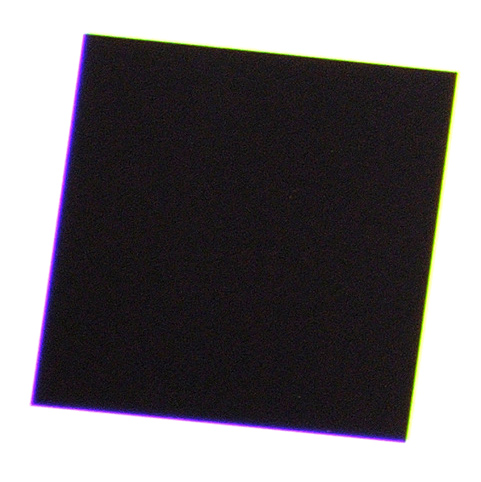
Lateral CAs are an issue at longer focal lengths. At 300mm f/5.6, we detected an average CA pixel width of more than 3px, which is rather poor for a modern lens.
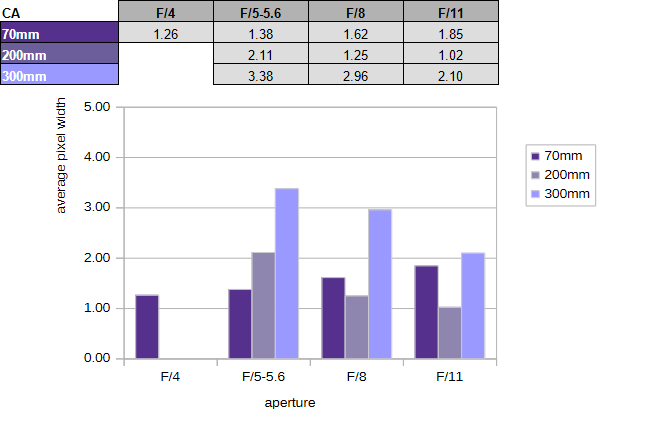
That’s not the whole story, though. While the above applies to the border region, the issue amplifies beyond. Below is an example of a corner rendering. Having said that, lateral CAs are mostly auto-corrected, but it illustrates that the 300mm setting is the weak spot of the lens by quite a margin.
Bokeh
The Fujinon XF 70-300mm f/4-5.6 R LM OIS WR is not the fastest tele-zoom lens around, but you can still achieve a decently shallow depth-of-field at long focal lengths and/or short focus distances.
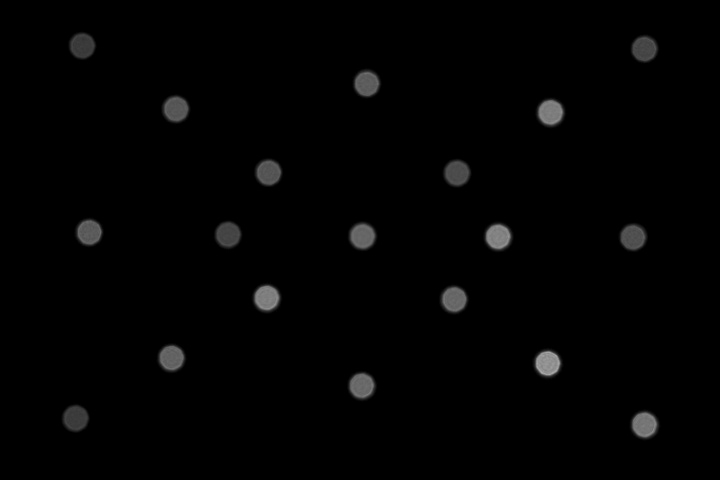
Let’s first take a look at out-of-focus highlights. They are nicely circular at f/5 (in the middle zoom range) and f/8, with just a hint of edginess from aperture shape creeping in at f/11. However, the inner zone of the discs is rather busy, and there’s some strong outlining.
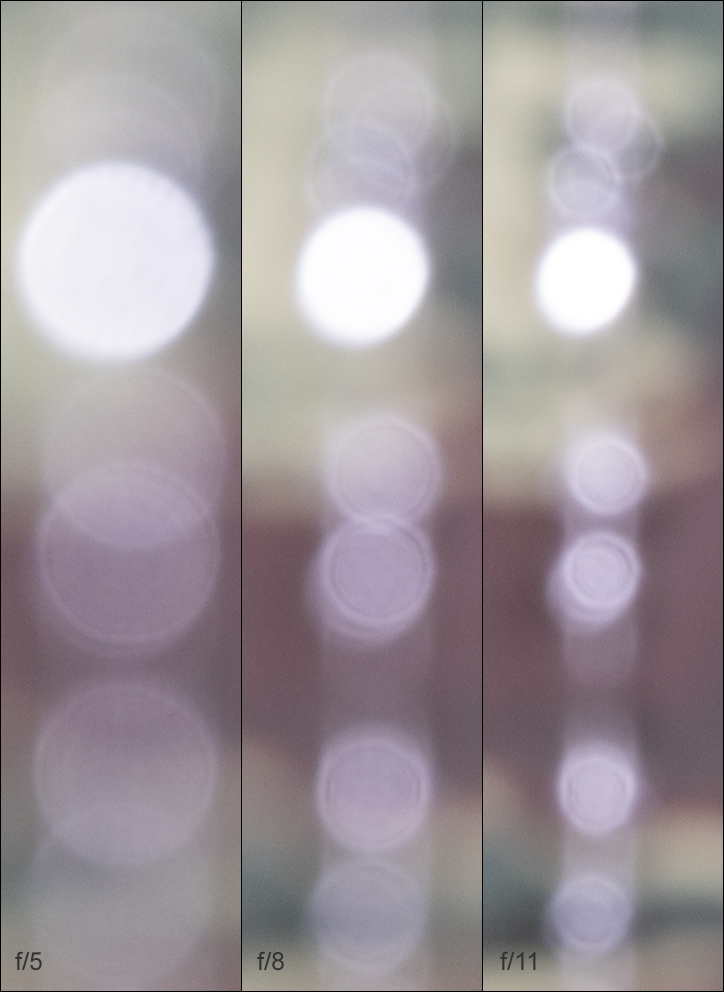
On the positive side, the disc shape remains circular across a broad image field. Only the corner discs are only slightly deteriorated. Stopping down restores the corner discs.
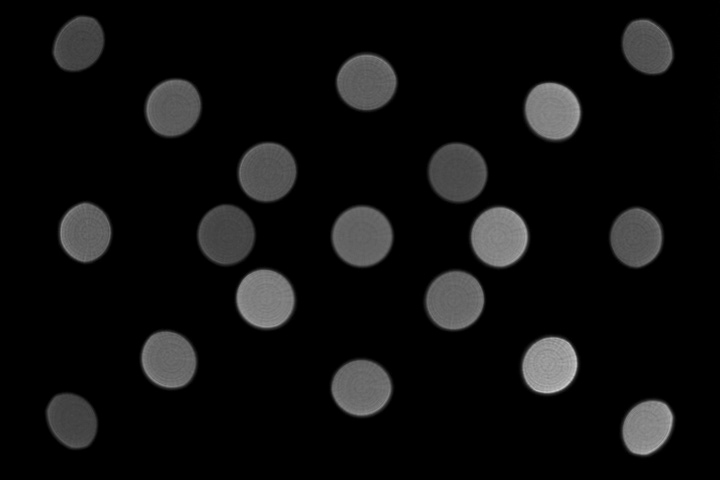
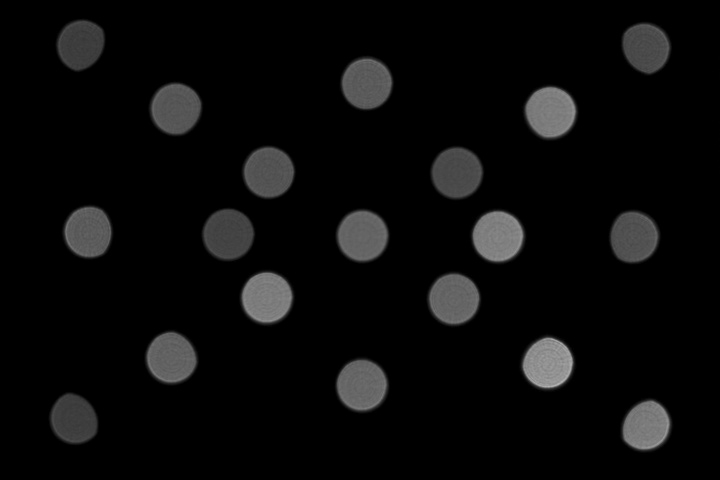
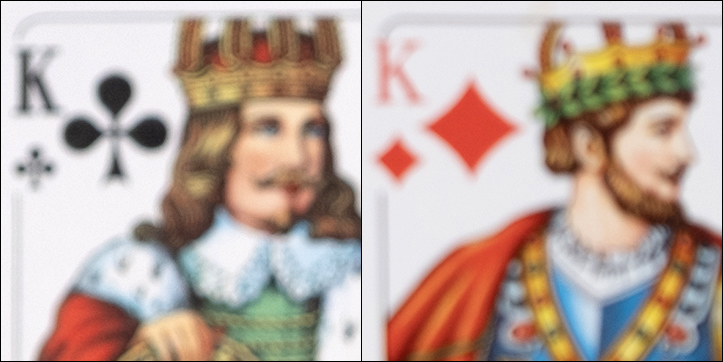
The rendering quality in the focus transition zone is good. Both background blur (shown to the left below) and foreground blur (to the right) are smooth.
Competition
The Fujinon XF 70-300mm f/4-5.6 R LM OIS WR doesn’t have to face a competitor with the same specs. However, the Sigma 100-400mm f/5-6.3 DG DN OS can be purchased for similar money. Obviously, the focal length range is a bit different, and it’s heavier and bigger. It is probably a better lens (we tested it in Sony E-mount) and a more serious option if, e.g., wildlife photography is your thing. Fujifilm has its own 100-400mm lens, but that’s more than double the price tag.
Sample Images


The Fujinon XF 70-300mm f/4-5.6 R LM OIS WR didn't fully convince us. This may be related to using it on an X-H2 for the gallery shots, and its 40 MP sensor is apparently a bit too much to swallow for this lens. On 26 MP - on which we still performed the lab tests - the situation isn't quite as tough. Here, the sharpness is fine in the 70mm to 200mm range. 300mm is still decent in the image center, less so at the borders. Lateral CAs, distortions, and vignetting are all a bit on the high side in RAW images; thus, autocorrection is a must-do with this lens - and it does the job. The quality of the bokeh is also a bit mixed, with rather busy specular highlights but nice blur quality.
In terms of build quality, it's a typical consumer-grade lens. The used materials are of good quality, and there's no wobbling even when zooming out to 300mm. The weather-sealing is certainly a nice plus for a lens that will primarily be used outdoors. Both the AF and the image stabilizer are pretty efficient. On the downside, although that's probably not relevant for the target market, manual focusing is a pain.
Overall, a decent option for users using a 26 MP camera, less so on 40 MP cameras unless you are willing to compromise.
The Good
- Compact
- Good build quality
- Quite sharp in the low to mid zoom range
The Bad
- Could be better at 300mm (on 40 MP sensors, at least)
- High CAs in RAW image (requires autocorrection)
- Poor manual focusing feedback
-
Optical Quality6
-
Build Quality7
-
Price / Performance7