


Introduction
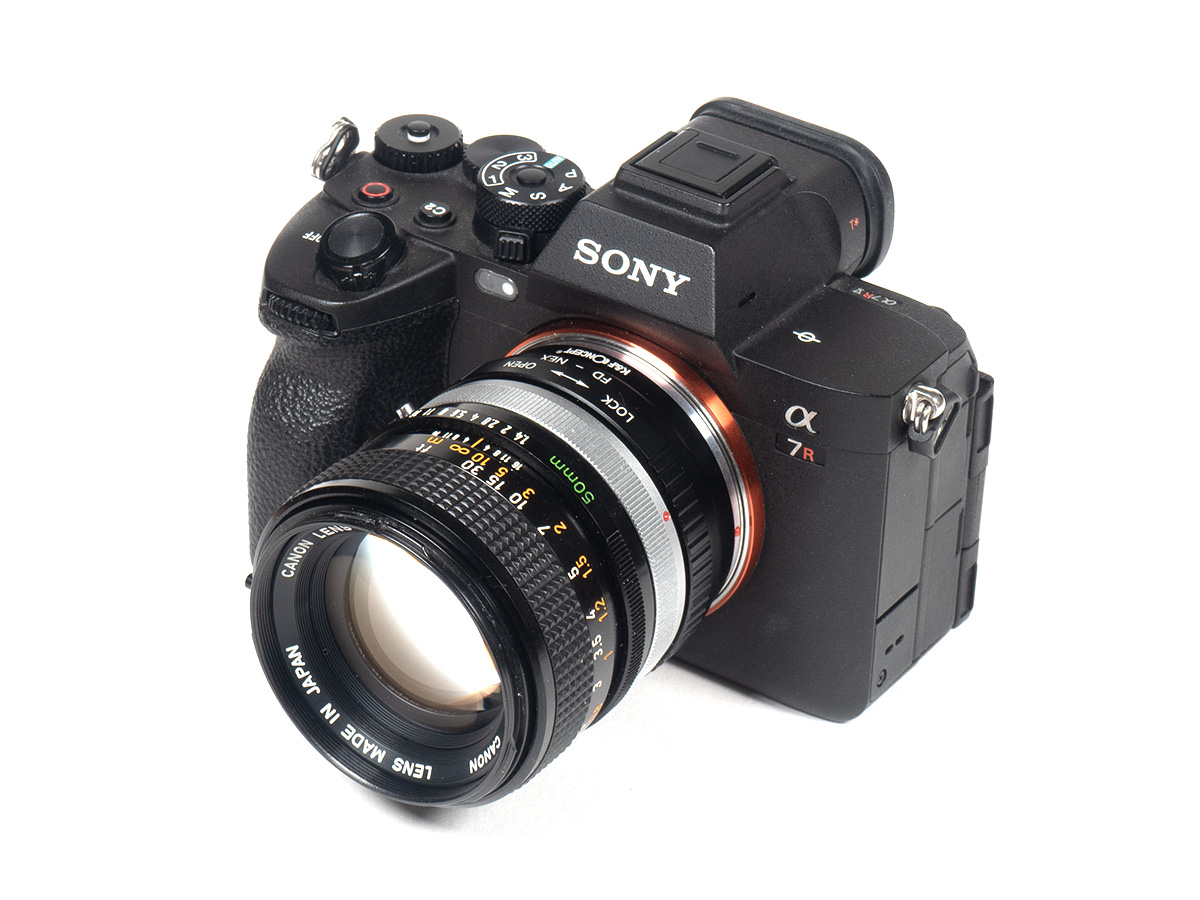
The Canon FD 50 mm f/1.4 S.S.C. is a classic standard-prime lens from Canon’s FD series of manual-focus optics for 35mm SLRs, introduced during the early phase of the FD system in the 1970s. Following the original FD 50 mm f/1.4 from 1971, it was released in March 1973 with Canon’s S.S.C. (Super Spectra Coating) to improve contrast and control flare compared with earlier single coatings (S.C).
As an FD-mount lens, the 50 mm f/1.4 S.S.C. used Canon’s breech-lock mounting system, which allowed open-aperture metering and automatic exposure communication with compatible bodies like the Canon F-1 and AE-1.
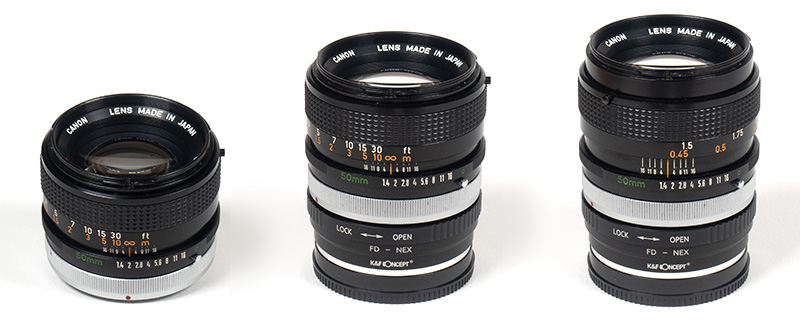
The breech-lock mechanism is somewhat annoying because mounting a lens is a 2-step process (mounting + locking).
Feedback on this from a reader regarding the breech lock system: The main benefit is that you can just attach the lens to the camera in a straight direction, and it locks itself by self-turning the locking ring by a small, however “big enough,” angle. At that stage the lens is loosely mounted on the camera. However, it already stays safely on the camera. Thereafter, you need to turn the locking ring further for firm mounting. On all other systems you need to hold in place AND turn at the same time, which some photographers at the time found to be riskier to not hit the right mounting position. Canon’s mounting system was considered to be more fail-safe.
Optically, this lens is built with 7 elements in 6 groups, a fairly typical formula for a fast normal prime of its era. The fast maximum aperture made it versatile for low-light and shallow-depth-of-field work, while the metal-and-mechanical construction of the period lent it a solid, tactile feel compared with later plastic-heavy designs.
In the broader context of Canon’s lens history, the FD 50 mm f/1.4 S.S.C. became one of the most widely used normal lenses of its generation. It remained relevant throughout the FD era until Canon transitioned to the New FD variants in the late 1970s and eventually to autofocus EF lenses in the late 1980s.
| Specifications | |
|---|---|
| Optical construction | 7 elements in 6 groups |
| Number of aperture blades | 8 |
| min. focus distance | 0.45m (max. object magnification 0.145x) |
| Dimensions | 67 x 49mm |
| Weight | 350g |
| Filter size | 55mm |
| Hood | – |
| Other features | – |
| Mount | Canon FD |
Distortions
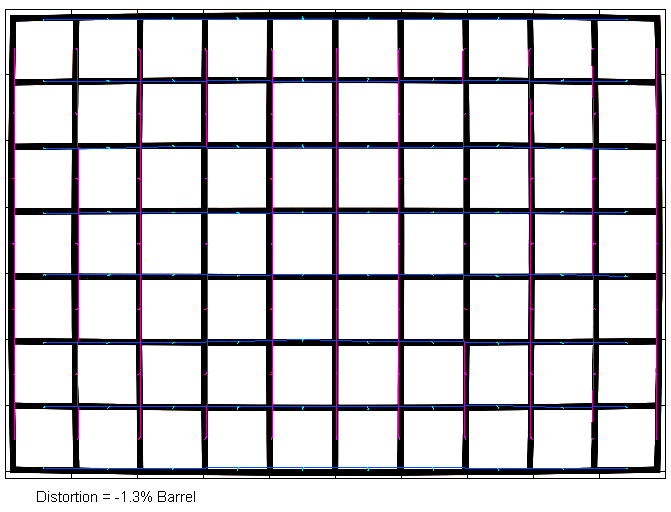
The Canon FD 50mm f/1.4 S.S.C is a bit different from the other vintage 50s that we have tested so far. The others produce negligible image distortion, whereas the Canon produces a mild barrel distortion of 1.3%. That’s still very low by today’s (sometimes wild) standards, though.
Vignetting
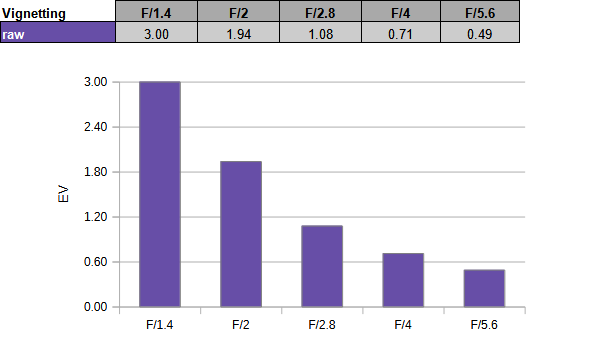
The vignetting is a bit surprising. Maybe it’s related to the specific design here, but at 3 EV (f-stops), the Canon lens produces far higher vignetting than, e.g. the Minolta MC Rokkor-PF 58mm f/1.4 that we reviewed a short while ago. As usual, stopping down helps, but the vignetting is only really acceptable from f/2.8 and decent from f/4 – which is “late”.
MTF (@ 42mp on Sony Full Format)
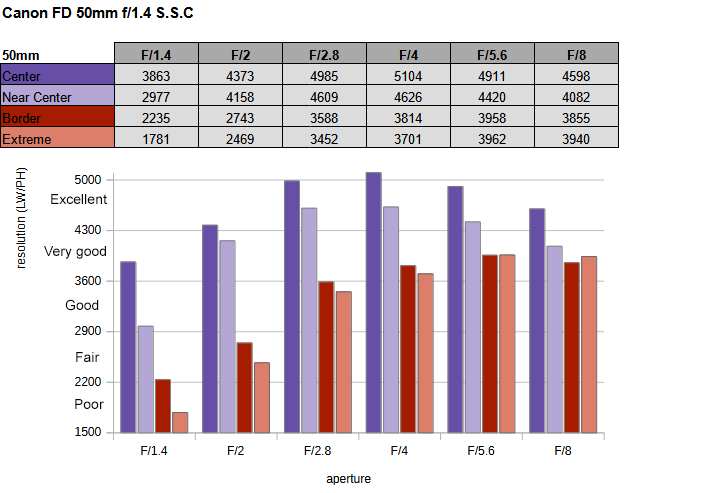
Despite its age, the Canon FD 50mm f/1.4 S.S.C is actually not too shabby regarding its resolution characteristic. The center is very good at f/1.4, albeit with the typical low contrast. There’s a sharp drop from the dead center, but at least minimal details are retained even in the corners (hello, Canon RF 45mm f/1.2 STM …). Stopping down boosts the near-center quality, and the outer image field quality creeps up a little without reaching good levels, though. This changes at f/2.8, where the broader center is excellent, and the borders/corners are finally good to very good. The best overall result is achieved between f/4 and f/5.6. Diffraction sets in at f/8, lowering the quality a bit.
The centering of the tested sample was OK. The field curvature was comparatively low.
Please note that the MTF results are not directly comparable across the different systems!
Below is a simplified summary of the formal findings. The chart shows line widths per picture height (LW/PH) which can be taken as a measure of sharpness. If you would like to know more about the MTF50 figures, you may check out the corresponding Imatest Explanations.
Chromatic Aberrations (CAs)
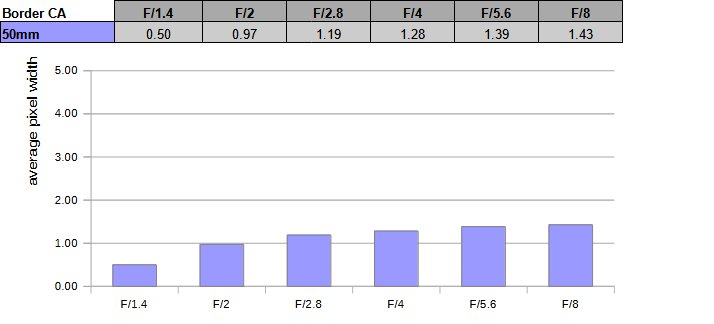
Lateral CAs are a bit of a mixed bag. They are low at f/1.4 (although possibly diluted by the low border resolution) but increase steadily from here. They peak at f/8 with a maximum CA pixel width of 1.4px at the image borders.
Bokeh
Let’s see what this oldie can give us in terms of bokeh “character”.
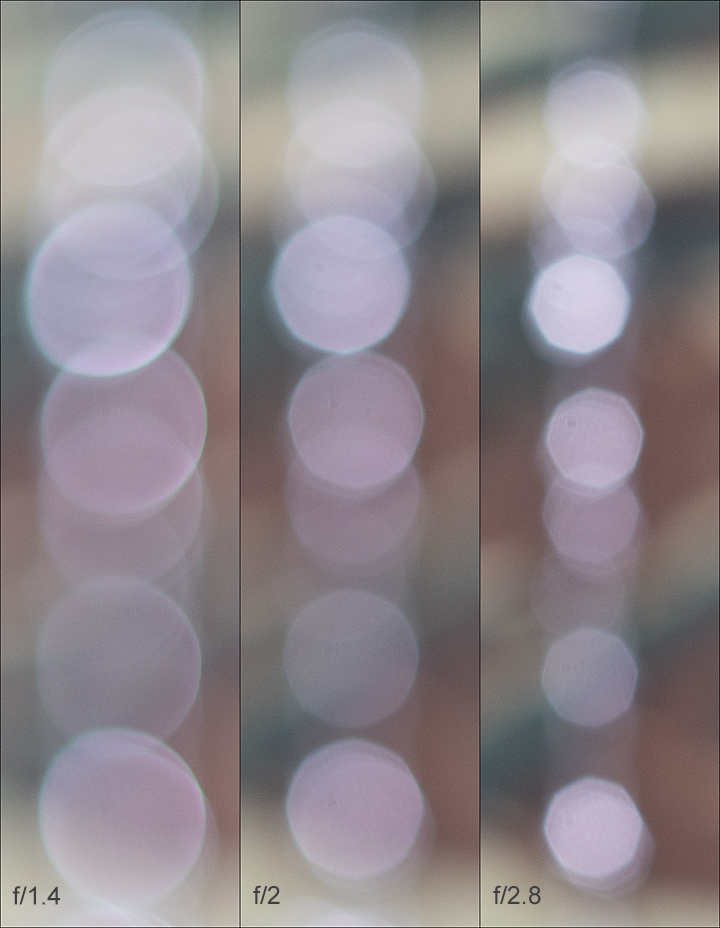
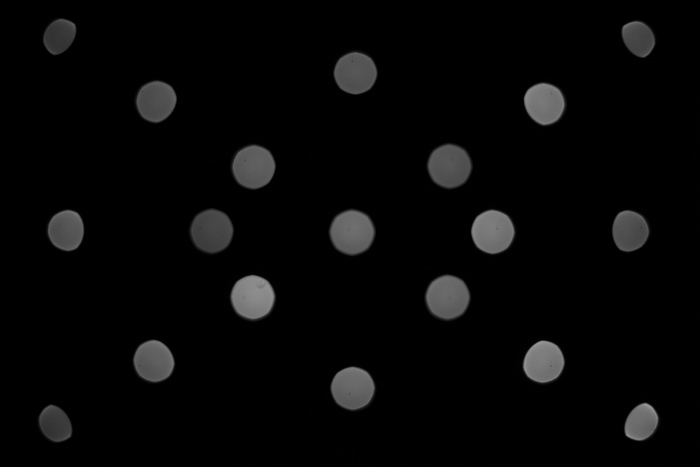
At f/1.4, the inner zone of the discs is quite clean (other than a bit of dust) – as to be expected from a lens without aspherical elements. There’s also some outlining. Stopping down to f/2 produces slightly edgy discs (from the 8 aperture blades) and the outlining is almost gone – and more so at f/2.8.
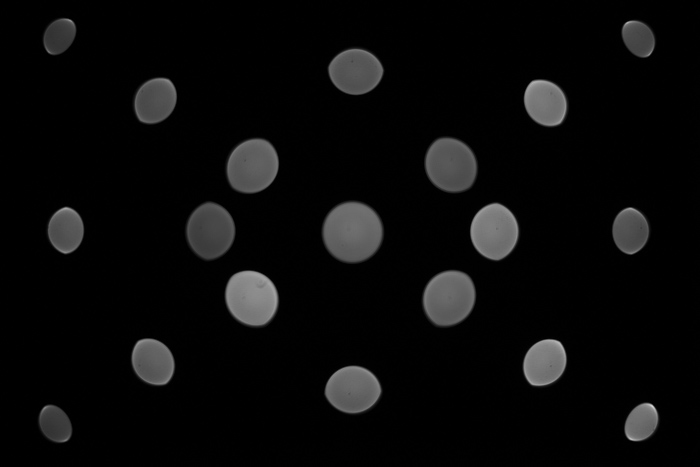
When looking at the highlight discs across the frame, we can notice the deterioration of the discs from the near-center to the edges. However, the discs stay more or less ellipsoidal. You may also observe the disc outlining at f/1.4. This is gone at f/2. As usual, the discs are restored to some degree, although the edgy aperture doesn’t make them more pleasing.

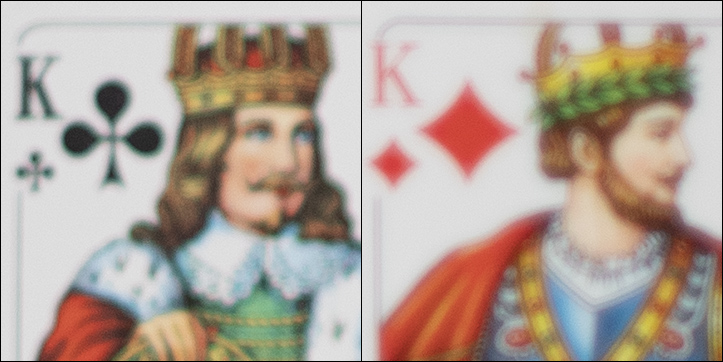
The quality of the general blur in the focus transition zone is pretty good in the image background (shown to the left below). The less important foreground is a bit “shadowy” and quite hazy.
Bokeh Fringing / LoCA
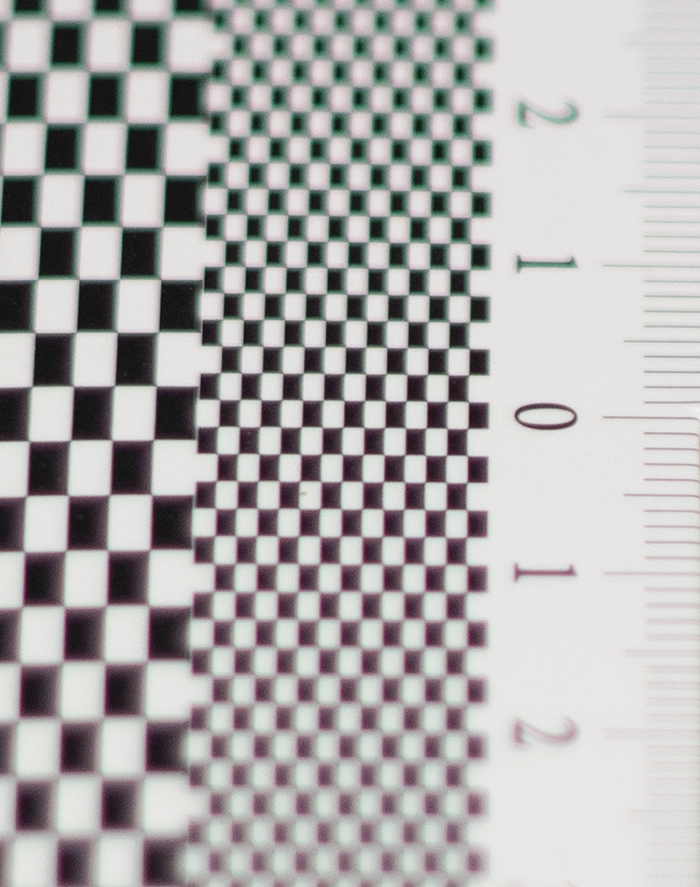
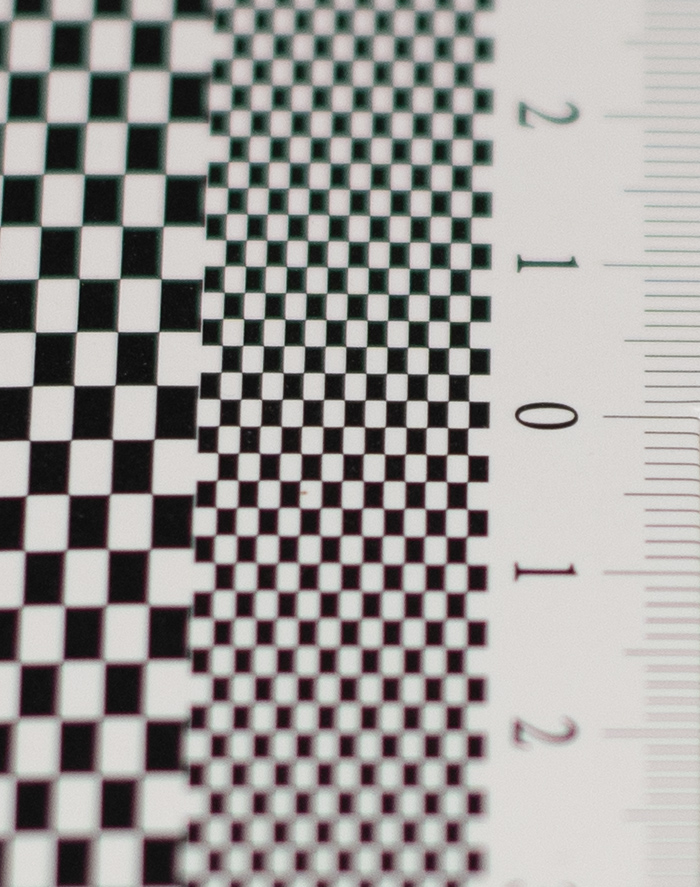
Boheh fringing/LoCA is an axial color fringing effect with purplish halos in front of the focus point and greenish beyond.
Once again, it’s hardly surprising that the Canon FD 50mm f/1.4 S.S.C. struggles just like the other fast vintage primes. The axial CAs are heavy at f/1.4. As usual, stopping down helps, but they are still obvious at f/2. They have faded at f/2.8 and are mostly gone by f/4.
You may also notice that the focus shifts towards the rear (RSA aka “Residual Spherical Aberrations”) when stopping down. However, the focus point at f/1.4 remains more or less in focus all the time. RSAs aren’t uncommon in fast lenses even today.
Sample Gallery
Just a few backyard photos here – I can’t spend too much time on vintage lenses, unfortunately.


The Canon FD 50mm f/1.4 S.S.C. is almost a modern take among the vintage lenses. Its optical performance isn't earth-shattering, but the readings didn't go down into the abyss even at f/1.4. The center quality is quite good at f/1.4, albeit with the usual drop in contrast. The borders/corners are poor, though. Images sharpen up at f/2, and they are pretty good across the frame from f/2.8. A lens this old with excellent center quality at its peak is impressive, actually. Image distortion and some lateral CAs are present. The vignetting is, surprisingly, on the high side at f/1.4, though. Unsurprisingly, axial CAs (LoCA) are massive at large aperture settings. The bokeh is OK, and yes, it can produce highlight bubbles, but its "vintage look" is somewhat underdeveloped.
As you may expect, the build quality is generally impressively high. Most of the lens is made of metal. The grippy focus ring is rubberized (?) and turns with the smooth, dampened action that we love in lenses from this era. There is one thing, though - the breech-lock mechanism. Maybe it's something to get used to, but the required 2nd step to lock/unlock the lens is cumbersome. If you just keep the lens mounted on an adapter, it's a non-issue, of course.
Overall, a good lens for its era.
-
Optical Quality5
-
Build Quality8
-
Vintage "Character"6