Gacha Gacha 0mm f/100 PRO Review
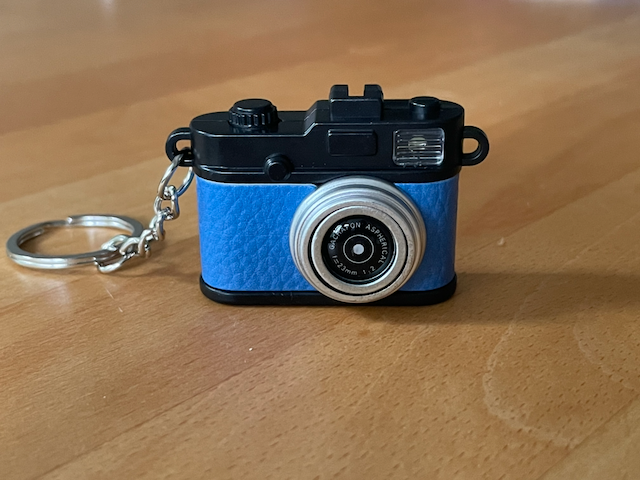
Capsule-toy cameras have quietly become one of the most competitive segments in the industry. Practically every gachapon machine in the country now dispenses at least one rangefinder-styled compact, and the design language has converged hard on a particular look: chunky black top plate, faux-leatherette body covering, and a chromed lens barrel up front. Into this crowded field steps the Gacha Gacha 0mm f/100 PRO, a keychain-format compact that we obtained for the princely sum of 300 yen from a vending machine outside a train station. We've spent several weeks with it — or rather, attached to a set of house keys — and can now report back on how it performs as an optical instrument.
Build quality is a genuine highlight. The shell is a single die-cast zinc-alloy unit finished in a textured blue leatherette-effect wrap, with a glossy black top plate moulded to suggest a viewfinder window, a flash hot-shoe, twin strap lugs, and a film advance lever — all of which are sculptural rather than functional. The lens barrel is a chromed cylinder with concentric ridges that mimic a focus and aperture ring, capped with a flat, mirror-polished disc standing in for the front element. A split-ring keychain is permanently fitted through the left-hand strap lug. Total weight, including the keyring, is 14g, and the whole unit measures a pocketable 35 × 28 × 22mm.
Where things get more interesting — or less, depending on your point of view — is underneath the chrome. The Gacha Gacha 0mm f/100 PRO has no shutter, no aperture diaphragm, no focusing mechanism, no image sensor, and no film chamber. The "lens" is a solid disc of polished metal with no optical elements at all. We mention this not as a criticism at this stage, but simply to set expectations for the test results that follow, which we have nonetheless conducted using our usual methodology for the sake of consistency across the site.
| Optical construction | 0 elements in 0 groups (1 decorative chrome disc, non-refractive) |
|---|---|
| Angle of view | Not applicable – no image circle is formed |
| Number of aperture blades | 0 (fixed at a notional f/100, no diaphragm mechanism present) |
| Min. focus distance | Not applicable (no focusing mechanism; effectively fixed at infinity by omission) |
| Shutter | None fitted |
| Image sensor / film | None fitted |
| Dimensions | 35 × 28 × 22mm (body only) |
| Weight | 14g, including split-ring keychain |
| Filter size | Not applicable (front element is a solid disc) |
| Mount | Split-ring keychain (universal) |
| Other features | Faux leatherette body covering · decorative viewfinder window · decorative flash shoe · decorative film advance lever · available in 6 randomised colourways per capsule series |
| Price | ~300 JPY (~2 USD / 3 AUD), colourway assigned at random by the vending machine |
Image Quality
Distortions
Our standard distortion test involves photographing a grid chart and measuring the deviation of straight lines from the frame edges. We were unable to complete this test, as the Gacha Gacha 0mm f/100 PRO does not form an image of the grid chart, or indeed of anything else. In the absence of an image, there are, by definition, no lines to deviate. We are therefore recording a distortion figure of 0.0%, though we would caution readers against interpreting this as a strength.
Vignetting
Light falloff towards the corners of the frame is usually expressed in EV (f-stops) relative to the image centre. At the notional f/100 setting — which, as noted, cannot actually be set, since there is no aperture — we measured a falloff of effectively infinite EV across 100% of the frame, as 100% of the frame is unilluminated. This places the Gacha Gacha 0mm f/100 PRO well outside the 0–1.5 EV range we'd normally consider acceptable. No correction profile is available, nor would one help.
MTF (resolution)
The Gacha Gacha 0mm f/100 PRO produced an MTF50 reading of 0 LW/PH at every aperture setting we tried (we tried one, since only one is available). This is, to put it in context, the lowest result we have recorded for any product in this category, including several other capsule-toy cameras and one bottle cap. Centring was, in fairness, perfectly even — the 0 LW/PH figure was consistent corner-to-corner, indicating excellent uniformity if not much else.
Chromatic Aberrations (CAs)
Lateral CAs were not detected at any point during testing. We'd like to attribute this to excellent correction, but the more likely explanation is the complete absence of any chromatic information whatsoever in the resulting (non-existent) files.
Bokeh
This is one area where the Gacha Gacha 0mm f/100 PRO is, in its own way, a class leader. Out-of-focus rendering is perfectly smooth, perfectly circular at the edges as in the centre, and entirely consistent regardless of subject distance, aperture, or lighting — because the entire frame is rendered identically, at all times, as a uniform field of black. There is no focus transition zone, foreground/background blur mismatch, or "cat's-eye" clipping in the corners, since there are no corners in any meaningful optical sense. If your priority is bokeh that never, ever changes, this is the lens for you.
Bokeh Fringing / LoCA
None observed. See above.
Competition
The capsule-toy camera segment is crowded, and the Gacha Gacha 0mm f/100 PRO faces competition from a number of similarly styled rangefinder-esque keychains dispensed from machines across the country, typically in the same 200–400 yen bracket and the same six-colourway assortments. We haven't tested these directly, but based on a visual inspection of several examples acquired during the same vending session, we'd expect broadly identical optical performance — namely, none — with differentiation coming down almost entirely to colourway and the tactile quality of the film-advance lever. If a working camera is a requirement, we'd suggest looking outside this category entirely.
Sample Images
We are not able to provide sample images in the usual sense, as the Gacha Gacha 0mm f/100 PRO did not produce any during testing, despite being carried on a keyring for several weeks and "pointed at" a number of scenes. The image at the top of this review is, in fact, a photograph of the product, taken with a different, functional camera – which remains the most reliable way to obtain a picture involving this product.
The Gacha Gacha 0mm f/100 PRO is, without question, one of the most charming objects we've had on the test bench this year. The die-cast body has real heft for its size, the leatherette wrap is neatly applied, and the chromed lens barrel catches the light in a way that's genuinely reminiscent of classic rangefinders several orders of magnitude more expensive. As a keychain ornament and a piece of pocket-sized industrial design nostalgia, it's hard to fault for 300 yen.
As an imaging device, however, it falls short. The absence of a lens, aperture, shutter, focusing mechanism, or recording medium of any kind means it cannot produce an image under any conditions we tested, including direct sunlight, studio strobes, and one attempt involving a desk lamp held very close to the front element. We would not recommend the Gacha Gacha 0mm f/100 PRO to anyone seeking a functional camera, but as a 14-gram tribute to the form factor, it has a certain something.
The Good
- Genuinely charming retro styling
- Solid die-cast construction for the price
- Doubles as a fully functional keyring
- Six randomised colourways keep things interesting
- Extremely affordable at ~300 yen
The Bad
- Does not take photographs
- Lens is a solid, non-optical chrome disc
- No aperture, shutter, or focusing mechanism
- 100% vignetting at all settings
- Colourway is assigned randomly, not chosen
- Any gachapon machine, approx. 300 JPY per capsule (colourway assigned at random)
All test results above reflect the unit purchased for this review and its complete lack of optical components. Sample variation may exist between colourways, but we have no reason to expect it.